
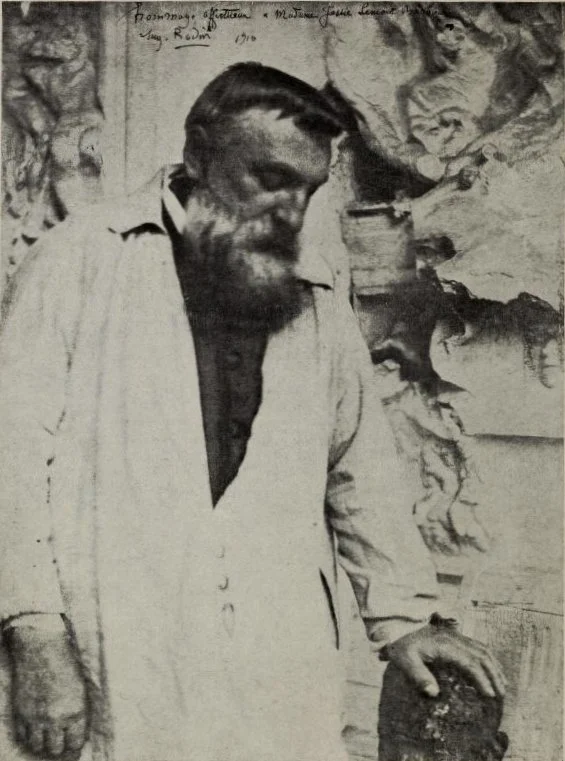
The work that is to be spoken of in these pages developed through long years. It has grown like a forest and has not lost one hour. One walks among these thousand forms overwhelmed with the imagination and the craftsmanship which they represent, and involuntarily one looks for the two hands out of which this world has risen.
One thinks of how small man's hands are, how soon they tire, and how little time is given them to move. And one longs to see these hands that have lived like a hundred hands; like a nation of hands that rose before sunrise for the accomplishment of this work. One asks for the man who directs these hands. Who is this man?
He is a man rich in years; and his life is one that cannot be related. It began and still continues; stretches out deeply into a great age, and to us, it seems as though it had passed many hundreds of years ago. It perhaps had a childhood; a childhood in poverty-dark, groping and uncertain. And maybe it possesses this childhood still, for, says St. Augustine somewhere, whither should it have gone? It holds, perchance, all its past hours, the hours of expectation and abandonment, the hours of doubt and the long hours of need. It is a life that has lost nothing and has forgotten nothing; a life that has absorbed all things as it passed, for only out of such a life as this, we believe, could have risen such fulness and abundance of work; only such a life as this, in which everything is simultaneous and awake, in which nothing passes unnoticed, could remain young and strong and rise again and again to high creations. Perchance the time will come when someone will picture this life, its details, its episodes and its conflicts.
Someone will tell a story of a child that often forgot to eat because it seemed more important to him to carve inferior wood with a cheap knife, and someone will relate some event of the days of early manhood that contained promise of future greatnessone of those incidents that are intimate and prophetic.
Auguste Rodin, by Rainer Maria Rilke, Translated by Jessie Lemon and Hans Trausil
Page 4,5