
8.28.2026
Deep listening does not take us beyond sound. It takes us deeper into sound—until we reach the edge of the abyss.
Sofia Gubaidulina — Sound, Spirit, and Transformation
Sofia Gubaidulina (1931–2025), together with Alfred Schnittke and Edison Denisov, was one of the leading composers of contemporary music in the Soviet Union. Yet her music cannot be understood only through its historical context. For Gubaidulina, sound was a way to reach beyond the material world—through the physicality of instruments, time, silence, and spirituality —toward a transformation of human consciousness.
I had the opportunity to experience this music over three days in New York at InfraSound’s The Edge of the Abyss: The Music and Legacy of Sofia Gubaidulina, held from August 28 to 30 at St. Malachy – The Actors’ Chapel in Times Square.
InfraSound is a New York–based ensemble and artist community largely made up of young musicians. Founded by students from the Contemporary Performance Program at the Manhattan School of Music, the group explores contemporary music not only through performance but also through improvisation and other experimental practices. In that sense, it seemed like a particularly fitting context for Gubaidulina’s music: a younger generation of musicians encountering the work of a composer whose own career was defined by a constant search for what sound could become.
Kathryn, a clarinetist, recommended the concert to me. I also remembered Yoshi from a previous performance, where I saw him play the flute. These two connections led me to the festival.
Over the three days, Gubaidulina’s own works were placed alongside pieces by contemporary composers whose music reflected or responded to her ideas. Sound, silence, time, prayer, and spirituality gradually came into focus.
At first, I imagined the festival as a three-day journey through Gubaidulina’s musical world. But after listening to all three programs, I realized that something more complicated had taken place. Rather than simply looking back at her legacy, the festival became a space where musicians of another generation reinterpreted her ideas.
And this was where the deeper question emerged: what remains of Gubaidulina’s search for the spiritual through sound when her music is heard today, outside the Soviet world in which she created it?
Night 1 — Friday, August 28, 8:00–9:30 PM
When I entered St. Malachy – The Actors’ Chapel in Times Square, Chris checked my ticket, asked my name, and let me inside. I asked Steven where the bathroom was, then found an empty seat toward the front and sat down. People around me were talking, and I was talking to someone too. Then, suddenly, the atmosphere changed, and Lucy Shelton began to sing.
Aus den Visionen der Hildegard von Bingen
Gubaidulina’s Aus den Visionen der Hildegard von Bingen (1994) is based on the visions of Hildegard von Bingen, the twelfth-century German nun and mystic. Gubaidulina set Hildegard’s words to music and dedicated the work to Alfred Schnittke, who was ill at the time. Shelton’s voice filled the chapel, and it felt as if the church itself had become a gigantic musical instrument.
God called everything into existence by His will, and created it so that His name might be known and worshipped. God does not reveal Himself only through visible and transient things. He also reveals what is invisible and eternal. The vision you see points toward this.
At first, extreme intervals rising and falling were sung again and again. Lucy’s voice echoed against the walls of the chapel, traveling back and forth through the space. At first, the resonance sounded like a vague mass of sound, but as my ears grew accustomed to it, I began to hear each individual interval emerge as a large shape within the chapel.
It happened again and again. Rather than simply listening to sound, I felt as if I had somehow entered Lucy’s voice. The force of it was overwhelming. The composer’s thoughts, contained in the text, seemed to become a voice and spread into the walls and even the air of the chapel.
In the second half, the music gradually slowed and became something like a whisper, almost like a prayer. In the first half, I felt as though I were swimming through a world filled with pus that had accumulated deep inside the heart. The violently rising and falling intervals and the resonance of the voice filling the space felt as if they were stirring something deep within me.
But in the second half, that world became quiet. I felt as though I were being wrapped in something, watched over by someone.
Suddenly, I heard an incredible song.
Then Yoshi, holding a microphone, began to speak, and a conversation started. Among various exchanges, he asked about performing Gubaidulina’s music in a chapel, in a church. Because Gubaidulina’s world is so closely connected to her faith, I felt that hearing her music not in a concert hall or studio but inside a church was a special experience. Lucy’s opening performance made that very clear to me.
Cello Preludes Nos. 1 & 2
Jules Biber, who has studied Gubaidulina’s cello music, performed Cello Preludes Nos. 1 & 2. The first piece consisted of simple points of sound connected through intricate changing meters. In the second, those point-like sounds were stretched horizontally, using a generous amount of bow.
Points and lines. Severance and continuity.
Even with similarly simple materials, completely different kinds of time emerged depending on how they were treated. The music was simple but very powerful. There was a sense of play in the sounds, and a feeling of the performer’s heart within them.
The program explained that many of Gubaidulina’s works grew out of her faith, and that the experiments she conducted in the mid-1970s with Astreia, an improvisational folk-music ensemble, became an important source of inspiration for her later music. InfraSound presented Gubaidulina’s determination to keep creating even under extremely difficult circumstances as evidence that art can nourish life.
Gubaidulina herself expressed this idea in these words:
“I understand the word ‘religion’ in its literal sense, as ‘re-ligio’—reconnection. In other words, the restoration of connection, the restoration of ‘legato’ in life. There is no more important mission for music.”
The points being connected in the first Prelude, and the sounds being stretched horizontally in the second, seemed to contain something of this idea of “reconnection.” Music can reconnect things that have been separated.
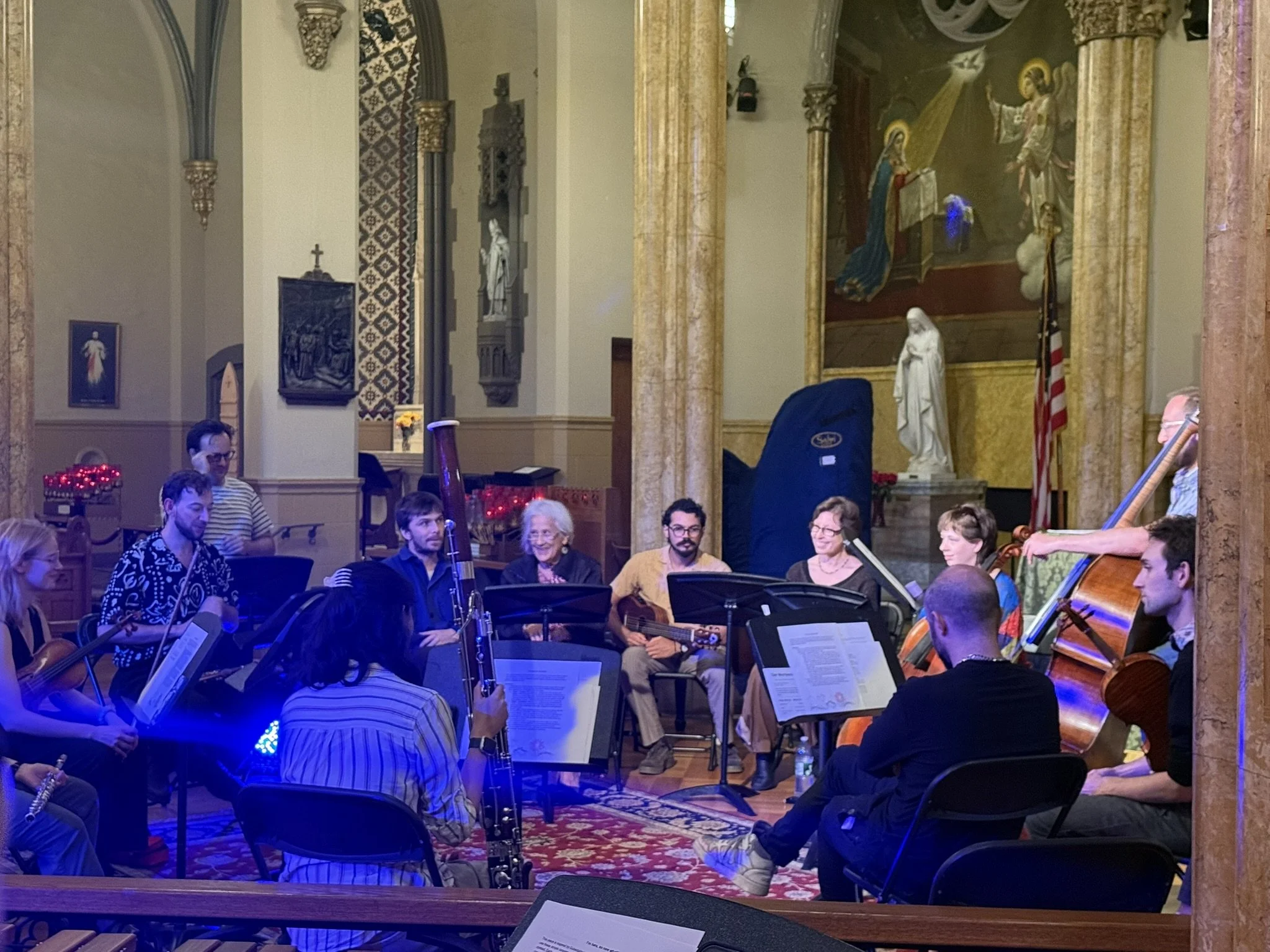
After the conversation ended, most of the audience left. I hadn't looked at the program online, so I didn't really know what would happen next. After a while, some people with a slightly unusual atmosphere about them began entering the chapel. Somehow, I could tell they were musicians, so I decided not to leave and stayed a little longer.
Everyone was very open, smiling and shaking hands with one another. Before I knew it, I realized that everyone there except me was a performer. Turner began arranging chairs in a circle in the center of the chapel, and soon the musicians came into the circle carrying their instruments. Everyone held a piece of paper and stared at it. Someone showed me one of the papers. It had words and drawings.
Looking at the program online later, I found that there had been six new works: I’m here, so now what? by Stefanie Proulx, inspired by Dots, Lines, and Zigzags (1976); Der Wortwechsel / The Conversation by Yoshi Weinberg, inspired by Sonatina (1978); Icarus Etude by Daniel Schreiner, inspired by Introitus (1978); The room as ocean by Madeline Hocking, inspired by String Quartet No. 2 (2012); BACH by Sam Zagnit, inspired by So sei es (2013); and Good Bye, Dulina by Alex Ring Gray, after Sofia Gubaidulina and Tom Higgenson.
All six were world premieres. At the bottom of the program, it said: Performed by members of the InfraCore, InfraMantle, and audience.
In other words, this was not a concert in which finished compositions were simply performed. The musicians had each taken inspiration from one of Gubaidulina’s works and written something on paper like a promise of what kind of music they were about to make. One person explained the idea written on the paper while the other musicians listened carefully. They weren't reading a score; they seemed to be trying to grasp the feeling of the music about to begin through the words and images.
Then the free jam session began.
Inside the circle were guitars, voices, and various wind and string instruments. Outside the circle were percussion instruments and an organ keyboard. Someone made a sound, someone else responded, and sounds overlapped, separated, and were joined by something new. Using the words and images as a starting point, everyone in the room listened to one another and connected their sounds.
At first, someone played something like a theme. From there, someone began playing the space with long notes. Suddenly, an organ sound appeared. The phenomenon of sound simply existing—a feeling I had experienced recently—appeared and disappeared again.
Everyone seemed to be doing completely crazy things, yet an extraordinary sense of harmony emerged. They were not synchronized. They were out of alignment. And yet, at certain moments, all that energy moved in the same direction.
It was almost like listening to Bach’s Brandenburg Concertos—a broken ensemble, yet somehow incredibly harmonious and pleasurable. Each person’s voice was somewhere inside it. They listened to one another, missed one another, intensified one another, played with one another, competed with one another, and resonated with one another.
From behind the percussion setup, JC continuously brought marimba, bells, gongs, and small drums into the chaos. Sometimes he dissolved them into it; sometimes he brought them to the surface; sometimes he imitated other timbres; sometimes he carved rhythms into the sound.
If Kandinsky had been alive, perhaps this was the kind of world he would have painted.
It felt as though Gubaidulina were being released, piece by piece, through these musicians' experience and sensibility. From Times Square in New York, something was resonating with her soul. It was a free, inventive, creative, playful, joyful, and extraordinarily rich period of time.
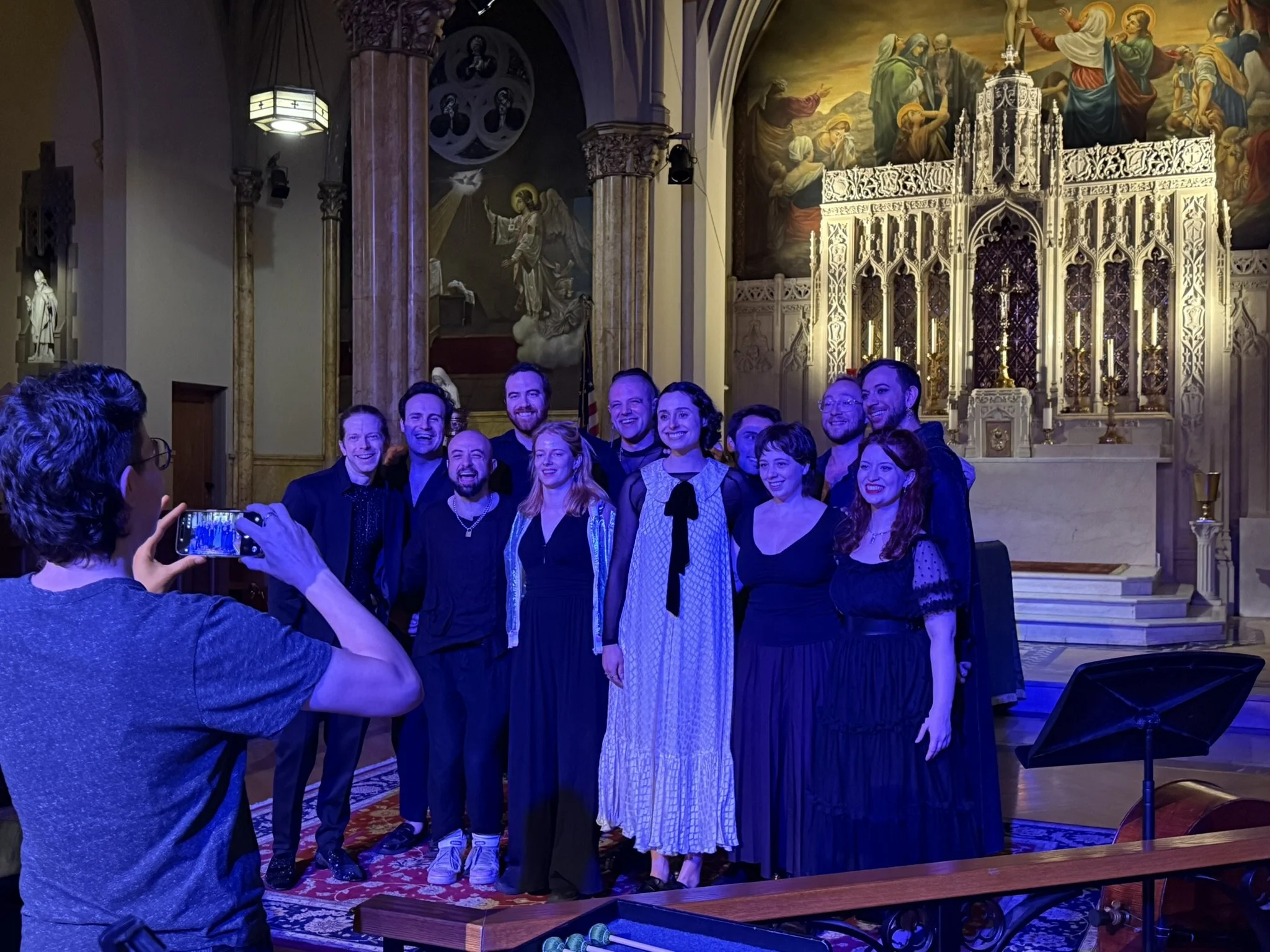
I thoroughly enjoyed my first contemporary music jam. The pianist, the male singer, and the cellist were people whose performances I had heard somewhere before. When the performance ended, I thanked Yoshi and left the chapel.
Night 2 — Saturday, August 29, 8:00–9:30 PM
The second night was a program of Gubaidulina’s solo and duet works. What made this night particularly interesting was that the program began with the same Aus den Visionen von Hildegard von Bingen that I had heard on the first night—but this time sung by Luke Paulino.
Aus den Visionen von Hildegard von Bingen
(From the Visions of Hildegard von Bingen, 1994)
For solo alto
Luke Paulino, alto
Where Lucy Shelton’s singing had felt less like singing than an entire world in itself, Luke’s voice resonated through the space and became a large image of sound, through which Hildegard’s visions seemed to emerge. The extreme intervals, painful and repeated again and again in the first half, suddenly reminded me of the threatening sounds in Shostakovich’s symphonies—the kind of sound that seems to approach you directly.
“God does not reveal Himself only through visible and transient things…”
Around this point, the distinctive resonance of a male falsetto appeared. In the second half, the music became more intimate, with breath like speech. When I closed my eyes and followed only the sound, I could feel something like a short prayer emerging behind the world Luke was creating.
If Lucy’s voice transformed the entire space into a world, Luke’s voice illuminated what existed deep within that world.
Detto I: Sonata for Organ and Percussion
(1978)
J Clancy, percussion
Austin Philemon, organ
The organ keyboard was on the left, while the sound came from the pipes behind us. JC’s percussion setup was directly in front of me on the right, so the sounds came from both front and back. But once the piece began, that spatial distinction hardly mattered.
Detto is Italian for “what has been said” or “what has been stated.” From the darkness, a low mass of organ sound quietly began creating a world behind us. As the organ slowly climbed upward, the tremolo of JC’s marimba emerged from within the resonance, and the two instruments began to converse.
Again, the organ sounds moved vertically as the percussion instruments imitated and decorated it. JC used small drums, bells, and rattles, playing all kinds of games around the organ’s continuo. At the end, a cluster of organ sound seemed to crush the space into pieces. It was highly dynamic.
Punkte, Linien, und Zickzack
(Points, Lines, and Zigzags, 1976)
Kathryn Vetter, bass clarinet
Daniel Schreiner, piano
Kathryn sat in front of the piano with her bass clarinet. Her right foot remained pressed down on the piano’s sustain pedal, while she played what sounded like an improvised cadenza by herself for about five minutes. The piece had a very wide range and complex vertical and horizontal movement through changing meters, somewhat like Denisov.
What fascinated me was how the sounds moved as points, lines, and zigzags. What a person plays cannot be neatly ordered, nor can it always be expressed in a single phrase. But by studying the movement of sound, Gubaidulina found a way to convey the movement of the human heart.
Kathryn’s bass clarinet sounded almost like myself. It moved in every direction—up and down, left and right—through a huge range of expression. What was especially interesting about this piece was the way the player’s breath, fingers, keys, and low vibrations resonated through the body of the piano.
At first, the instrument's resonance filled the space. When it stopped, the grand piano quietly and dully seemed to be saying the same thing. It felt like wandering alone inside a cave, calling for help, and then hearing your own cry from far away a few seconds later.
Eventually, Daniel put his hands inside the piano, touched and rubbed the strings, and imitated the same kind of singing as the clarinet. Now it felt as though a large number of people in a distant town were repeating that voice. The sense of distance changed completely.
It was a very strange sensation. When everything became quiet, the resonance disappeared.
Except for the first piece, many of the works performed tonight were written around 1978. Gubaidulina was in her mid-forties in the mid-1970s. She had already graduated from the Moscow Conservatory and was entering a different stage than in her earlier years, when she worked on film music while continuing to compose. She was searching for her own musical language, and she had begun to focus intensely on the existence of sound itself.
In 1975, Gubaidulina formed the improvisational group Astreia with Viktor Suslin and Vyacheslav Artyomov. They explored folk instruments, improvisation, and electronic sound, searching for what sound could become through performance rather than constructing music entirely from a predetermined score.
Knowing this changed the way I heard the 1978 works. The feeling I had noticed earlier in Detto I—the organ and percussion searching for each other’s sounds while creating a space—began to sound different.
For Gubaidulina in the 1970s, music was a journey into the existence of sound.
After a short break, Yoshi played the flute alone.
Sonatina
(1978)
Yoshi Weinberg, flute
In Sonatina, the instrument sounds like a voice. It breathes, hesitates, sighs, and speaks. Gubaidulina treats the sound of the flute almost as though it were the human voice. It is a short work, but it contains an intimate stretch of time, as if one person were speaking directly to another.
Phrases like recitative, subtle accents, sudden changes in dynamics—the melody seems to recall Baroque and Romantic music without directly quoting it, transforming it instead into something like breath and speech. It was very different from the brilliant virtuoso world of the flute that I know.
The flute has a face, with eyes, a mouth, and a nose.
Through Yoshi, the flute seemed to speak, look down, and smile. Her exploration is already clearly present in this 1978 Sonatina.
Chaconne
(1962)
Daniel Schreiner, piano
In 1962, Gubaidulina was thirty-one and still a graduate student at the Moscow Conservatory, where she had studied with Vissarion Shebalin since 1959. Marina Mdivani, a Georgian pianist and student of Emil Gilels, commissioned the Chaconne. Gubaidulina wrote the work to make use of Mdivani’s powerful chordal technique and energetic temperament.
By this period, Gubaidulina had already encountered Mahler, Schoenberg, and Stravinsky through Peiko, and had been strongly influenced by Philipp Hershkovitz, a pupil of Webern. She was also interested in Tatar folk music and electronic music. At the same time, she wrote film music to make a living.
Chaconne was written during this period. It begins with an eight-bar theme and develops through a series of variations, eventually moving toward a toccata-like section and then a fugue. Powerful chords, sharp rhythms, sudden contrasts, and intense virtuoso movement define it. Modern sonorities enter into a traditional form.
Daniel Schreiner’s performance made it feel as though these sounds were being pulled directly from the body of the piano. Daniel drew the chords from the keyboard, causing the piano’s strings and hammers to vibrate intensely. The chords resonated inside the instrument, and those vibrations spread into the space. The physical movement of striking the keys itself became part of the music.
Traditional form.
↓
Modern sound.
↓
The body of the piano.
Chaconne exposes the piano's body from within an old form.
Listening to it alongside the works of the 1970s makes Gubaidulina’s transformation visible. In Chaconne, she draws the piano's power out of its formal structure. After that, Gubaidulina moved even closer to sound itself.
In Punkte, Linien, und Zickzack (1976), sound becomes movement—points, lines, and zigzags. In Sonatina (1978), the physical sounds of the flute—breath and speech—come to the foreground. In Detto I (1978), organ and percussion imitate, overlap, and transform each other, creating form from the movement of sound itself.
From form, to the body of the instrument, and then to sound itself.
In croce
(1979)
For organ and cello
Austin Philemon, organ
Elizabeth Kate Hall-Keough, cello
In croce is Italian for “on the cross.” The horizontal line of the cross represents the earthly time in which we live, while the vertical line represents the connection between human beings and God. Human beings living within time and something that transcends time become movements of sound.
The organ begins in the high register and gradually moves downward. The cello begins in the low register and moves upward. Eventually, they cross. The sound's movement itself draws the shape of a cross.
At the point where they intersect, the cello’s violent tremolo collides with the organ cluster. A moment appears in which the two directions meet at a single point, and the sound seems to explode.
The cello creates sound through bow, strings, fingers, and body, moving continuously through time as if breathing. The organ sustains long tones, resonating through the space and creating enormous layers of sound. The cello moves through time; the organ suggests something beyond time.
The lines of sound become a cross.
Here, I felt that everything Gubaidulina had been exploring up to this point had become concentrated. The horizontal is the time in which human beings live. The vertical is that which transcends time. And music emerges from the place where the two intersect.
It connects human beings living within time with something beyond time. Music reconnects what has been separated.
The word “re-ligio” from the program came back to me once again.
Night 3 — Sunday, August 30, 8:00–9:30 PM
The third night was a journey with InfraCore toward “cosmic ecstasy.” It brought together dramatic, mysterious, and “liminal” chamber works. Sounds produced by different bodies—voice, strings, winds, percussion, and organ—crossed one another. The music expanded toward fantasy, joy and sorrow, angels, memory, death, and prayer.
From the “body of sound” explored on Night 2, the program moved further toward a spiritual realm beyond it.
Excerpts from Galgenlieder (Gallows Songs) à 5
(1996)
For mezzo-soprano, flute, percussion, organ, and double bass
VI. Die Prozession (The Procession)
XIV. Das Mondschaf (The Moon Sheep)
Sophie Delphis, mezzo-soprano
Yoshi Weinberg, bass flute
Austin Philemon, organ
Sam Zagnit, double bass
J Clancy, percussion
Sofia Gubaidulina selected fifteen poems from Christian Morgenstern’s collection Galgenlieder (Gallows Songs) and composed them as a song cycle. Morgenstern’s world is filled with wordplay, nonsense, black humor, strange creatures, and fantasy. Gubaidulina transforms this world into an acoustic landscape created by multiple instruments.
The complete work lasts about fifty-five minutes. On this occasion, approximately eight minutes were performed.
VI. Die Prozession (The Procession)
When the organ gently stirred something like a melancholy wind, the bass flute and other instruments began to whisper. The words, voices, breaths, strikes, vibrations, and resonances of the instruments mixed together and gathered into a single space.
As timbre, rhythm, voice, and language crossed one another, a strange world emerged. It was a cynical world without hope, like Berg’s Lulu. Then Sophie’s voice entered the ensemble. Her voice, too, sounded like one of the instruments, entering that strange world.
XIV. Das Mondschaf (The Moon Sheep)
The moon sheep stands in a wide field and waits, waits. It waits for the great day of shearing. The moon sheep.
The moon sheep pulls up a blade of grass, and then returns to its mountain pasture. The moon sheep.
The moon sheep speaks to itself in a dream.
“I am the dark space of the universe.”
The moon sheep.
In the morning, the moon sheep is dead. Its body is white, and the sun is red. The moon sheep.
The story seems to move forward, but at the end it returns once again to the words “the moon sheep.” Yet the “moon sheep” at the beginning and the “moon sheep” at the end are no longer the same being.
At first, it is an animal. Then it becomes the universe. Finally, it becomes a corpse. The word expands into the universe, then disappears through death.
Meanwhile, the instruments' timbres also changed. Even the sound of J Clancy’s bells seemed completely different from when I first heard them. The musicians were drawn toward one another’s sounds, and Sophie’s voice, too, became like an instrument.
Voice and instruments called to each other and resonated with one another. I listened to the human voice not as language, but as sound.
Within Morgenstern’s nonsensical world, meaningful words continually transform into something else. An animal becomes the universe. The universe becomes a corpse. And finally, even the word itself returns to sound.
Perhaps this music was transforming me from a mind trying to understand meaning into a listening body simply experiencing sound.
No—yes.
That is exactly what happened.
While listening to this piece, I stopped chasing meaning and found myself inside the sound itself.
Yoshi Weinberg’s bass flute continuo was wonderful. I remained caught in its gravity, experiencing a world that felt like a spell.
Sam Zagnit’s double bass had been fitted with solo strings and tuned higher than usual, I was told. It was highly individual. At the beginning, he tuned two double basses, and their sounds were very different. One had the familiar sound of an orchestral double bass. The other remained strongly in my memory as a special double-bass sound created specifically for this performance.
String Quartet No. 2
(1987)
Giancarlo Latta, violin
Madeline Hocking, violin
Elijah Spies, viola
Elizabeth Kate Hall-Keough, cello
In String Quartet No. 2, a transformation from one state to another emerges through the difference between ordinary articulation and the production of overtones. For Gubaidulina, an instrument's physical nature and the way sound is produced become symbols. By “symbol,” I do not mean that one sound represents something else. Rather, the transformation of the sound itself becomes an experience of moving from everyday time toward essential time, from existence toward essence.
Listening to the piece, I could hear someone stretching a sound while another performer expanded its overtones. They put energy into the bow, making the sound rush forward with a buzzing quality, drawing the resonance of the overtones through the space.
The ordinary sound of the strings and the overtones produced by harmonics have completely different qualities, even though they come from the same strings. Instead of simply drawing the bow across the string, the performer touches a particular point on it to produce the overtone. Through that tiny difference, the sound itself changes into another form.
The same sound becomes another sound depending on how it is touched. The same instrument sounds like a different instrument. And the change does not feel like merely a change of timbre. It feels as though the sound itself is moving into another state.
This, I think, is what Gubaidulina means by “metamorphosis.”
This sensation is difficult to capture in a recording. When you actually hear it in a space with some resonance, such as a church, you can hear the overtones born from a single sound spreading out from the performer’s body and filling the space.
It was almost like listening to Jackson Pollock scattering and spreading paint across a huge canvas. The sound does not remain a single point. It flies outward through the bow's movement and creates layers of resonance.
What is happening here is not the expression or depiction of something through sound. The transformation itself occurs on the instrument: ordinary sound becomes overtone, one sound becomes countless resonances, sound becomes space.
That is why the “symbol” in this work is not a meaning outside the sound. It is the transformation itself taking place inside the instrument and within the sound.
Ein Engel (An Angel)
(1994 / for alto or mezzo-soprano and double bass)
Luke Paulino, contralto
Ein Engel was written in 1994 and dedicated to Ulrich Eckhardt for his sixtieth birthday. It lasts approximately seven minutes and uses a poem by the German poet Else Lasker-Schüler (1869–1945).
Luke’s singing allowed the words to emerge quietly from the low resonance of the double bass. From a low voice to a sudden high note, then descending again. It was as though an angel appeared from far away and began speaking to us.
Two different bodies—the voice and the double bass—created sound as they moved alongside one another. There were moments when Luke’s voice seemed to turn words into sound.
In the poem, an angel walks secretly through the city. The angel gathers love from people for “the one” who has departed for heaven. While alive, that person loved his neighbor more than himself. Tears, shining eyes, words falling from people’s lips—small offerings of love are gathered one by one.
Here, the angel seems to walk through the world of the living, collecting love for the dead, moving between the visible and invisible worlds.
In 1994, Gubaidulina had already left the Soviet Union and moved to Germany. Religion and spirituality were becoming increasingly important in her music. In In croce, which I heard earlier, the horizontal time in which human beings live intersected with a vertical time that transcends it. In Ein Engel, an angel mediates between these two worlds.
But Gubaidulina does not attempt to depict an angel through music. Instead, the two bodies themselves—the voice and the double bass—transform into something else within the sound.
Sam Zagnit’s double bass was especially striking. He was playing the kind of double bass normally used in an orchestra. From this enormous, low, heavy-bodied instrument, harmonics and glissandi produced sounds that were thin, light, and trembling.
A huge, heavy body produced a sound so light and transparent that it seemed almost incompatible with the body that created it. There is a reversal here between the physical image of the instrument and the sound that emerges from it.
It is not simply a depiction of an angel through high notes. Rather, a huge physical body belonging to the earth produces a sound that seems not to belong to an earthly body.
The voice works in the same way. The alto voice does not exist only to communicate the meaning of the poem. The voice itself becomes an acoustic phenomenon, overlapping with the double bass, sometimes moving alongside it, sometimes dissolving into its resonance.
The human voice and the enormous body of the string instrument call to each other and create a single world of sound. Within that world, something invisible in reality begins to appear.
In String Quartet No. 2, the difference between ordinary articulation and harmonics—a difference existing inside the instrument—appeared as a transformation from one state to another. The same thing happens in Ein Engel. But here, the transformation expands beyond instrumental acoustics to the boundary between the visible and invisible worlds.
A light, transparent sound emerges from a heavy double bass. The human voice changes from language into sound. When the two bodies resonate with one another, we sense something not physically present.
The angel is not depicted by sound.
The angel's presence emerges when sound transforms into another state.
Garten von Freuden und Traurigkeiten
(Garden of Joys and Sorrows)
(1980)
For harp, flute, and viola
Violetta Maria Norrie, harp
Yoshi Weinberg, flute and bass flute
Elijah Spies, viola
Garten von Freuden und Traurigkeiten is a one-movement work for harp, flute, and viola. According to Gubaidulina, the work was strongly influenced by two seemingly opposite literary worlds: Sayat-Nova by Iv Oganov and poetry by the twentieth-century German poet Francisco Tanzer.
Gubaidulina found a contrast between vivid Eastern colors and a Western consciousness. Yet the two worlds also shared an important similarity: meditation and refinement. Images in Oganov’s work—the flowers, pain, garden, rose, lotus, and diamond-white garden—led Gubaidulina to imagine this “garden” as a concrete auditory experience. At the same time, Tanzer’s reflections on the world and its wholeness became connected to the image of this garden flowering in ecstasy.
Listening to the piece, I first felt that the resonance created by Violetta Maria Norrie’s harp was like the entrance to the garden. Long glissandi appear from the beginning, making sound something not fixed at a single pitch but continuously changing. Above them, Yoshi Weinberg’s flute passes through with small movements, while the low resonance of the bass flute appears at times. High and low sounds, sparkling and dark sounds cross one another, and then Elijah Spies’s viola enters.
The three instruments create a single space while producing sound through three completely different bodies. The harp produces sound through directly vibrating strings, the flute through breath, and the viola through bow and string. Their physical differences become part of the music itself.
The flute and harp often occupy the high register, and the harp’s glissandi and the flute’s delicate melodic movements suggest Eastern colors. But what supports the form of the work is not simply an “Eastern” sound. Gubaidulina specifically points to the contrast between bright, major-like sounds produced by the natural harmonic series and the tense sounds of minor seconds and minor thirds.
Natural harmonics create an open, luminous resonance. Minor seconds and minor thirds, by contrast, create tension and shadow through their narrow intervals. In other words, “joy” and “sorrow” are not expressed as emotions through melody or narrative. They exist within the sound itself as different acoustic states.
The bright, sparkling resonance of Norrie’s harp, the breath-filled sound of Weinberg’s flute and bass flute, and the sustained tones and shadows created by Spies’s viola all intersect. Through this intersection, joy and sorrow no longer sound like separate emotions. They seem to exist simultaneously within a single resonance.
Here, Tanzer’s worldview becomes important.
When is it really over?
What is the true end?
All boundaries are
drawn into the earth
as if with a piece of wood
or the heel of a shoe.
“This far…”
This is the boundary. Everything is artificial. Tomorrow, we will play a different game.
Tanzer’s question, “Does the boundary really exist?” can be transformed in Gubaidulina’s music into another question: Where is the boundary between one sound and another?
The three instruments—harp, flute, and viola—have different bodies, yet their resonances overlap and gradually form a single “garden.” This garden is not one you can see with your eyes. You perceive it through sound.
The music does not directly depict the poetic images of flowers, roses, lotuses, light, and diamonds. The music transforms them into harmonics, intervals, timbres, glissandi, and resonance. As a result, things that seem to be opposites—East and West, nature and artifice, joy and sorrow—cross one another within the sound, and their boundaries gradually become blurred.
The garden is an acoustic space in which different things coexist and the boundaries between them are themselves transformed.
Garten von Freuden und Traurigkeiten can therefore be heard not as a work that translates literary images into musical descriptions, but as a work that creates an entire world from the qualities of sound itself.
“Joy” and “sorrow,” “East” and “West,” “nature” and “artifice” may never have been clearly separated in the first place. Perhaps we are the ones who draw a line between them and call one side “here” and the other “there.”
So sei es
(So Be It / “May it be so,” 2013)
For violin, double bass, piano, and percussion
Giancarlo Latta, violin
Sam Zagnit, double bass
Daniel Schreiner, piano
J Clancy, percussion
So Be It was the first complete composition Gubaidulina finished after the year of crisis she experienced in 2012. She wrote the work in memory of Viktor Suslin, who died on July 10, 2012. “So Be It” is the English translation of “Amen.” In other words, it does not simply mean “I hope this happens.” It is the “so be it” at the end of a prayer.
The musicologist Tatiana Frumkis writes that the B-A-C-H motif, beloved by both Gubaidulina and Suslin, appears like a secret seal. It appears together with the “cross motif” found in the subject of Bach’s C-sharp minor fugue from Book I of The Well-Tempered Clavier.
The violin and double bass become two protagonists engaged in a dramatic dialogue, while the piano and percussion sometimes support them and sometimes seem to oppose them. This structure connects with In croce, Detto I, and Seven Words, which I heard earlier.
Giancarlo Latta’s violin and Sam Zagnit’s double bass exchange sounds as though two human beings were speaking to each other. Daniel Schreiner’s piano and J Clancy’s percussion enter into the relationship and sound like the environment surrounding the two protagonists. Sounds that support and sounds that interfere. Sounds that approach and sounds that move away.
Within this dialogue, I felt that the music was not simply an instrumental composition but a depiction of a relationship itself.
And finally, a chorale appears, accompanied by sparkling overtones produced through harmonics. By moving from ordinary sound toward overtones, sound itself changes into another state.
Tatiana Frumkis understands this chorale as a “farewell greeting” to Suslin. It is a farewell, but not a final farewell. Their connection remains forever.
Here, the connection with String Quartet No. 2 becomes visible. In String Quartet No. 2, the materiality of sound—strings, overtones, resonance—was explored. The difference between ordinary articulation and harmonics, existing within the instrument itself, became a transformation from one state to another.
In So sei es, that transformation of sound moves further toward memory, death, prayer, and spiritual acceptance. Sounds produced by different bodies—Giancarlo Latta’s violin, Sam Zagnit’s double bass, Daniel Schreiner’s piano, and J Clancy’s percussion—eventually transform into a chorale of shimmering overtones.
Death does not sever a relationship.
The relationship changes into another form within sound.
“So sei es—may it be so.”
The words sound both like a farewell to Suslin and like a prayer that their connection will remain forever.
Looking back, the works I heard on the third night shared a common movement: crossing boundaries. In Galgenlieder, words leave meaning and return to sound. In String Quartet No. 2, ordinary sound becomes overtone. In Ein Engel, a transparent sound emerges from the heavy body of the double bass, and the boundary between the visible and invisible worlds begins to waver.
In Garten von Freuden und Traurigkeiten, the boundaries between joy and sorrow, East and West, nature and artifice are questioned. And in So sei es, this transformation moves toward death, memory, and prayer.
Sound is not something used to express something else.
Sound itself moves from one state to another.
Within that movement, the boundaries between things we normally keep separate—body and spirit, life and death, the visible and invisible, beginning and end—begin to waver.
“So sei es—may it be so.”
Perhaps these are not words of ending.
Perhaps they are words for accepting transformation.
At first, I thought of this festival as a three-day journey through Gubaidulina’s ideas about music. After actually listening to all three programs, however, I realized that something more complex was taking place.
The first day began with getting to know Gubaidulina herself. We heard from musicians who had worked with her and learned how she thought about music. Then, in the community jam that followed, the musicians created sounds in the moment, using texts and images inspired by her works. Someone produced a sound, someone else responded; sounds overlapped and separated, sometimes interfering with one another and sometimes supporting one another. They were not perfectly synchronized, yet at certain moments they moved in the same direction. Music did not exist as a completed form from the beginning. It was born between people and changed through their relationships. Through this experience, I realized that understanding Gubaidulina’s music is not simply a matter of knowing her ideas intellectually. It is also about listening to the moment when sound moves between people and creates a relationship.
On the second day, that relationship moved into the instruments' bodies. Piano, flute, bass clarinet, organ, percussion, cello—each instrument has its own physical body. When a string is bowed, it vibrates. When air is blown into an instrument, the air begins to move. When a key is struck, a hammer hits a string. In an organ, air itself becomes sound. Listening to Gubaidulina’s music makes these seemingly ordinary physical phenomena feel unfamiliar again. In Punkte, Linien, und Zickzack, the breath, finger movements, and low vibrations of the bass clarinet seemed to resonate into the body of the piano. In Detto I, the organ and percussion searched for each other’s sounds, layering and transforming them. In Sonatina, the breath of the flute no longer sounded simply like “the sound of a flute,” but like the breathing and voice of a human being. The instruments were not merely tools for producing sound. They seemed to possess bodies within the music itself. Sound emerged from those bodies, moved into the space, encountered other sounds, and became something else. What I heard on the second day was not only sound itself, but the process through which sound was born, moved, entered into relationships with other sounds, and changed.
By the third day, that transformation began to extend into another realm. In Galgenlieder, words gradually lost their function as language and became voice, breath, and resonance. At first, I tried to understand the poems' meaning, but at some point I stopped following it and found myself inside the sound itself. In String Quartet No. 2, ordinary string sounds opened into overtones, and one sound seemed to become another. In Ein Engel, an enormous and heavy double bass produced sounds that were unexpectedly transparent and light. In Garten von Freuden und Traurigkeiten, boundaries between joy and sorrow, East and West, nature and artifice began to dissolve. And in So sei es, this transformation became connected with memory, death, and prayer.
At first, I had imagined the three days as a one-way journey—from the body to sound, from sound to form, from form to emotion, and finally to the spirit. But as I listened more deeply to the sounds themselves and continued to follow their transformations, memory, death, and prayer seemed to emerge almost without warning. Sound was not expressing the spirit. Rather, spiritual experience emerged through the transformation of sound itself.
In that sense, what connected the first day to the third was not a simple ascent from body to spirit, but the processes of relationship and transformation taking place within sound. One person produces a sound, another listens, and the sound responds. The body of an instrument vibrates; the sound spreads through space, encounters another sound, overlaps with it, and changes. As I followed those changes, words and images appeared, and eventually I found myself touching memory, death, and prayer. If the three days can be understood as a single movement, it moved from people to sound, from sound to the body, from the body to resonance, from resonance to transformation, and from transformation toward memory and prayer.
For that reason, after three days, I can no longer think of Gubaidulina’s music simply as music that begins with sound and eventually reaches the spiritual. First there is sound, and there is the body of that sound. The sound resonates in space, encounters another sound, and changes through that relationship. As we listen deeply to that transformation, spiritual experience does not appear outside the sound. It rises from within the act of listening itself.
The space of St. Malachy – The Actors’ Chapel was essential to this experience. Its importance was not simply that a church was an appropriate setting for Gubaidulina’s religious sensibility. Sounds produced by voices and instruments reflected off the walls and ceiling, filling the space with resonance, generating overtones, and slowly disappearing. All of this became part of what we heard. Sound does not end when it is produced. It continues to resonate in space, overlap with other sounds, and exist for a time before disappearing. In a church, that time is stretched out, allowing the physical vibration of sound to become a spatial experience—and, eventually, a spiritual one.
Listen to the sound. Listen to where it comes from. Listen to how one sound encounters another. Listen to the moment when sound becomes something else. There is no need to go somewhere in search of a meaning beyond it. If you simply listen deeply enough, you may suddenly find yourself in a place that cannot be explained by sound alone.
When we listen deeply to sound, an experience beyond sound begins to emerge.
What The Edge of the Abyss left me with was not an answer about Gubaidulina’s music, but a question about the very act of listening to her sound.
The People Who Took Me into the Abyss Through Deep Listening
Night 1
Lucy Shelton — voice — Aus den Visionen von Hildegard von Bingen
Jules Biber — cello — Cello Preludes Nos. 1 & 2
Community Jam
Night 2
Luke Paulino — contralto / voice — Aus den Visionen von Hildegard von Bingen
J Clancy — percussion / Austin Philemon — organ — Detto I
Kathryn Vetter — bass clarinet / Daniel Schreiner — piano — Punkte, Linien, und Zickzack
Yoshi Weinberg — flute — Sonatina
Daniel Schreiner — piano — Chaconne
Austin Philemon — organ / Elizabeth Kate Hall-Keough — cello — In croce
Night 3
Sophie Delphis — mezzo-soprano / Yoshi Weinberg — bass flute / Austin Philemon — organ / Sam Zagnit — double bass / J Clancy — percussion — Galgenlieder
David Bloom — conductor
Giancarlo Latta — violin / Madeline Hocking — violin / Elijah Spies — viola / Elizabeth Kate Hall-Keough — cello — String Quartet No. 2
Luke Paulino — contralto / Sam Zagnit — double bass — Ein Engel
Violetta Maria Norrie — harp / Yoshi Weinberg — flute / bass flute / Elijah Spies — viola — Garten von Freuden und Traurigkeiten
Giancarlo Latta — violin / Sam Zagnit — double bass / Daniel Schreiner — piano / J Clancy — percussion — So sei es
David Bloom — conductor
Production & Technical
Turner McCabe — Production Assistant
Alex Gray — Tech Director – Electronics
Brian Ellis — Lighting
8.28.2026
2025年に亡くなったソ連時代を代表する作曲家ソフィア・グバイドゥーリナを追悼するInfraSound Ensemble NYCの公演「The Edge of the Abyss: The Music and Legacy of Sofia Gubaidulina」を聴いた。
この公演を教えてくれたのは、タイムスパンズで出会ったクラリネット奏者のキャサリンだった。また、公演のディレクターを務めたヨシのことも、以前リームの公演でフルートを吹いていたのを覚えていた。そんな二つのつながりが重なったこともあり、この公演に足を運ぶことにした。
会場は、タイムズスクエアにあるSt. Malachy – The Actors’ Chapel。そこで8月28日から30日までの3日間にわたり、グバイドゥーリナの音楽と、その作品が残した遺産を振り返るプログラムが組まれた。
公演では、グバイドゥーリナの作品を中心に、彼女の音楽的思想や精神性、そして彼女が生涯を通じて探究した「音」と「沈黙」「時間」「祈り」といったテーマが浮かび上がってきた。また、彼女自身の作品だけでなく、彼女の音楽や思想と呼応する現代の作曲家たちの作品も取り上げられ、単なる追悼公演ではなく、グバイドゥーリナが現在の音楽に何を残したのかを考える場となっていた。
3日間のプログラムを聴いていると、グバイドゥーリナの音楽が、ソビエト時代という歴史的背景だけによって理解されるものではないことが次第に感じられてくる。むしろ、物質的な世界の向こう側にあるものを、音そのものを通して探ろうとする彼女の姿勢が、世代や時代を越えて現在の音楽家たちにも受け継がれているように思えた。
第1夜 — 8月28日(金)20:00–21:30
タイムズスクエアにあるSt. Malachy – The Actors’ Chapelに入ると、クリスにチケットを見せ、名前を聞かれて中へ入った。スティーブンにトイレの場所を尋ね、それから前のほうに空いている席を見つけて座った。開演まで、しばらくそこで待っていた。
周りでは人々が話をしていた。自分も誰かと話していたが、突然、空気が変わって、Lucy Sheltonが歌い始めた。
ソフィア・グバイドゥーリナの《Aus den Visionen der Hildegard von Bingen》は、12世紀のドイツの修道女、ヒルデガルト・フォン・ビンゲンの幻視をグバイドゥーリナが歌にして、病に苦しんでいたアルフレート・シュニトケに捧げた作品だ。
Sheltonの声がチャペルの中に響き、教会が巨大な楽器になったようだった。
神は、その意志によってすべてを存在へと呼び出し、
ご自身の名が知られ、崇められるように、それを創造された。
神は、目に見えるもの、移ろいゆくものだけを通して
ご自身を示されるのではない。
そこに、目に見えないもの、永遠なるものをも啓示される。
あなたが見ている幻は、そのことを指し示している。
初めは、極端に上下する音程が何度も歌われた。ルーシーの声はチャペルの壁に反響し、空間の中を何度も往復する。はじめはその響きがぼんやりとした塊のように聞こえ、耳が慣れてくると、ひとつひとつの音程が、大きな形となってチャペルの空間に浮かび上がってくるのがわかった。
それが何度も繰り返される。音を聴いているというより、いつの間にかルーシーの声の中に入り込んでいるような迫力で、テキストに込められた作家の想いが声になり、チャペルの壁や空気にまで広がっていた。後半になると、音楽はゆっくりになり、ささやくような、祈りのような音楽へと変わっていった。
前半では、心の奥に溜まった膿のような世界の中を泳いでいるようだった。音程の激しい上下と、空間を満たす声の響き。その中にいると、自分の内側まで掻き回されていくような感覚があった。しかし後半では、その世界が静かになった。何かに包まれ、誰かに見守られているような気分になった。
突然、とんでもない歌を聴いた。
そして、マイクを持ったヨシが話しだし、対談が始まった。いろんな応答があったが、ヨシは彼女の作品をチャペル、教会で演奏することについて質問していた。
グバイドゥーリナの世界は彼女の信仰と結びついているから、私はコンサートホールやスタジオではなく、教会で彼女の音楽を聴けるのは特別な経験だと思うし、ルーシーの最初の歌で、そのことをよく思い知らされた。
グバイドゥーリナのチェロ音楽を研究してきたJules Biberが、《Cello Preludes No. 1 & 2》を演奏した。
第1番はシンプルな音の点が、細かな変拍子の中でつながっていく。第2番では、その点のような音を、今度は弓をたっぷりと使って横へ引き延ばしていく。
点と線。切断と持続。
同じようにシンプルな素材でも、その扱いによってまったく違う時間が生まれていた。シンプルだが、とても力強く、遊びがある音に心がこもっている。この演奏も、グバイドゥーリナの世界をよく象徴しているように感じた。
プログラムには、グバイドゥーリナの多くの作品が彼女の信仰から生まれていること、そして1970年代半ば、即興演奏を行う民族音楽アンサンブル「アストレア(Astreia)」での実験が、その後の音楽への重要な着想になったことが書かれていた。
InfraSoundは、過酷な状況の中でも創造し続けたグバイドゥーリナの姿を、芸術が「生きる糧」となりうることの証として捉え、今回のコンサートを開催したという。
その考えを、グバイドゥーリナの言葉が表している。
「私は『宗教(religion)』という言葉を、その文字通りの意味、すなわち『re-ligio(再結合)』として理解しています。つまり、つながりの回復、人生における『レガート(音のつながり)』の回復のことです。音楽にとって、これ以上に重要な使命はありません。」
第1番の点のつながり、第2番の音が横へ引き延ばされること。そこにも、グバイドゥーリナが言う「再結合」の感覚があるように思えた。音楽には、離れていたものをもう一度つなぐ力がある。
対談が終わると、ほとんどの人たちは帰ってしまった。私はプログラムをウェブで見ていなかったので、何が起こるかあまりよくわからなかった。
しばらくすると、少し変わった雰囲気の人たちがチャペルに入ってきた。なんとなく音楽家だとわかった。このまま帰らずに、もう少しいることにした。みんなとてもオープンで、笑顔で握手を交わしたりしている。
気がつくと、そこにいるのは私以外、全員演奏家だった。
ターナーがチャペルの中央に椅子を丸く並べていた。やがて演奏家たちが楽器を持って、その円の中に集まってくる。みんな何か紙を手にして、それをじっと見ていた。
私もその紙を見せてもらった。そこには、言葉や絵が描かれていた。ウェブに掲載されていたプログラムを見ると、6つの新作が並んでいた。
I’m here, so now what? — Stefanie Proulx
Inspired by Dots, Lines, and Zigzags (1976)
Der Wortwechsel / The Conversation — Yoshi Weinberg
Inspired by Sonatina (1978)
Icarus Etude — Daniel Schreiner
Inspired by Introitus (1978)
The room as ocean — Madeline Hocking
Inspired by String Quartet No. 2 (2012)
BACH — Sam Zagnit
Inspired by So sei es (2013)
Good Bye, Dulina — Alex Ring Gray
After Sofia Gubaidulina and Tom Higgenson
すべてワールドプレミア。そして最後に、Performed by members of the InfraCore, InfraMantle, and audienceと書かれていた。
つまり、これは完成された作品を演奏するコンサートではなかった。
演奏家たちは、それぞれグバイドゥーリナの作品からインスピレーションを受け、「これからどんな音楽をするのか」という約束のようなものを紙に書いていた。一人がその紙に書かれたアイデアを説明する。すると、ほかの演奏家たちはそれをじっと聴いている。楽譜を読むのではなく、その言葉やイメージから、これから始まる音楽のフィーリングをつかもうとしているようだった。
そして、フリージャムセッションが始まった。
サークルの中には、ギター、歌、さまざまな管楽器や弦楽器。円の外には打楽器とオルガンのキーボードが置かれている。誰かが音を出す。別の誰かがそれに反応する。音が重なり、離れ、また別の音が入ってくる。言葉や絵をきっかけにして、その場にいる人たちが互いの音を聴きながら、音をつないでいく。
はじめに誰かがテーマのようなものを奏で、そこからロングノートで空間を奏でる人や、突然オルガンの音が現れたり、この間感じた、音がただそこにある現象が現れて消えていった。
みんなめちゃめちゃなことをやっているようで、とても調和がとれていた。そろっていないのに、外れているのに、あるときはそのエネルギーが同じ方向に向かっていった。
まるでバッハのブランデンブルクを聴いているような、壊れた合奏なのに、すごく調和が取れていて、気持ちがいい。
彼らひとりひとりの声が、どこかでそこにあった。みんなよく聴き合い、外しあい、高め合い、ふざけ合い、競い合い、響き合っていた。
パーカッションセットの後ろからJCが、マリンバやベルやゴング、小さい太鼓を次から次にそのカオスの中に溶け込ませたり、浮かび上がらせたり、他の音色を真似たり、そこに刻みを入れたりしていた。
もしカンディンスキーが生きていたら、きっとこんな絵を描いていたのかもしれない世界だ。
彼らの経験やセンスからグバイドゥーリナがどんどん解き放たれていくような。ニューヨークのタイムズスクエアから彼女の魂に響くような、それは自由で、創意と創造に富み、遊びと喜びに溢れる豊かな時間だった。
はじめてのコンテンポラリージャムを堪能した。
ピアニストや男性歌手やチェリストは、以前どこかで演奏を聴いたことがある人たちだった。演奏が終わったのでヨシにお礼を言って、チャペルを後にした。
第2夜 — 8月29日(土)20:00–21:30
グバイドゥーリナのソロとデュエットのプログラム。
《Aus den Visionen von Hildegard von Bingen》
(『ヒルデガルト・フォン・ビンゲンの幻視から』、1994)
アルト独唱
Luke Paulino, alto
第1夜ではLucy Sheltonの歌で聴いた《Aus den Visionen von Hildegard von Bingen》を、今夜はLuke Paulinoの声で聴いた。同じ作品でも、歌い手の身体が変わることで、音楽そのものの見え方がまったく違ってくる。
ルーシーの歌が、歌というよりもひとつの世界そのものだったのに対して、ルークの声は、空間に反響しながら大きな音の像となり、その像によってヒルデガルトの幻視が描かれていくようだった。
前半で何度も繰り返される、痛みのような極端な音程。その響きが、ショスタコーヴィチの交響曲に現れる、こちらへ迫ってくる脅威のような音とよく似ていることに気がついた。
「神は、目に見えるもの、移ろいゆくものだけを通して……」
そのあたりで、男性のファルセット特有の響きが現れた。後半になると、音楽は寄り添うようなものになった。語りかけるような息づかい。その一つひとつに込められた思いを、目を閉じて音だけを追っていると、ルークのつくる世界の背後に、短い祈りのようなものが浮かび上がってくる。
第1夜にルーシーの声が空間そのものをひとつの世界に変えたとすれば、第2夜のルークの声は、その世界の奥にあるものを照らしていた。同じ作品が、異なる身体を通ることで、別の幻視として現れてきた。
《Detto I: Sonata for Organ and Percussion》
(1978)
オルガンと打楽器のためのソナタ
J Clancy, percussion
Austin Philemon, organ
左にオルガンのキーボードがあり、音は後ろのパイプからくるので、右の目の前にJCの打楽器のセットがあり、前後から音が聴こえてきたが、一度始まってしまうと、あまり関係なかった。
Dettoはイタリア語で、「言われたこと」「述べられたこと」の意。
暗闇から低いオルガンの塊が静かに後ろから世界を作っていった。ゆっくりと登っていくオルガンの響きの向こうから、JCのマリンバのトレモロがやってきて、2つの楽器が対話する。
ここでもオルガンの積み重なる縦の動きと、様々な打楽器がオルガンの模倣や装飾をする。JCは小さな太鼓やベルや鈴などを使い、オルガンのコンティヌオに、様々な遊びを繰り広げていく。最後はオルガンのクラスターが空間をぐしゃぐしゃにし、大変ダイナミックだった。
《Punkte, Linien, und Zickzack》
(『点、線、そしてジグザグ』、1976)
Kathryn Vetter, bass clarinet
Daniel Schreiner, piano
キャサリンがバスクラを構えてピアノの前に座っている。そして、右足はピアノのサステイン・ペダルを踏み込んだまま、即興のようなカデンツァを5分くらいずっと一人で演奏する。
とても広い音域が使われている、デニゾフのような変拍子の縦と横に広がる複雑な曲だったが、その点や線、ジグザグに音が動く様子が面白い。
人の奏でるものは、音が出なくても整っていたり、一言で言い表せたりしない。でもグバイドゥーリナは、音の動きを研究することで、人の心の動きを伝えたと思う。
キャサリンのバスクラは、まるで自分のように響いた。上下左右に様々な表現に動いた。
この曲が面白かったのは、楽器の息や指、キー、低音の振動が、ピアノのボディに反響して共鳴していたことだ。
初めは楽器の残響が空間を覆い、それが止むと、静かに鈍く、グランドピアノが同じことを言っている。
洞窟の中で一人で彷徨って助けを求めていて、数秒後に自分の叫びを遠くから聴くような感覚だった。
やがて、前に座っていたダニエルがピアノの中に手を入れて、弦に触れ、擦って、クラリネットと同じような歌を模倣すると、今度は遠くの町から大勢の人たちが、その声を繰り返しているような距離を感じた。
とても不思議な感覚だった。静かになると、残響は感じなくなった。
1曲目を除くと、今回演奏された作品の多くは1978年に書かれている。1970年代半ばのグバイドゥーリナは40代半ばだった。すでにモスクワ音楽院を卒業し、映画音楽の仕事をしながら作曲を続けていた初期とは違う段階に入っていた。自分自身の音楽語法を探していた時期で、音の存在に強い関心を向けていた。
1975年、グバイドゥーリナはヴィクトル・ススリン、ヴャチェスラフ・アルチョーモフとともに、即興演奏グループAstreia(アストレイア)を結成した。そこでは民族楽器や即興、電子的な音響などを用い、あらかじめ完全に決められた楽譜から音楽を組み立てるのではなく、演奏することを通して、音が何になりうるのかを探っていった。
このことを知ってから1978年の作品を聴くと、先ほどの《Detto I》で感じた、オルガンと打楽器が互いの音を探りながら空間をつくっていく感覚も、少し違って聴こえてくる。
1970年代のグバイドゥーリナにとって、音楽は音の存在を探る旅だった。
休憩を取ってから、ヨシがひとりでフルートを吹いた。
《Sonatina》
(1978)
Yoshi Weinberg, flute
《Sonatina》では、楽器が声のように聴こえてくる。息をし、ため息をつき、語りかける。グバイドゥーリナは、フルートという楽器の音を、まるで人間の声のように扱っている。
短い作品だが、そこにはひとりの人間が誰かに向かって語りかけるような、親密な時間がある。レチタティーヴォのようなフレーズ、細かなアクセント、突然の強弱の変化。旋律も、バロックやロマン派の音楽を思わせながら、それをそのまま引用するのではなく、息や発話のようなものへと変えている。
私が知っている、華やかな技巧のフルートの世界とは違う。
フルートには顔があり、目や口や鼻がついている。ヨシを通じてフルートが何かをしゃべったり、うつむいたり、微笑んだりするわけだ。この78年の《Sonatina》にも彼女の探求がよく表れていた。
《Chaconne》
《シャコンヌ》(1962)
Daniel Schreiner, piano
1962年、グバイドゥーリナは31歳で、まだモスクワ音楽院の大学院に在籍し、1959年からヴィッサリオン・シェバリーンのもとで研究を続けていた。《Chaconne》は、ジョージア出身のピアニスト、マリーナ・ムディヴァニからの委嘱によるものだった。ムディヴァニはエミール・ギレリスの弟子で、第1回チャイコフスキー国際コンクールの優勝者でもある。グバイドゥーリナは、彼女の強力な和音奏法と活発な気質を生かすために、この作品を書いた。
この時期、グバイドゥーリナはすでに、ペイコを通してマーラー、シェーンベルク、ストラヴィンスキーなどに触れ、ウェーベルンの弟子だったフィリップ・ヘルシュコヴィッツからも大きな影響を受けていた。そして、タタールの民俗音楽や電子音楽にも関心を向けていた。一方、生活のためには映画音楽も書いていた。実験的な作品が十分に演奏・出版されなかったソ連では、映画音楽は重要な収入源でもあった。
《Chaconne》は、そんな時期に書かれた。
8小節の主題から始まり、変奏を重ねながら、トッカータ的な運動を経てフーガへと発展していく。そこには強烈な和音、鋭いリズム、急激なコントラスト、そして激しいヴィルトゥオーゾの動き。伝統の中に、モダンな響きが入り込んでいる。
Daniel Schreinerの演奏は、その響きがピアノの身体から引き出されているようだった。ダニエルは鍵盤から和音を引き出し、ピアノの弦とハンマーを激しく振動させる。和音が楽器の中で共鳴し、その振動が空間へ広がっていく。鍵盤を叩く身体の運動そのものが音楽をつくっている。
伝統的形式。
↓
現代的な音響。
↓
ピアノという楽器の身体。
《Chaconne》は、古い形式の内側からピアノの身体を露出させていく。
それを踏まえて1970年代の作品と並べて聴くと、グバイドゥーリナの変化が見えてくる。
《Chaconne》では、形式の中でピアノから音の力を引き出していく。その後、グバイドゥーリナはさらに音そのものへ近づいていった。
1970年代半ばには、ヴィクトル・ススリン、ヴャチェスラフ・アルチョーモフとともに即興演奏グループAstreiaを結成。民族楽器、即興、電子音響を使いながら、あらかじめ完全に決められた楽譜の外側で、音そのものを探っていった。
《Punkte, Linien, und Zickzack》(1976)では、音を「点」「線」「ジグザグ」という運動として捉える。《Sonatina》(1978)では、フルートの息や発話のような身体的な音が前面に出てくる。そして《Detto I》(1978)では、オルガンと打楽器が互いの音を模倣し、重ね、変形させながら、音の運動そのものからひとつの形式をつくっていく。
形式から出発し、楽器の身体へ。そして音そのものへ。
《In croce》
《イン・クローチェ》(1979)
オルガンとチェロのために
Austin Philemon, organ
Elizabeth Kate Hall-Keough, cello
In croceはイタリア語で、「十字架において」。
十字架の水平の線は、私たちが生きる地上の時間を、垂直の線は、人間と神とのつながりを表している。時間の中に生きる人間と、時間を超えたものが、音の動きになっている。
高い音から始まったオルガンは次第に低い方へ、低い音から始まったチェロは高い方へ音が移動し、やがて交差する。音そのものの動きが、十字架の形を描いている。
そして交差する地点で、チェロの激しいトレモロとオルガンのクラスターがぶつかり、二つの方向が一点で交わる、音響が爆発するような瞬間が現れる。
チェロは、弓と弦、指と身体によって音をつくり、呼吸するように変化しながら時間の中を連続的に動いていく。オルガンは、長く持続する音で空間を響かせ、巨大な響きの層をつくっていく。
時間の中を動くチェロと、時間を超えたものを思わせるオルガン。音の線が十字架になる。
ここには、これまでグバイドゥーリナが探ってきたものが凝縮されているように感じる。
水平は人間が生きる時間、垂直はその時間を超えたもの。そして、その二つが交差する場所から音楽が生まれる。
時間の中にいる人間と、時間を超えたものを結びつける。
音楽は、離れているものをもう一度つなぐための行為。
プログラムにあった「re-ligio(再結合)」という言葉が、ここでふたたび頭をよぎった。
第3夜 — 8月30日(日)20:00–21:30
InfraCoreとともに「宇宙的な恍惚(cosmic ecstasy)」への旅へと向かう。劇的で、幽玄で、そして「境界的(liminal)」な室内楽作品を集めたプログラムである。声、弦、管、打楽器、オルガンなど、異なる身体から生まれる音が交差し、幻想、喜びと悲しみ、天使、記憶、死、そして祈りへと音楽が広がっていく。第2夜で探られた「音の身体」から、さらにその先にある精神的な領域へと進んでいく夜である。
《Excerpts from Galgenlieder(Gallows Songs)à 5》(1996)
メゾ・ソプラノ、フルート、打楽器、オルガン、コントラバスのために
VI. Die Prozession(行列)
XIV. Das Mondschaf(月の羊)
Sophie Delphis, mezzo-soprano
Yoshi Weinberg, bass flute
Austin Philemon, organ
Sam Zagnit, double bass
J Clancy, percussion
ソフィア・グバイドゥーリナは、クリスティアン・モルゲンシュテルン(1871–1914)の詩集『Galgenlieder(絞首台の歌)』から15編を選び、歌曲集を作曲した。言葉遊びやナンセンス、ブラックユーモア、奇妙な生き物や幻想に満ちたモルゲンシュテルンの世界を、グバイドゥーリナは複数の楽器による音響へと変容させている。全55分の作品から、今回は約8分間が抜粋された。
VI. Die Prozession(行列)
オルガンがふわっと憂鬱な風のようなものを起こすと、バスフルートやほかの楽器がささやきだす。楽器たちの言葉、声、息、打撃、振動、響きが混ざり合い、一つの空間に集まっていく。音色やリズム、声と言葉が交差しながら、奇妙な世界がつくられていく。ベルクの《ルル》のような、どこまでいっても希望のないシニカルな世界だった。
そして、ソフィーの歌声が合奏の中に加わっていく。声もまた、楽器の一つのように響きながら、その奇妙な世界の中へ入っていく。
XIV. Das Mondschaf(月の羊)
月の羊は、広い野原に立っている。
そして待つ、待つ。
大きな毛刈りの日を待っている。
月の羊。
月の羊は、一本の草をむしり、
それから自分の山の牧場へ帰っていく。
月の羊。
月の羊は、夢の中で自分に語りかける。
「私は宇宙の暗い空間なのだ。」
月の羊。
月の羊は、朝になると死んでいる。
その身体は白く、太陽は赤い。
月の羊。
物語が進んでいるようで、最後にはまた「月の羊」という言葉に戻る。しかし、最初に読んだ「月の羊」と最後の「月の羊」は、もう同じ存在ではない。最初は「動物」だったものが、途中で「宇宙」になり、最後には「死体」になる。言葉が宇宙へ拡大し、死によって消滅する。
その間、楽器の音色もどんどん変わっていった。J Clancyの鈴の音さえ、最初に聴いたときとはまるで違って聞こえる。演奏家たちは互いの音に惹かれ、ソフィーの声もまた、一つの楽器のように響いている。声と楽器が互いを呼び、響き合っていた。人の声を、言葉としてではなく、一つの音として聴いていた。
モルゲンシュテルンのナンセンスな世界の中で、意味のある言葉が次々と別のものへ変わっていく。動物が宇宙になり、宇宙が死体になる。そして最後には、その言葉さえ音へ戻っていく。もしかすると、この音楽は、私が持っている「意味を理解しようとするマインド」から、ただ音を感じる聴き手の身体へ、自分自身を変容させていたのかもしれない。
いや、そうだ。この作品を聴いている間、私は意味を追いかけるのをやめて、音そのものの中にいた。Yoshi Weinbergのバスフルートのコンティヌオが素晴らしかった。その重力にずっと捕らわれて、まるで呪文のような世界を味わった。Sam Zagnitが使っていたコントラバスは、ソロ用の弦を張り、調弦を高く設定していたそうだ。とても個性的だった。彼は初めに2つのコントラバスをチューニングしていて、音色がとても違っていた。ひとつはオーケストラで馴染みのあるものだったが、もうひとつは、この演奏のための特別なコントラバスの音色として強く印象に残った。
《弦楽四重奏曲第2番》
(1987年)
Giancarlo Latta, violin
Madeline Hocking, violin
Elijah Spies, viola
Elizabeth Kate Hall-Keough, cello
《弦楽四重奏曲第2番》では、通常の発音と倍音による発音の違いを通して、一つの状態から別の状態への「変容」が生まれる。グバイドゥーリナにとって、楽器の性質や音の発生の仕方そのものが「象徴」になる。ここでいう象徴とは、ある音が何か別のものを表すということではない。音響そのものの変化が、日常的な時間から本質的な時間へ、存在から本質へと移行する体験になるのである。
実際に聴いていると、誰かが音を引き延ばし、別の誰かがその音から倍音を広げていく。弓に勢いをつけ、ブーンと音を走らせながら、その倍音の響きを空間へ描いていく。通常の弦楽器の音と、フラジオレットによる倍音。その二つは、同じ弦から生まれているにもかかわらず、まったく違う響きを持っている。弓で普通に音を出すのではなく、弦の特定の位置に触れることで倍音を鳴らす。そのわずかな違いによって、音そのものが別の姿へ変わっていく。
同じ音が、触れ方によって別の音になる。同じ楽器が、別の楽器のように響く。しかも、その変化は単なる音色の変化としてではなく、音が別の状態へ移っていくように感じられる。グバイドゥーリナが言う「変容(metamorphosis)」とは、まさにこういうことなのだと思う。
この感覚は、録音ではなかなか伝わらない。教会のようにある程度響きのある空間で実際に聴くと、一つの音から生まれた倍音が、演奏者の身体を離れて空間いっぱいに広がっていくのがわかる。それは、まるでジャクソン・ポロックが絵具を巨大なキャンバスに撒き、広げていくのを聴いているようだった。音が一つの点にとどまらず、弓の動きによって空間へ飛び散り、響きの層をつくっていく。
ここで起こっているのは、何かを音によって「表現」したり「描写」したりすることではない。普通の音から倍音へ、一つの音から無数の響きへ、音から空間へと、変化そのものが楽器の上で起こっている。
だから、この作品における「象徴」は、音の外側にある意味ではない。楽器の内部で、そして音響の内部で起こる変容そのものなのだ。
《Ein Engel(天使)》
(1994年/アルトまたはメゾソプラノとコントラバスのために)
Luke Paulino, contralto
《Ein Engel》は、1994年、ウルリヒ・エックハルトの60歳の誕生日を記念して献呈された、約7分の作品である。テキストには、ドイツの詩人エルゼ・ラスカー=シューラー(1869–1945)の詩が使われている。
ルークの歌唱は、コントラバスの低い響きに、言葉が静かに浮かび上がってくる。低い声から突然高い音へ、そしてまた沈んでいく。その動きは、まるで天使が遠くから現れ、こちらに語りかけているようだった。声とコントラバスという二つの異なる身体が、互いに寄り添いながら音をつくっていく。ルークの声には、言葉が音になっていくような瞬間があった。
詩の中では、天使が人知れず街を歩いている。天へと旅立った「あの人」のために、人々から愛を集めるためだ。その人物は、生前、自分よりも隣人を愛した人だった。涙、輝く瞳、唇からこぼれる言葉。人々が差し出す小さな愛が、一つずつ集められていく。ここで天使は、生者の世界を歩きながら死者のための愛を集める存在であり、目に見える世界と目に見えない世界、その二つの世界のあいだを行き来する存在のように思える。
1994年、グバイドゥーリナはすでにソ連を離れ、ドイツに移住していた。彼女の音楽では、宗教や精神性がますます意味を持つようになっていた。これまで聴いてきた《In croce》でも、人間が生きる水平の時間と、それを超える垂直の時間が交差していた。《Ein Engel》では、その二つの世界のあいだを、天使という存在が媒介している。しかし、グバイドゥーリナは天使を音楽によって「描写」しようとはしない。むしろ、声とコントラバスという二つの身体そのものが、音の中で別の姿へ変わっていく。
特にSam Zagnitのコントラバスの音が印象的だった。彼は、通常のオーケストラで使われるコントラバスを弾いていた。巨大で、低く、重い身体を持つ楽器から、フラジオレットやグリッサンドによって、細く、軽く、揺らめくような音が現れる。巨大で重い身体から、身体に似つかわしくないほど軽く、透明な響きが生まれる。ここには、楽器の物理的なイメージと、そこから生まれる音との逆転がある。天使だから高い音、という単純な描写ではない。むしろ、地上にある巨大な身体としてのコントラバスから、地上の身体には属していないような音を引き出す。
声も同じだ。アルトの声は、詩の意味を伝えるためだけに存在しているのではない。声そのものが一つの音響となり、コントラバスの響きと重なり、ときには寄り添い、ときにはその響きの中へ溶けていく。人間の声と巨大な弦楽器の身体が、互いに呼び合いながら、一つの音の世界をつくっていく。そして、その音の世界の中で、現実には見えないものが立ち現れてくる。
《弦楽四重奏曲第2番》では、通常の発音と倍音という、楽器の内部にある違いが、一つの状態から別の状態への「変容」として現れていた。《Ein Engel》でも同じことが起こっている。ただし、ここではその変容が、楽器の音響からさらに、現実の世界と目に見えない世界との境界へと広がっている。重いコントラバスから、軽く透明な音が生まれる。人間の声が言葉から音へ変わっていく。そして二つの身体が響き合うことで、そこには存在しない何かを感じる。
天使は、音によって描かれているのではない。音が別の状態へ変容する、その瞬間に、天使の存在が立ち現れるのである。
《喜びと悲しみの庭/Garten von Freuden und Traurigkeiten》
(1980年)
ハープ、フルート、ヴィオラのために
Violetta Maria Norrie, harp
Yoshi Weinberg, flute and bass flute
Elijah Spies, viola
《Garten von Freuden und Traurigkeiten》は、ハープ、フルート、ヴィオラのための一楽章作品である。グバイドゥーリナによれば、この作品は、一見すると正反対の二つの文学的世界から強い影響を受けている。一つは、モスクワの作家イヴ・オガノフ(Iv Oganov)による、東方の吟遊詩人・歌手サヤト=ノヴァを扱った作品『Sayat-Nova』。もう一つは、20世紀ドイツの詩人フランシスコ・タンツァー(Francisco Tanzer)の詩である。グバイドゥーリナはそこに、鮮やかな東方的色彩と西洋的な意識という対照を見いだした。
しかし、この二つの世界には重要な共通点もあった。それは、瞑想性と洗練である。オガノフの作品に登場する「花の痛みの試練」「歌う庭の響き」「薔薇の啓示」「音楽によって火を灯された蓮」「ダイヤモンドの縁取りとともに再び鳴り始める白い庭」といったイメージは、グバイドゥーリナに、この「庭」を具体的な聴覚体験として想像させた。一方、タンツァーの詩における、世界とその全体性についての思索は、この庭の恍惚とした開花というイメージと結びついていった。
実際に聴いていると、まずVioletta Maria Norrieのハープがつくる響きが、この庭の入口のように感じられた。冒頭から現れる長いグリッサンドは、音を一つの固定された高さではなく、連続的に変化するものとして聴かせる。その上をYoshi Weinbergのフルートが細かな動きで通り過ぎ、ときにはバス・フルートの低い響きが現れる。高い音と低い音、きらめく音と暗い音が交差し、そこにElijah Spiesのヴィオラが加わる。弓と弦によって生まれる持続する音が、ハープやフルートとは異なる身体を持ちながら、その響きの中へ入っていく。三つの楽器がそれぞれ違う方法で音を生み出しながら、一つの空間をつくっていく。
フルートやハープは高音域を多く用い、ハープのグリッサンドやフルートの細かな旋律的な動きが、東方的な色彩を思わせる。しかし、この作品の形式を支えているのは、単なる「東洋的な音色」ではない。グバイドゥーリナ自身が特に挙げているのが、自然倍音による明るく長調的な響きと、短2度・短3度による緊張した響きとの対立である。自然倍音は、開かれた明るい響きを生み出す。一方、短2度や短3度は、狭い音程による緊張と陰影を生み出す。
つまり、「喜び」と「悲しみ」は、旋律や物語によって感情として表現されるのではない。異なる音響的な状態として、音そのものの中に存在している。Norrieのハープから生まれる明るくきらめく響き、Weinbergのフルートやバス・フルートの息を含んだ音、Spiesのヴィオラがつくる持続音や陰影。それぞれの音が交わることで、「喜び」と「悲しみ」は別々の感情ではなく、一つの響きの中で同時に存在しているように聴こえてくる。
ここで、タンツァーの世界観が重要になる。彼の詩には、世界を人工的に分割してしまう境界への問いがある。
Wann ist es wirklich aus?
Was ist das wahre Ende?
Alle Grenzen sind
Wie mit einem Stück Holz
Oder einem Schuhabsatz
In die Erde gezogen.
本当に終わるのは、いつなのか?
本当の終わりとは何なのか?
あらゆる境界は、まるで一本の木片か、あるいは靴のかかとで地面に引かれた線のようなものだ。
「ここまで……」
ここが境界だ、と。
すべては人工的なものだ。
明日になれば、私たちは別のゲームをする。
「境界は本当に存在するのか?」というタンツァーの問いが、グバイドゥーリナの音楽では、「音と音のあいだの境界はどこにあるのか?」という問いへ変換されている、と考えることができる。
ハープ、フルート、ヴィオラという三つの楽器も、それぞれ異なる身体を持っている。弦を直接振動させるハープ、息によって音を生み出すフルート、弓と弦によって音をつくるヴィオラ。その異なる身体から生まれる響きが重なり、一つの「庭」を形成していく。
この庭は、目で見る庭ではない。音によって知覚される庭である。花、薔薇、蓮、光、ダイヤモンドといった詩的なイメージは、音楽によって直接描写されるのではなく、倍音、音程、音色、グリッサンド、共鳴へと変換される。
その結果、東洋と西洋、自然と人工、喜びと悲しみという一見対立するものが、音の中で交差し、その境界が次第に曖昧になっていく。「庭」とは、異なるものが共存し、その境界そのものが変化していく音響空間なのである。
《Garten von Freuden und Traurigkeiten》は、こうして文学的なイメージを音楽的な描写へ変換するのではなく、音そのものの性質から、ひとつの世界を立ち上げる作品として聴くことができる。「喜び」と「悲しみ」も、「東洋」と「西洋」も、「自然」と「人工」も、最初から明確に分かれているのではない。私たちがそこに線を引いて、「こちら側」「あちら側」と呼んでいるだけなのかもしれない。
《So sei es》
(『そうでありますように』/『かくあれ』、2013)
ヴァイオリン、コントラバス、ピアノ、打楽器のための作品
Giancarlo Latta, violin
Sam Zagnit, double bass
Daniel Schreiner, piano
J Clancy, percussion
《So Be It》は、2012年にグバイドゥーリナが経験した危機の一年を経て、彼女が完成させた最初の作品である。彼女はこの作品を、2012年7月10日に亡くなったヴィクトル・ススリンを追悼して作曲した。「So Be It」は「Amen(アーメン)」という言葉の英訳である。つまり、単に「そうなるといい」という意味ではなく、祈りの最後に置かれる「そうあれかし」「アーメン」という言葉である。
音楽学者タチアナ・フルムキスによれば、グバイドゥーリナとススリンの双方に愛されていたB-A-C-H音型が、秘密の印章のように現れる。それは、バッハの《平均律クラヴィーア曲集》第1巻 嬰ハ短調フーガの主題として現れる「十字架のモティーフ」とともに姿を現す。ヴァイオリンとコントラバスという二人の「主人公」が劇的に対話し、その周囲でピアノと打楽器が、ときには二人を支え、ときには敵対するように響く。この構造は、これまで聴いてきた《In croce》や《Detto I》《Seven Words》にもつながっている。
Giancarlo LattaのヴァイオリンとSam Zagnitのコントラバスは、まるで二人の人間が互いに語り合うように音を交わしていく。そこにDaniel SchreinerのピアノとJ Clancyの打楽器が入り込み、二人の関係を取り巻く環境のように響く。支える音と、それを妨げるような音。近づく音と離れていく音。その対話の中に、単なる器楽曲ではなく、一つの関係そのものが描かれているように感じられる。
そして最後に、フラジオレットによる、きらめく倍音を伴ったコラールが現れる。通常の音から倍音へと移っていくことで、音そのものが別の状態へ変わっていく。タチアナ・フルムキスは、このコラールをススリンへの「別れの挨拶」と捉えている。それは別れを告げる挨拶ではあるが、最後の別れではない。二人の結びつきは永遠に残るからである。
ここで《弦楽四重奏曲第2番》とのつながりが見えてくる。《弦楽四重奏曲第2番》では、弦そのもの、倍音、響きという音の物質性が探られていた。通常の発音と倍音という、楽器の内部にある違いが、一つの状態から別の状態への「変容」として現れていた。
《So sei es》では、その音の変容がさらに、記憶、死、祈り、そして精神的な受容へと向かっていく。Giancarlo Lattaのヴァイオリン、Sam Zagnitのコントラバス、Daniel Schreinerのピアノ、J Clancyの打楽器という異なる身体から生まれた音が、最後にはきらめく倍音のコラールへと変わっていく。
死によって関係が断ち切られるのではなく、音の中で別の形へと変わっていく。
「So sei es――そうでありますように。」
その言葉が、ススリンへの別れであると同時に、二人の結びつきが永遠に残ることへの祈りとして響いてくる。
振り返ってみると、第3夜で聴いた作品には、共通して「境界を越える」という動きがあった。『Galgenlieder』では言葉が意味を離れて音へ戻り、弦楽四重奏曲第2番では通常の音が倍音へと変容する。《Ein Engel》では、重いコントラバスの身体から透明な音が生まれ、目に見える世界と目に見えない世界の境界が揺らぐ。《Garten von Freuden und Traurigkeiten》では、喜びと悲しみ、東洋と西洋、自然と人工の境界そのものが問い直される。そして《So sei es》では、その変容が死と記憶、そして祈りへと向かっていく。
音は、何かを表現するためのものではない。音そのものが、ある状態から別の状態へ移っていく。その移行の中で、私たちが普段は分けて考えているもの――身体と精神、生と死、見えるものと見えないもの、始まりと終わり――の境界が揺らいでいく。
「So sei es――そうでありますように。」
それは終わりの言葉ではなく、変容を受け入れるための言葉なのかもしれない。
最初、私はこのフェスティバルを、三日間かけてグバイドゥーリナの音楽観をたどっていく旅のように考えていた。実際に三日間を聴き終えてみると、そこにはもっと複雑な動きが起こっていた。1日目は、グバイドゥーリナを知ることから始まった。彼女と仕事をした音楽家たちの話を聞き、彼女がどのように音楽を考えていたのかを知る。そして、その後に行われたコミュニティ・ジャムでは、彼女の作品から触発されたテキストやイメージをもとに、音楽家たちがその場で音を作っていった。誰かが音を出し、別の誰かが反応し、音が重なり、離れ、互いに邪魔をしたり支えたりする。完全に同期しているわけではないのに、ある瞬間には同じ方向へ進んでいく。音楽が最初から完成された形として存在するのではなく、人と人との間で生まれ、その関係の中で形を変えていく。その経験によって、グバイドゥーリナの音楽を理解することは、彼女の思想を知識として知ることだけではなく、音が人と人の間を移動し、関係を作っていく瞬間そのものを聴くことなのだと分かった。
2日目になると、その「関係」は楽器の身体へと移っていった。ピアノ、フルート、バスクラリネット、オルガン、打楽器、チェロ。それぞれの楽器には、それぞれ固有の身体がある。弦を擦れば振動が生まれ、息を吹き込めば空気が動き、鍵盤を叩けばハンマーが弦を打つ。オルガンでは空気そのものが音になる。グバイドゥーリナの音楽を聴いていると、こうした当たり前の現象が、当たり前ではなくなってくる。《Punkte, Linien, und Zickzack》では、バスクラリネットの息や指の動き、低い振動がピアノの内部にまで響き、《Detto I》では、オルガンと打楽器が互いの音を探りながら、音を重ね、変形させていく。《Sonatina》では、フルートの息が単なる「フルートの音」ではなく、まるで一人の人間の呼吸や声のように聞こえてくる。楽器は音を出すための道具ではなく、それ自体が音楽の中で身体を持っている。そして、その身体から生まれた音が空間へ広がり、別の音と出会うことで、さらに別のものへ変わっていく。2日目に聴こえていたのは、音そのものだけではなく、音が生まれ、動き、他の音と関係し、変化していく過程だった。
そして3日目になると、その変化はさらに別の領域へ広がっていった。《Galgenlieder》では、言葉が言葉としての意味を失い、次第に声や呼吸や響きへと変わっていく。最初は詩の意味を理解しようとしていたはずなのに、いつの間にか意味を追いかけることをやめ、音そのものの中にいた。《String Quartet No. 2》では、通常の弦の音から倍音が浮かび上がり、一つの音が別の音のように変わっていく。《Ein Engel》では、巨大で重いダブルベースから、予想もしなかった透明で軽い響きが生まれる。《Garten von Freuden und Traurigkeiten》では、喜びと悲しみ、東と西、自然と人工といった境界そのものが揺らいでいく。そして《So sei es》では、その変容が記憶や死、そして祈りへと結びついていく。
私は最初、この三日間を「身体から音へ、音から形へ、形から感情へ、そして精神へ」という一方向の旅として考えていた。しかし、音そのものを聴き、その音が変化していくのを聴き続けるうちに、いつの間にかそこに記憶や死や祈りが現れてきた。音が精神を表現したのではない。音そのものが変化することによって、精神的な経験が生まれていた。
その意味は、1日目から3日目までを貫いていたのは、単純な「身体から精神へ」という上昇ではなく、音の中で起こる「関係」と「変容」だった。人が音を出し、別の人がそれを聴き、音が応答する。楽器の身体が振動し、その音が空間に広がり、別の音と重なり、変化する。その変化を追っているうちに、言葉やイメージが現れ、やがて記憶や死や祈りに触れていく。今回の三日間を一つの流れとして捉えるなら、それは「人から音へ、音から身体へ、身体から共鳴へ、共鳴から変容へ、そして変容から記憶や祈りへ」という動きだった。
だから、この三日間を終えた今、彼女の音楽は、まず音があり、その音の身体があり、その音が空間に響き、別の音と出会い、その関係の中で音が変化していく。その変化を深く聴いていると、精神的な経験は、音の外側にあるのではなく、音そのものを深く聴くことの中から立ち上がってくる。
そして、その経験を支えたのがSt. Malachy – The Actors’ Chapelという教会の空間だった。この場所が重要だったのは、単にグバイドゥーリナの宗教性にふさわしい「教会」だったからではない。声や楽器から生まれた音が壁や天井に反射し、残響となって空間を満たし、倍音を生み、そしてゆっくりと消えていく。そのすべてを、音として聴くことができた。音は鳴った瞬間に終わるのではない。空間の中で響き、他の音と重なり、その響きが消えていくまでの時間を持っている。教会という場所では、その時間が長く引き伸ばされ、音の物質的な振動が、そのまま空間的な、そして精神的な経験へと変わっていく。
音を聴く。音がどこから生まれているのかを聴く。音と音がどのように出会うのかを聴く。そして、音が別のものへと変わっていく瞬間を聴く。その先に何かを「探しに行く」のではない。ただ音を深く聴いていると、いつの間にか、音だけでは説明できない場所にいる。音を深く聴いていくと、音を超えた経験が現れる。
《The Edge of the Abyss》が残したのは、グバイドゥーリナの音を聴くということそのものへの問いだった。