
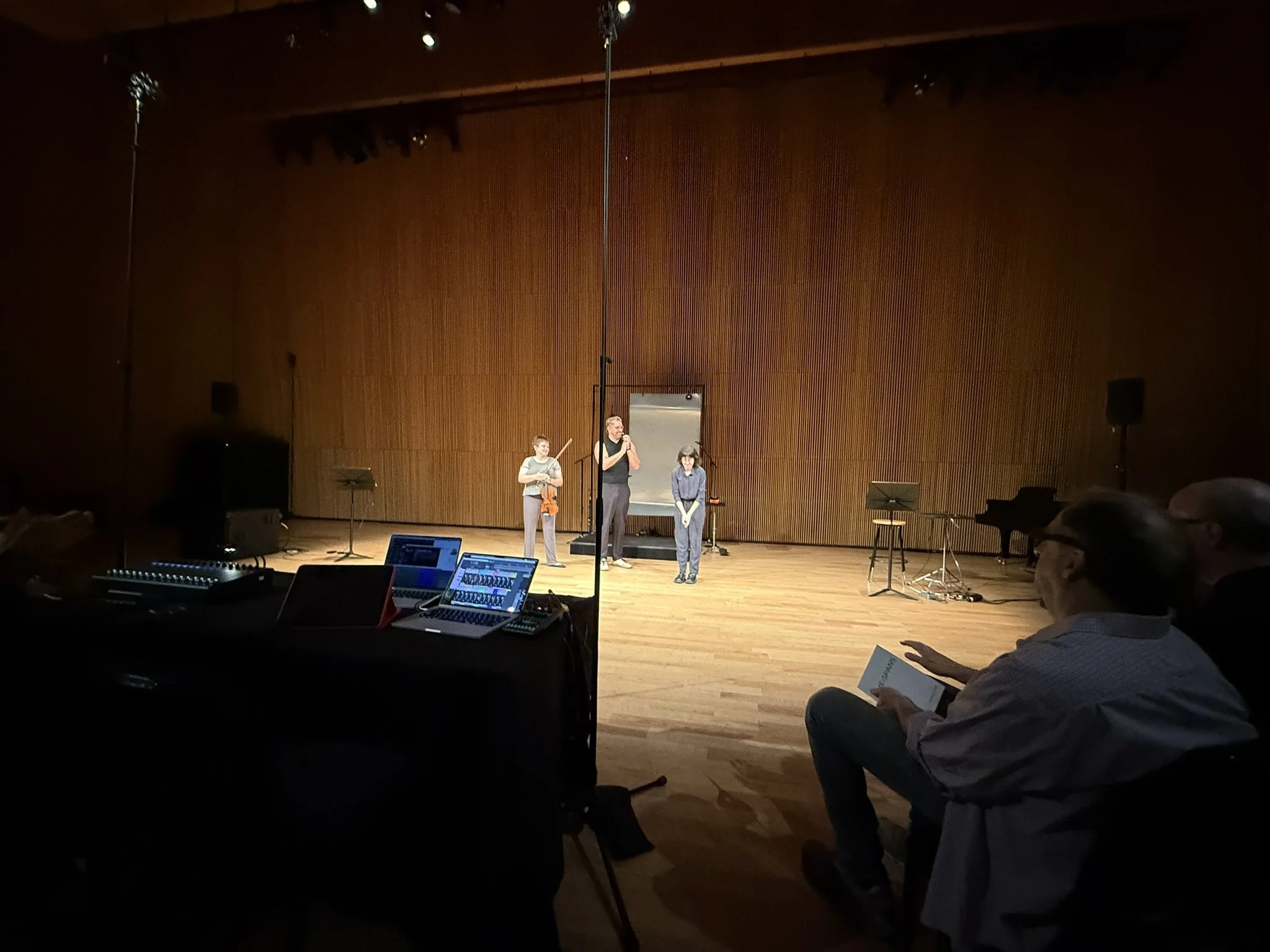
8.14.2026
Mary Flagler Cary Hall
I heard Kelley Sheehan live for the first time. I've been interested in her ever since the 2026 TIME lineup was announced because I felt her ideas and the music she's made so far were different from those of other composers. What was different?
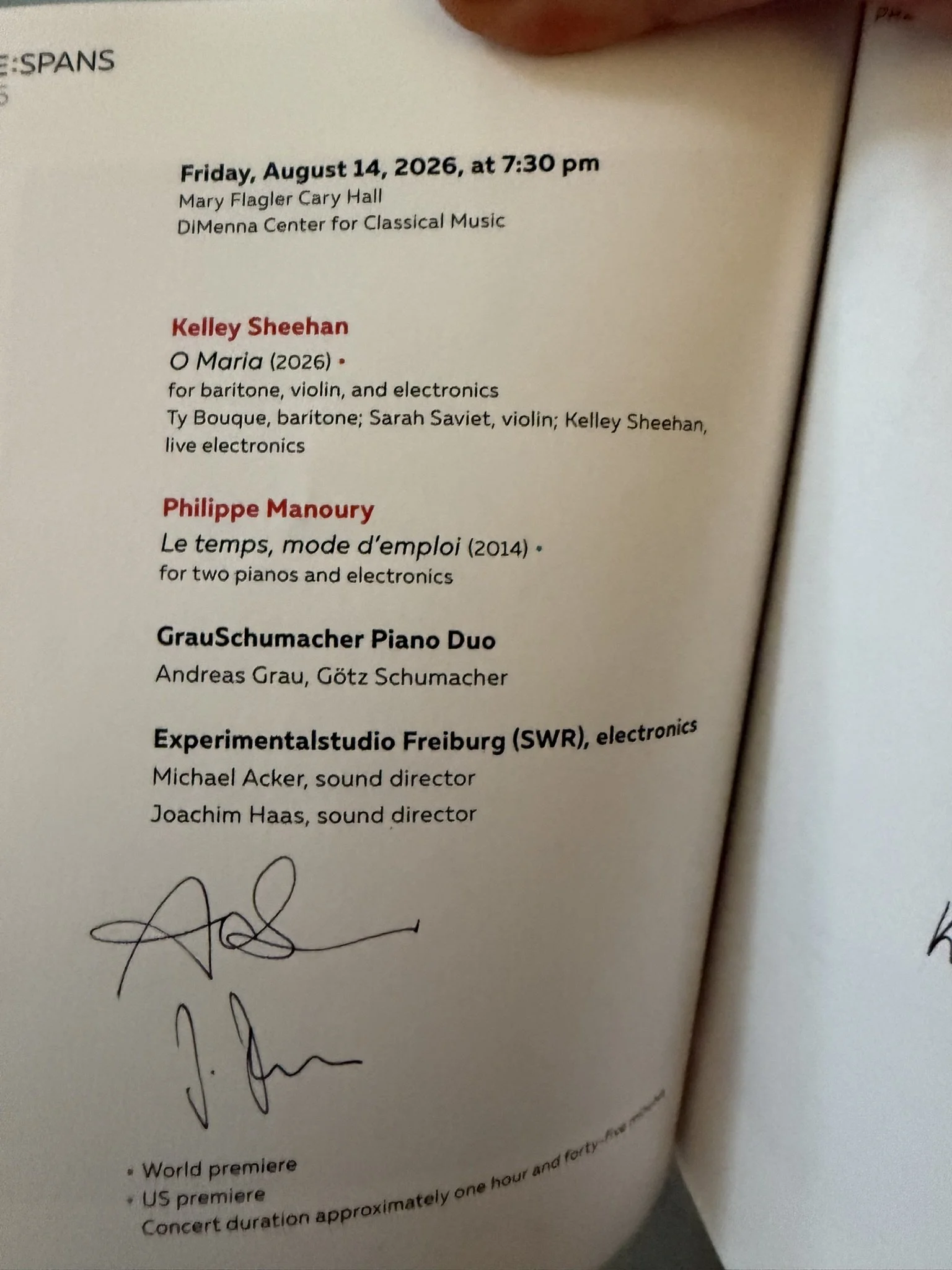
Kelley Sheehan
O Maria, 2026
for baritone, violin, and live electronics
World Premiere
Ty Bouque, baritone
Sarah Saviet, violin
Kelley Sheehan and SWR Experimentalstudio, live electronics
In this session, Joachim Haas of SWR was controlling the fader. At the front of the studio, a thunder sheet was hanging, a metal sheet like the one Strauss used for the storm in An Alpine Symphony. On the left was a violin, and on the right a singing bowl, each carefully placed and even lit so that their shadows would appear beautifully. Around them, on the right, were Ty Bouque’s chair and a transparent tube; on the opposite left was the violinist’s stand, with speakers set up around the performers. Was this horror? It had the acoustics of horror. It was frightening.
Bouque pressed a black rod against his throat and made it rumble. He changed registers and produced all kinds of strange voices. The microphone picked them up and sent them through the speakers to the thunder sheet in the center, causing the sheet itself to resonate in an eerie way. As with Mark’s overtones, Kelley’s resonance was something I had never experienced before. Sarah’s violin sounded as if she were squeezing it tightly with both hands, producing a rough, grinding, scraping sound that made me feel as though I myself were being squeezed.
In the program note, Kelley writes that the voice is always present, porous, and open at its boundaries; that a single throat, a single string, becomes a place where something possesses it, twists it, and muddies it from within. The voice that actually emerges can exceed the body that produces it, or resist that body. Voice = sound can enter everywhere. In everyday life, this is a serious problem, because we rarely think about the privacy of sound as much as we think about visual privacy. I strongly connected with this note. Kelley says the work is about the intrusion of sound and the dialogue, experiments, bodily movements, and traces that took place with Bouque in the process of creating it. The voice leaves the body, transforms, and becomes another kind of existence.
Behind them was a gong and something black that looked like a land mine, though I did not know what it was used for. This was truly different from any musical experience I had ever had, because almost everything was entrusted to Ty Bouque, Sarah Saviet, and Joachim—their channels and their individual decisions. They had nothing but individuality.
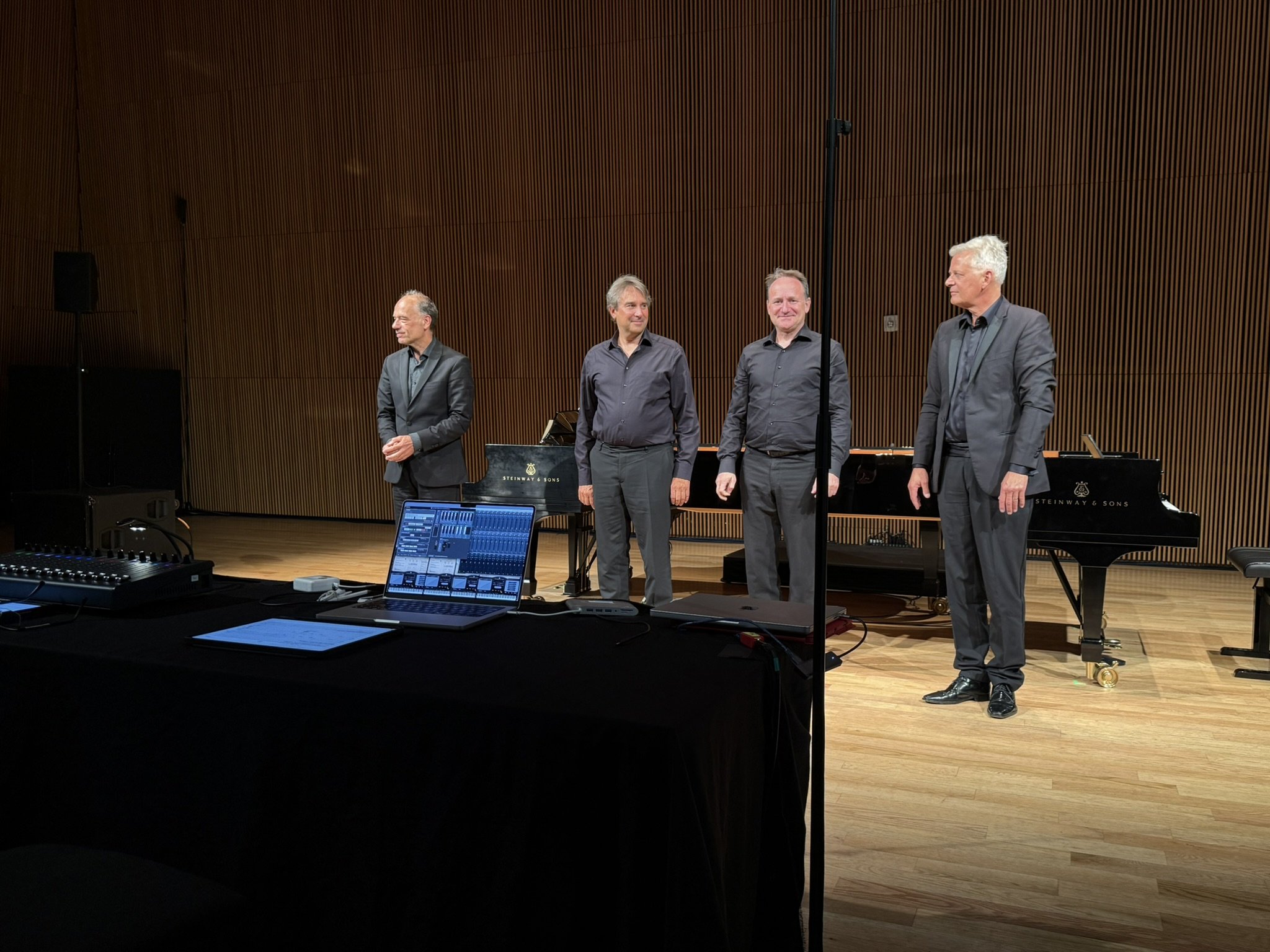
I felt this very strongly when I listened to Manoury afterward, because Manoury’s music reminded me of IRCAM and Messiaen, and the piano four-hands playing was also super-virtuosic, something I had heard somewhere before. What moved me more was the collision of intentions between the two people from the experimental studio and the two pianists. At the central table, Michael Acker was sitting in Kelley’s place. On the laptop he was operating, four pianos were preset, and I could see each part’s movements on the monitor. Next to him, Joachim Haas was, as always, controlling the fader, almost as if he were playing the eight speakers himself. The two followed the score and turned the piano four-hands and electronics into an ensemble.
What happens when you experience Sheehan and Manoury one after another, directly behind the engineers who have continued to support the evolution of music from the shadows, treating electronics as one instrument? In this age of AI, Sheehan treats machines like living things. She loves the deviations and mistakes of machines. For Sheehan, music is not the score or the performers. It is one organic body in which various elements mix together, beyond instruments and bodies, always changing without fixing a theme into a meaning. She embodies what Fichter, the director of TIME, describes: not presenting a theme, not offering an interpretation, but creating a state in which sound and music exist within a network that goes beyond machines, people, and instruments.
At the end, she rubbed two singing bowls against the thunder sheet. I do not know exactly what the two people experienced at the SWR Experimentalstudio, or how they experienced it. But when I listened to Kelley’s earlier works, I began to understand what was happening in O Maria, and what they were trying to say. Kelley has enjoyed hitting school desks with her hands and putting her ear against them to hear what kind of sounds they make. I used to cut holes into the wooden top of my desk and play golf. Some people in the world transform the things around them into something else and live happily. On my hole-riddled desk, my friends rolled erasers into balls and turned pencils into putters. Sometimes tournaments would begin. Tiger Woods would appear. We would spend time imitating cartoons about professional golfers. If you did something like that in a public school today, would you be sued for property damage? My family would never be able to come home. But there was an ecosystem there. Every day we thought of a different game and practiced it with whatever was around us. Nobody cared about some famous something-or-other. As far as the naked eye could see, there were only rice fields, so whatever existed became the object of our play. Anything we could take apart, we took apart.
In this way, Kelley’s missed flute notes, ponand the ching, all those notes that seemed to miss their target, the sound of a violin and a voice—or something that I could no longer tell was a violin or a voice—something that sounded as if a ghost might appear. But when I could see the invisible connections between the four people, there was a sensation I had never experienced before. A sensation that was not IRCAM, not some experimental laboratory, not TIME. Not Juilliard, not Northeastern, not the poor neighborhoods of Queens. When I experienced this, I began to see what I was looking at through my own subjectivity in Manoury, and what my mind was unconsciously caught up in. It exposed how my preferences and thoughts projected onto my senses made me feel what I felt.
Manoury is a master of contemporary music in his seventies. But if I had not listened to Kelley, I probably could not have removed the filter covering my own mind and body and experienced Manoury in this way. The ching Nick rings at Wiley’s when a hamburger is ready, and the ching in Kelley’s new work that does not belong anywhere, both music and sound, famous and unknown—through these things, it became possible, even for a moment, to separate sound from recognition, to separate it from thought. I feel fortunate that I was able to experience the fusion of Manoury’s piano four-hands and electronics in that small studio, with such a small audience.
Through Kelley, I learned that a maze does not end unless you solve it yourself. And you have to find the exit yourself. This time, I found the exit by discovering Kelley inside Manoury. If I had remained caught up in the piano sound and their technique, Kelley would have appeared. I was asked, “What are you listening to?” I stopped listening to the technique and the sound of the piano. By doing so, perhaps I was able to touch, just a little, the true beauty of Manoury—the instruction manual for time.
Philippe Manoury
Le temps, mode d'emploi, 2014
for two pianos and electronics
US Premiere
GrauSchumacher Piano Duo
SWR Experimentalstudio, electronics
But what stayed with me most was spending that time in the same seat, feeling the backs of Kelley and Michael. The syndicate, including the audience, experiences a transformative process that creates relationships rather than presenting a theme. There, I felt a resonance between Sheehan and Fichter. At the end, I got Kelley’s autograph. I also got autographs from the two people from the experimental studio.
Today, too, the girl in the yellow dress was sitting next to me. During Manoury, her small body trembled and moved up and down. The girl’s small body was absorbing Manoury. Sheehan taught me that everything within it can become an instrument and become music. Many artists were at Cary Hall, including George Lewis. But what I took home that night was not a composer’s name. It was the question of what I am listening to.
8.14.2026
Mary Flagler Cary Hall
8.14.2026
ケリーシーハンを生で初めて聴いた。タイムスパンズ2026年のラインナップが出た時から注目していた。なぜなら彼女の考えていることやこれまでの音楽が他の人と違うと感じたからだ。何が違うんだろう。
Kelley Sheehan
O Maria, 2026*
for baritone, violin, and live electronics
World Premiere
Ty Bouque, baritone
Sarah Saviet, violin
Kelley Sheehan and SWR Experimentalstudio, live electronics
このセッションではSWRのJoachim Haasがフェダーをコントロールしていた。スタジオの正面にはサンダーシートというシュトラウスがアルペンで嵐で使う金属の板が吊り下げてあり、左にはバイオリン、右にはシンキングボールがそれぞれ丁寧に飾ってある。影が奇麗に映るように照明までしてある。そのまわりのスペースでは右にタイブークの椅子と、透明なチューブが置いてあって、反対の左にはバイオリニストのスタンドがある。そして、それぞれスピーカーがセットしてある。これはホラーかどうか。ホラーと同じ音響だった。怖かった。タイブークが喉に黒い棒を押し当ててゴロゴロいわせたり、音域を変えて、いろんな変な声を出して、それをマイクが拾って、中央のサンダーシートにスピーカーで響かせて、その響きでサンダーシートが怪しく響いている。マークのオーバーノートもそうだったが、ケリーのこの響きも味わったことが無いものだった。サラのバイオリンはまるでサラがバイオリンを両手でギューッと絞って鳴らしているようだった。ゴリゴリギコギコした、自分も絞られているような音だった。
プログラムノートでケリーは、声はどこにでもあり、浸透し、境界が開かれたもので、ひとつの喉、ひとつの弦が、内側から何かに取り憑かれ、ねじ曲げられ、濁らされる場所と記していた。実際に現れた声が、それを生み出した身体を超えてしまうこと。あるいはその身体に抵抗すること。声=音はどこにでも侵入してくる。普段の生活ではとても深刻な問題だ。なぜなら、人は暮らしの中で視界よりも音のプライバシーをほとんど問題にしていないからだ。このノートを読んでとても共感した。そしてケリーはこの作品は音の侵入と生まれるまでに行われたタイブークとの対話、実験、身体の動き、その場所で起きた痕跡だという。
声が身体から離れ、変形し、別の存在へと変わっていく。後ろには銅鑼がセットしてあって、黒い地雷の様なものがセットしてあるが、どこで使われたかはわからなかった。
本当にどんな音楽の感覚とも違っていた。なぜなら、それはほぼ、タイブークとサラサビットとヨアキムのチャンネルのコントロールにゆだねてあるからだ。彼らは個性しかない。それはこのあとのマヌーリを聴いた時に物凄くよく感じた。なぜならマヌーリの音楽はイルカムやメシアンを連想させるし、ピアノの連弾もどこかで聴いたことがあるスーパービルトゥオーゾだった。それよりも私が感激したのは、実験室の2人とピアニスト2人の意思のぶつかり合いだ。中央のテーブルにはシーハンの席にミハエル・アッカーが座っている。彼の操作するラップトップには4つのピアノがプリセットされていてそれぞれのパートの動きがモニターを通じてみることが出来た。その隣のヨアキム・ハースは相変わらずフェダーを操り、8つのスピーカーをまるで演奏しているようだ。2人とも楽譜を追ってピアノの連弾とエレクトロニクスをアンサンブルさせていた。エレクトロニクスが一つの楽器であり、音楽の進化を影で支え続けてきたエンジニアのすぐ後ろでシーハンとマヌーリを続けてみたらどうなるか。
このAI時代に、シーハンは機械を生き物のように扱う。彼女は機械のずれや間違いに愛を持っている。シーハンにとって音楽とは、楽譜や演奏家ではなく、楽器や体を超えた、様々な要素が交じり合う一つの有機体だ。そして、それは常に変わり続け、テーマを固定した意味として提示しない。タイムスパンズのディレクター、フィヒターが語っていることを体現している。テーマを提示せず、解釈を与えず、機械、人、楽器を超えたネットワークの中に音と音楽がある状態。
最後は、シンキングボールをサンダーシートに2つこすり付けていた。
一体、SWRの実験室で2人が何をどう体験したかはわからないが、ケリーの昔の作品を聴いてみると、オーマリアで何が起こっていたか、彼らが何を言いたいのかがよく分かった。
ケリーは、学校の机を手で叩いたり、耳をあててどんな音がするか楽しんできた。私は木製の天板にカッターで穴をあけゴルフを楽しんでいた。このように、世間には身の回りの物を別な何かに変容させ、人生を幸せに生きる人たちがいる。穴の開いた私の机には友人が消しゴムを丸めてボールを作り、鉛筆をパターに変えて、ある時はトーナメントが始まり、タイガーウッズが現れたり、プロゴルファーの漫画の真似をしながら時間を過ごしたものだ。今公立の学校でそんなことをしたら、器物破損で訴えられるのだろうか。うちの家族が家に帰ってこれなくなる。しかし、そこには一つのエコシステムがあった。毎日違う遊びを考えては身の回りにあるもので実践していた。誰もどこかの有名な何かには興味が無かったし、肉眼で見渡せる限り水田しかなかったので、あるものが遊びの対象だった。分解できるものは何でもバラバラにしていたものだ。
このようにケリーのはずした笛の音や、ぽんやチーンという、全部はずした音に、お化けが出てきそうな、バイオリンと声なのかなんなのかわからない響き。でも、4人の見えないつながりが見えると、その味わったことがない感覚。イルカムでもどこかの実験室でもタイムスパンズでもない感覚。ジュリアードでもノースイースタンでもクイーンズの貧民街でもない感覚。これを味わえば、マヌーリで私が自分の主観で何を見て、私の心が無意識で何にとらわれているか。自分の嗜好や思考が私の感覚に映して感じさせていることを浮き彫りにしていた。マヌーリは70過ぎの現代作曲家の巨匠だ。しかし、ケリーを聴かなければ、自分の心と体にかかっているフィルターを取り除いてマヌーリを体験することはできなかっただろう。
ワイリースでハンバーガーが出来た時にニックが鳴らすチーンも、ケリーの新作で、どこにも属さない外れたチーンも、音楽も音も、有名も無名もそうやって、認識として、思考から切り離してみることが一瞬でも可能だったのだ。マヌーリの連弾とエレクトロニクスの融合は、あの小さなスタジオで小さなオーディエンスで体験できるのは幸運だと思う。私はケリーを通じて、迷路は自分で解かないと終わらないことを学んだ。そして、その迷路の出口は自分で見つけないといけない。今回の出口はマヌーリの中にケリーを発見したことで見つかった。私がピアノの音色や彼らの技術に気を捕らわれていたらケリーが現れた。あなたは何を聴いているのと質問された。技術やピアノの音色を聴くのをやめた。そうすることでマヌーリの真の美しさ、時間の取扱説明書に少しは触れることが出来たかもしれない。
Philippe Manoury
Le temps, mode d'emploi, 2014
for two pianos and electronics
*US Premiere*
GrauSchumacher Piano Duo
SWR Experimentalstudio, electronics
しかし、私が一番心に残っているのは、同じ席でケリーとミハエルの後ろ姿を感じながら時間を過ごしたことだ。聴衆も含めたシンジケートが、テーマの提示ではなく関係を生み出す変容のプロセスを体験する。そこに、シーハンとフィヒターの共鳴を感じた。
最後にシーハンからサインをもらった。実験室の2人にももらった。今日もとなりは黄色いドレスの少女だった。彼女はマヌーリでは小さな体が震えたり、上下に揺れていた。小さな少女の体がマヌーリを吸収している。
シーハンが教えてくれたことは、その中にいるすべてが楽器であり、音楽となりえることだ。クレイホールにはジョージルイス他、沢山のアーティストがいた。けれど、この夜、私が持ち帰ったのは作曲家の名前ではなかった。自分が何を聴いているのか疑うことだった。