
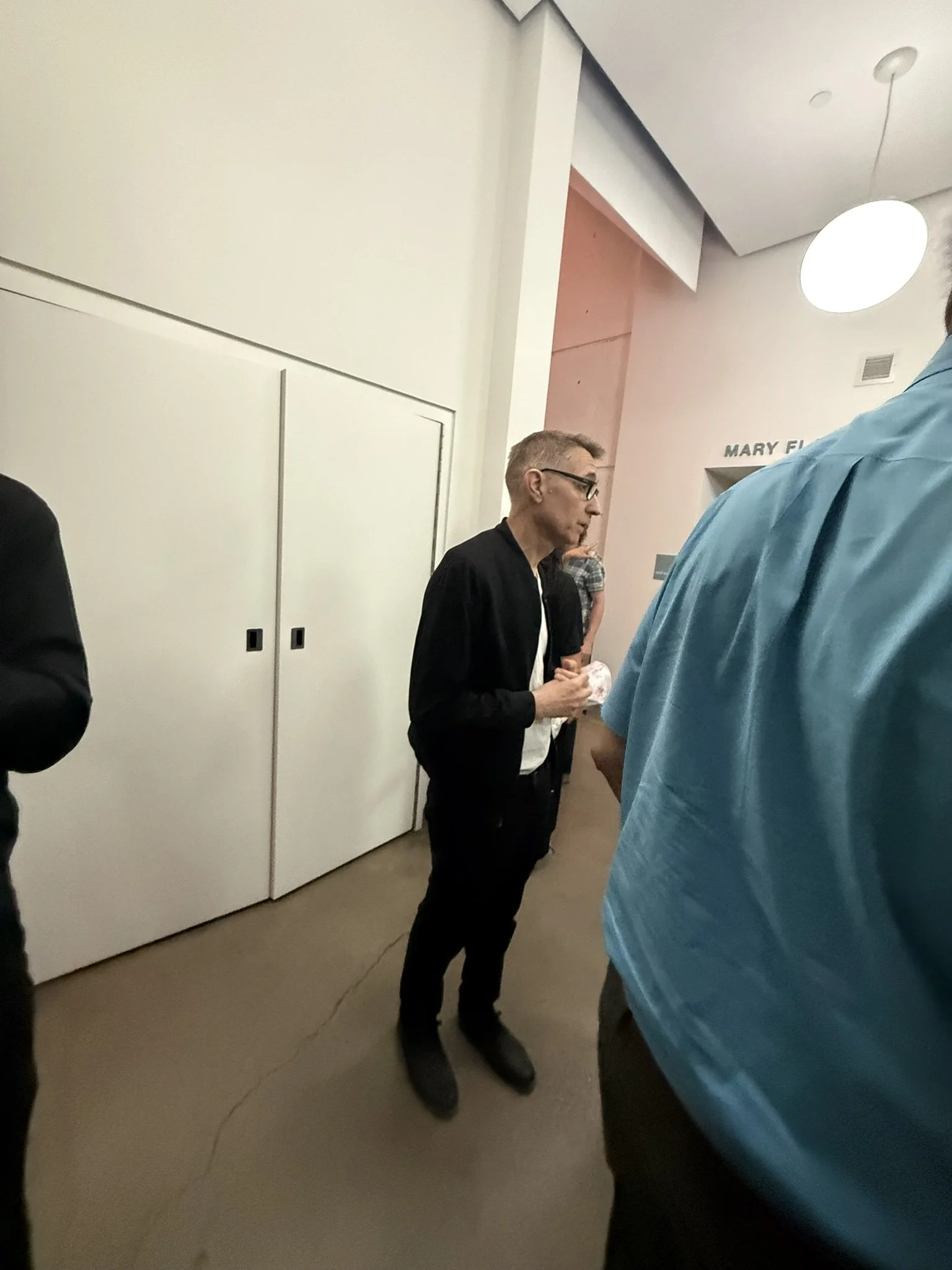
Mark Andre
...selig ist... (2024)*
for piano and pre-recorded electronics
US Premiere
Ning Yu — Piano
SWR Experimentalstudio (Freiburg, Germany)
Michael Acker — Sound Director
Joachim Haas — Sound Director
Vanishing
I felt as though I had witnessed many different kinds of endings.
We usually follow the melody. We watch the instrument move, the person singing, and try to remember what we hear. But Mark Andre turns his attention to the barely perceptible vibrations that remain after a sound has seemingly ended.
He records these minute sounds and, through acoustic analysis, makes a world of sound that normally lies beyond human perception almost visible, as if we were looking through a microscope. Fundamental tones, overtones, the sound of the hammer striking the strings, the vibration of the strings, resonance, reverberation, noise. Inside what we normally hear simply as “a piano sound,” countless other sounds begin to emerge.
At the center of Cary Hall stood a grand piano, surrounded by eight speakers.
Several piano sounds appeared and gradually disappeared. Then the remaining resonance was heard continuing from the speakers, having been recorded beforehand.
A piano sound eventually ends, whether the strings are struck by hammers or the sustain pedal prolongs the resonance. In this work, the electronics extended the reverberation that would normally disappear. The piano then placed fragments of sound upon this sustained resonance.
It was like a prism of sound.
Passing sound through a prism, the hidden resonances within it were separated and released into the space like light. I was hearing sounds I had never heard before.
Standing in a corner of Cary Hall, looking at the piano and the eight speakers, I began to feel that the entire space itself had become one enormous instrument.
Sound was born, spread through the space, transformed into something else, and disappeared. We watched this process unfold for nearly an hour.
The work was written as a memorial for a child who had died. The score contains a quotation from Matthew 5:4: “Blessed are those who mourn, for they shall be comforted.” The electronics also incorporate recordings of places where the child had played and sung, the sound of a river, the voices of a choir, and sounds from a hospital. These sounds become traces of places and memories.
What emerged was:
Silence.
Presence and absence.
Memory and forgetting.
Life and death.
And at the boundary between them: resonance, faint reverberation, minute vibrations, noise.
What can be heard at the moment a sound disappears.
The sound after the sound has disappeared.
Andre delicately illuminated the act of leaving, dying, and vanishing through the interval in which sound disappears.
And what remained was my own hearing.
When the time came, the musicians and engineers entered the hall and took their places. I closed my eyes and waited for the sound to begin, but nothing happened for a while.
I opened my eyes. Ning Yu was looking at the two engineers in front of her.
A high metallic tone from a singing bowl suddenly rang out. Then a drone emerged, something like air pressure, and continued. Suddenly, Yu pressed hard on the piano pedal. The body of the piano resonated as if struck, as though fragments of the instrument itself were vibrating.
The vibration traveled through the floor and into my body.
From several speakers placed in the distance came a sound like a thin membrane of light. Within that resonance, the piano began playing fragments of sound in many different ways.
Sometimes the piano's gestures had a strong rhythmic force. Sometimes several sounds were repeated in loops. Above and around them, membranes of sound emerged from the speakers, tracing slow curves shaped by slight frequency differences. The piano continued to play its fragments.
As an electronic loop began to disappear, the piano introduced the next motif, behind which another electronic resonance was already waiting.
Gradually, it became impossible to tell where one ended and the other began.
Even when the pedal was released, the resonance did not stop.
Simple piano attacks spread coldly through the space: the trembling of piano strings, the sound of hammers, the cloudy resonance produced when adjacent keys were pressed together.
This was not simply a piano with electronics added.
It was a single acoustic body.
And within that body, sound was constantly becoming something else.
Mark Andre
Mark Andre (born in Paris in 1964) is a French-born composer based in Germany. With an interest in mathematics and engineering, he studied composition in Paris before moving to Germany, where he studied with composer Helmut Lachenmann.
Religion, memory, loss, silence, and disappearance occupy an important place in Andre's music. Rather than treating sound simply as pitch or melody, he approaches it as a physical phenomenon. Breath, resonance, noise, decay, and reverberation become audible.
His particular interest lies in the moment when sound disappears, at the boundary where sound passes into silence.
Through recording and acoustic analysis, he captures the faint vibrations and traces that remain there and transforms them into compositional material.
Andre's music asks us to consider what we hear, how we perceive sound, and how hearing itself relates to existence.
SWR Experimentalstudio
SWR Experimentalstudio is a world-renowned research and production center for contemporary music, particularly live electronics, based in Freiburg, Germany. Founded in 1971, it is part of SWR, the Southwest German Broadcasting Corporation.
Here, composers work with specialists to develop techniques for transforming, amplifying, processing, and spatializing the sounds produced by live performers in real time.
The sound specialists at SWR are therefore not simply technicians. The performer, the electronic system, and the sound directors work together to create music as if they were forming a single instrument.
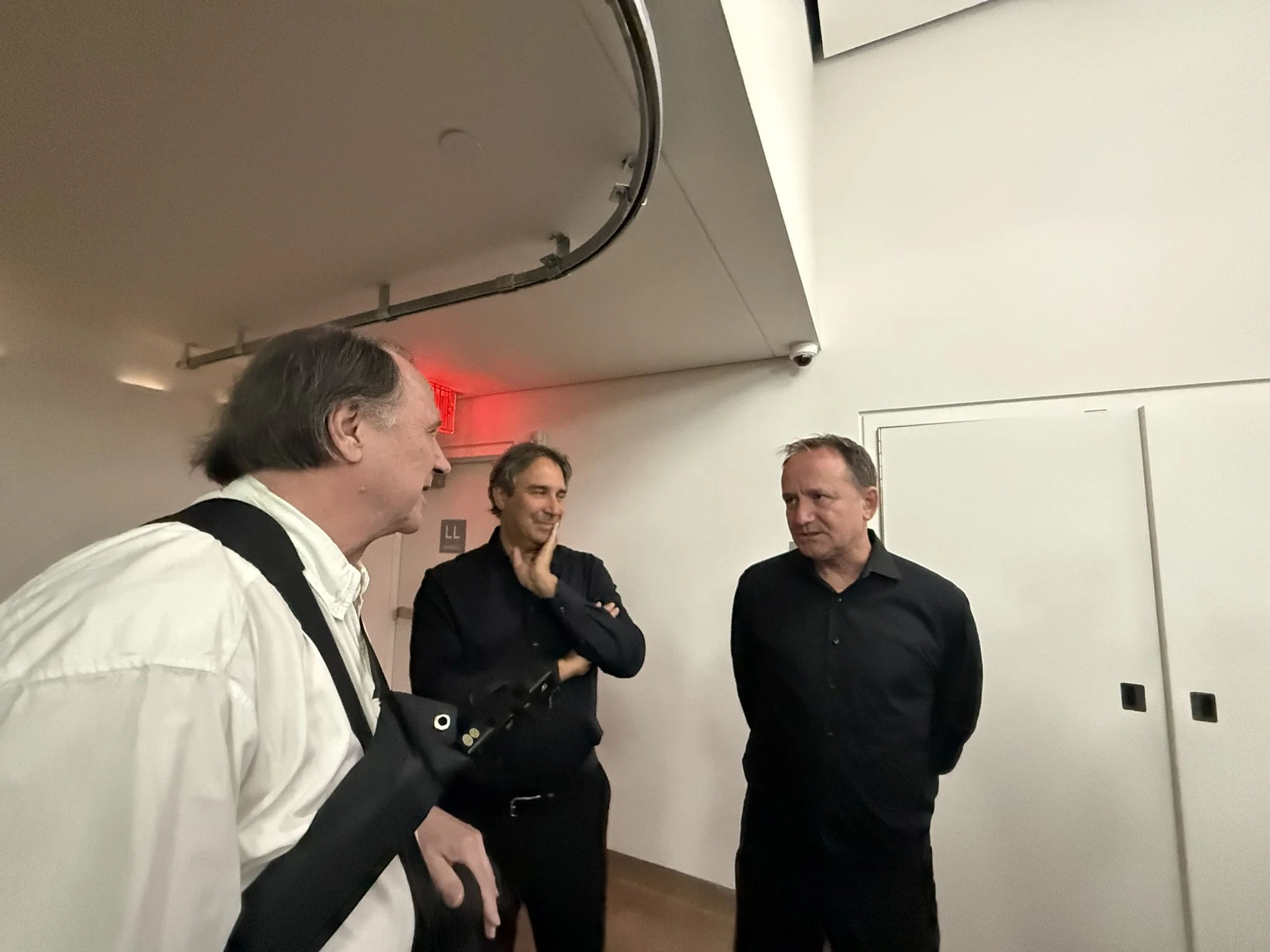
Joachim Haas is a sound director and music information technologist at SWR Experimentalstudio and currently serves as its director. He has worked at the studio since 2001 and has been involved in producing and performing live-electronic works by numerous composers, including Mark Andre.
In works like Andre's, where instrumental sound and electronics are extraordinarily closely intertwined, Haas's role is particularly important.
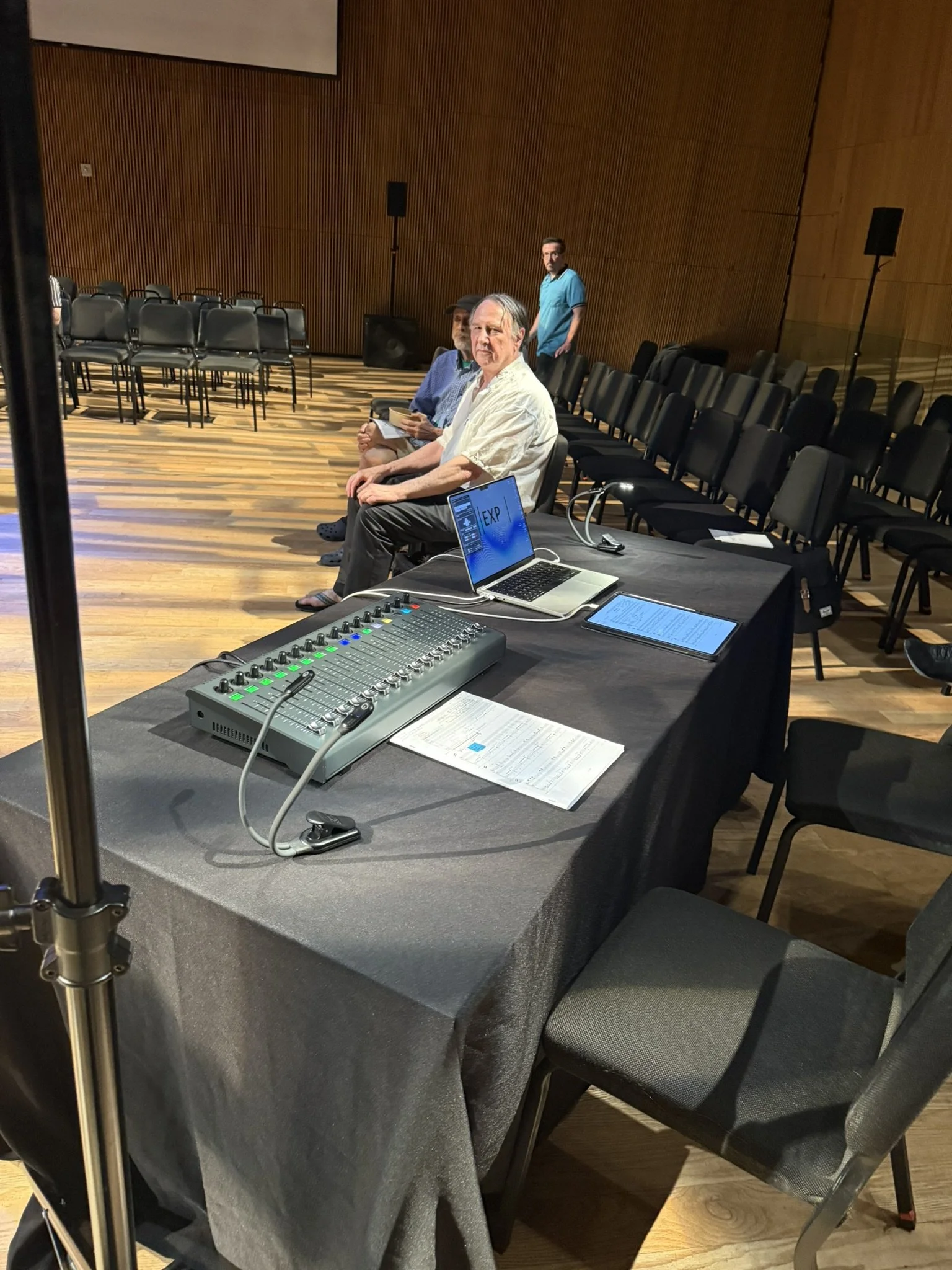
Michael Acker is also a sound director at SWR Experimentalstudio. In live-electronic performances, he works in real time with the volume, balance, timbre, spatial position, and timing of electronic sounds.
In other words, he does not simply “play back” completed electronic sounds for the audience. He performs the electronics together with the musicians.
SWR Experimentalstudio has been associated with composers who shaped the history of electronic music, including Karlheinz Stockhausen, Pierre Boulez, John Cage, and Luigi Nono. Today, it continues to support composers such as Mark Andre, Georg Friedrich Haas, and Chaya Czernowin.
For this performance, Joachim Haas and Michael Acker were not simply responsible for the sound. They co-created the work, bringing Andre's electronic system to life as music within the performance space.
In other words:
Ning Yu — piano
Michael Acker — sound director
Joachim Haas — sound director
SWR Experimentalstudio
To hear Mark Andre performed by this team is to experience more than a pianist accompanied by electronics.
It is a pianist, two specialists shaping the electronics in real time, and more than half a century of Freiburg's electronic music tradition coming together through Mark Andre to create a single acoustic space.
Vanishing/残響
8.12.2026
Mark Andre
...selig ist..., 2024*
for piano and pre-recorded electronics
* US Premiere
Ning Yu
Piano
SWR Experimentalstudio (Freiburg, Germany)
Michael Acker, sound director
Joachim Haas, sound director
Program Notes
Mark Andre
. . . selig ist . . . (2024)
消えゆくもの ― vanishing
いろんなエンディングを見た気がする。
私たちは大抵、メロディを追い、楽器が動いている姿や、誰かが歌っているところを見たり、覚えようとする。けれどMark Andreが耳を向けるのは、音が鳴り終わったあとのごく小さな音の振動だ。彼はそうした微細な音を録音し、音響解析で人間の知覚では捉えられない音の世界を、まるで顕微鏡を覗くように可視化していく。基音、倍音、打鍵音、弦の振動、共鳴、残響、ノイズ。普段ならひとつの「ピアノの音」として聴いてしまうものの内部に無数の響きが聴こえる。
Cary Hallの中央にはグランドピアノが置かれ、その周囲を8台のスピーカーが取り囲んでいた。いくつかのピアノの音色が鳴り、やがて消える。その後に残る響きがあらかじめ録音され、スピーカーから持続して聴こえてくる。
ピアノの音は、ハンマーで弦を叩いても、ペダルを使って響きを引き伸ばしても、いつかは終わる。この作品では、エレクトロニクスが、本来なら終わってしまうはずの残響を引き伸ばしていた。そしてピアノは、その持続する響きの上に、音の欠片を乗せていく。
それは、音のプリズムだった。音をプリズムに通すことで、その中に隠れていた別の響きが分解され、光のように空間へ解き放たれていく。これまで聴いたことのない響きだった。
Cary Hallの隅に立って、生のピアノと8台のスピーカーを眺めていると、この空間が一つの巨大な楽器のように感じた。音が生まれ、空間に広がり、別の音へと変化し、そして消えていく。その過程を私たちは一時間近く眺め続けた。
この作品は、亡くなった子どものための追悼として書かれている。「悲しむ者は幸いである。彼らは慰められるであろう。」マタイによる福音書、第5章第4節の言葉の引用が楽譜にある。電子音響には、子どもが遊んだ場所や歌った場所、川の音、聖歌隊の声、病院の音などもあらかじめ録音され使われ場所や記憶の痕跡として変換されている。
そこで聴こえてくるのは、
沈黙。
存在と不在。
記憶と忘却。
生と死。
その境界に残る、残響、かすかな共鳴、微細な振動、ノイズ。
音が消えていく瞬間に聴こえるもの。
音が消えた後の音。
Andreは、去ること、死んでいくこと、消滅することを、音が消えていく間を繊細に浮かび上がらせていた。そして残ったのは私の聴覚だった。
時間になると、彼らがスタジオに入ってきて、席についた。目を閉じて音が鳴るのを待っていたがなかなか始まらなかった。目を開けて目の前を見ると、Ning Yuが2人のエンジニアを見つめていた。シンキングボールで高い金属音がキーンと始まり、その後、ドローンの空気圧の様な音が鳴り続け、突然、ピアノのペダルを強く踏んで、叩くようなピアノのボディが反響し楽器そのものの欠片が振動しているようだった。踏みつけた振動が床を伝い、身体にまで響いてくる。そして遠くに置かれたいくつかのスピーカーから、光の膜のような響きが聴こえてくる。その響きの中で、ピアノがさまざまな方法で、音の欠片を奏でていった。
ピアノの動きは、リズムが強かったり、いくつかの音をループさせるように奏でられた。そしてそこにはスピーカーから音の膜が現れ、ハーツのずれによるゆっくりしたカーブが描かれ、ピアノは音の欠片を奏で続けた。
エレクトロニクスの音のループが消えていこうとすると、次の動機がピアノから始まって、また違う、エレクトロニクスの響きがその音の背後にはあった。だんだん境目が解らなくなる。ペダルを上げても響きが止まらない。そして、単純ないくつかの音の打鍵が冷たく空間に広がる。ピアノ線の震える音や、ハンマーの音、隣同時の鍵盤を同時に抑えたときの濁り。
Mark Andre(1964年、パリ生まれ)は、フランス出身でドイツを拠点に活動する現代音楽の作曲家。数学や工学にも関心を持ち、パリで作曲を学んだ後、ドイツに移住し、作曲家Helmut Lachenmannに師事。Andreの音楽では、宗教、記憶、喪失、沈黙、消滅といったテーマが重要な位置を占めている。音を単なる音程や旋律としてではなく、物理的な現象として捉え、息、共鳴、ノイズ、減衰、残響などが聴こえる。彼が関心を寄せるのは、音が消えていく瞬間、音が沈黙へと移行する境界。録音や音響分析によって、そこに残るかすかな振動や痕跡を捉え、それを作曲の素材とする。Andreの音楽は、私たちは何を聴き、どのように音を知覚しているのか、聴覚と存在を音楽で問いかける。
SWR Experimentalstudioは、ドイツ・フライブルクにある、現代音楽、とりわけライブ・エレクトロニクスのための世界的に重要な研究・制作拠点である。1971年に設立され、SWR(南西ドイツ放送)に属している。
ここでは、演奏家が発する生の音をリアルタイムで電子的に変形し、増幅し、加工し、さらに空間の中で動かすための技術や方法を、作曲家とともに開発している。そのため、SWRの音響スタッフは、演奏家、電子音響システム、サウンド・ディレクターが一体となって、ひとつの楽器のように音楽を作る。
Joachim Haasは、SWR Experimentalstudioのサウンド・ディレクター/音楽情報技術者であり、現在はスタジオの責任者を務めている。2001年から同スタジオで活動し、Mark Andreをはじめとする多くの作曲家のライブ・エレクトロニクス作品の制作と実演に携わってきた。特にMark Andreのように、楽器から出る音と電子音響が極めて緊密に結びついている作品では、Haasの役割は重要である。
Michael AckerもSWR Experimentalstudioのサウンド・ディレクターである。ライブ・エレクトロニクスの演奏では、電子音響の音量、バランス、音色、空間的な位置、変化のタイミングなどをリアルタイムで操作する。つまり、完成した電子音を客席に「再生する」のではなく、演奏家とともに、その場で電子音響そのものを演奏している。
SWR Experimentalstudioには、これまでKarlheinz Stockhausen、Pierre Boulez、John Cage、Luigi Nonoなど、電子音響の歴史を作ってきた作曲家たちが関わってきた。現在もMark Andre、Georg Friedrich Haas、Chaya Czernowinなどの作品を支えている。今回の演奏でJoachim HaasやMichael Ackerは、作曲家が設計した電子音響のシステムを、実際の演奏空間で音楽として成立させる共同制作者なのだ。
この電子音響研究所のJoachim HaasやMichael Ackerは、その電子音響を演奏家とともに演奏する人なのだ。
つまり、
Ning Yu — piano
Michael Acker — sound director
Joachim Haas — sound director
SWR Experimentalstudio
このメンバーでマークを演奏するということは、ピアニスト + 電子音響を操作する2人の専門家 + フライブルクの半世紀以上にわたる電子音楽の伝統をMark Andreを通じて音響空間を構築したのだ。