
My Third TIME:SPANS 2026
Rain.
The stands faced one another in the center of the studio, with the audience surrounding them in a square. Roughly 200 seats. It was a large studio, big enough for an orchestra. A strange feeling made it seem like the music was sounding somewhere inside me.
Program
TIME — Parker Quartet / Farrin / Kurtág
György Kurtág
Officium breve in memoriam Andreae Szervánsky, Op. 28 (1989)
Fifteen short pieces: Officium breve. The music gradually becomes smaller and smaller. Sound. Resonance. Gesture. The Parker Quartet gave an incredibly delicate performance. Gestures that belonged to nineteenth-century music appeared clearly in the shape of the sound, occupying the space before disappearing. At times, I felt the four instruments spreading their individual colors throughout the entire room. I imagine the Parker Quartet must also be very good at the Romantic repertoire.
Kurtág wrote this work as a tribute to Endre Szervánsky, who himself had been influenced by Webern, creating what is essentially a requiem for the two composers. The title uses Andreae, the Latinized form of Szervánsky's first name. References to Szervánsky appear at both ends of the piece, with a quotation from Webern at its center.
I stared into the tiny space between one sound disappearing and the next sound arriving. I did not wait for anything to happen. I simply listened. From Szervánsky to Webern, and then to Kurtág. The four performers' consciousness seemed to absorb the noise we had brought with us. As the music became silent, my perception of the space became increasingly sensitive. Each short fragment appeared in the room as clearly as a work of art. At the same time, the music seemed to touch the consciousness of the audience surrounding the studio like a square. I found myself watching the audience as if I were seeing people absorbed in a work of art in a gallery. I could see the gestures of the performers in the center, and the flow of their consciousness. What action would they take next? What would they play? Those brief events appeared and disappeared as if in slow motion. Before I could think about whose music was being quoted, I was struck by how the Parker Quartet's richly lyrical sound had fused so beautifully with the world of Kurtág.
I think this was partly because the program began with Kurtág's music from different periods, and each piece had a completely different sound and expressive character.
Aus der Ferne III (1991) / Aus der Ferne V (1999)
Aus der Ferne — “From Afar.” During the Cold War, the Vienna-based publisher Universal Edition played an important role in spreading Kurtág's music throughout Western Europe. Alfred Schlee, who led Universal Edition for forty years, was an important figure in that process. Aus der Ferne III was written for Schlee's 90th birthday, while Aus der Ferne V was written in memory of him after his death.
The Parker Quartet's sound had an extraordinary physical presence. Unlike Officium breve, I didn't feel I was hearing quotations from someone else's music. Instead, the sound had a unique three-dimensional quality. In the 1991 Aus der Ferne III, the cello's heartbeat-like pulses supported a violin high above them, drifting slowly through the space. At times, my awareness of the high register suddenly became extremely sharp. Even someone who had never met Schlee might somehow feel something of his personality. In the 1999 Aus der Ferne V, the cello's pulses seem to turn inward. The trembling of the soul in the high register becomes a thin, awkward energy. It felt as if the individuality and soul of a single human being were gradually leaving the body. At the end, a thin scale rises upward and comes to a stop.
As I followed the sounds, I noticed the scores on the music stands and began listening while watching them. The scores looked almost like patterns, but I could see that the four voices were stretching and articulating different figures. As long as I did not lose track of the viola, I could follow the turning of the pages and never completely lose my place. Perhaps the Parker Quartet is one of the groups in the world that understands Kurtág most deeply. The sound color, the shape of the sound, the consciousness that produces it, and the invisible energy of the four performers—opening and closing, expanding and contracting—were completely different from piece to piece. I gradually began to understand how intensely and carefully they approach Kurtág.
Hommage à Mihály András: 12 Microludes for String Quartet, Op. 13 (1977)
These twelve micro-preludes were written to commemorate the 60th birthday of the Hungarian cellist Mihály András. Each one was short and concentrated, and each had a completely different character. Although this is a work from 1977, it felt to me like the most abstract music of the program—a distilled reality. It seemed to remain in contact with something surreal. I had an incredibly fresh sensation. The sounds were glowing.
Six Moments Musicaux, Op. 44 (2005)
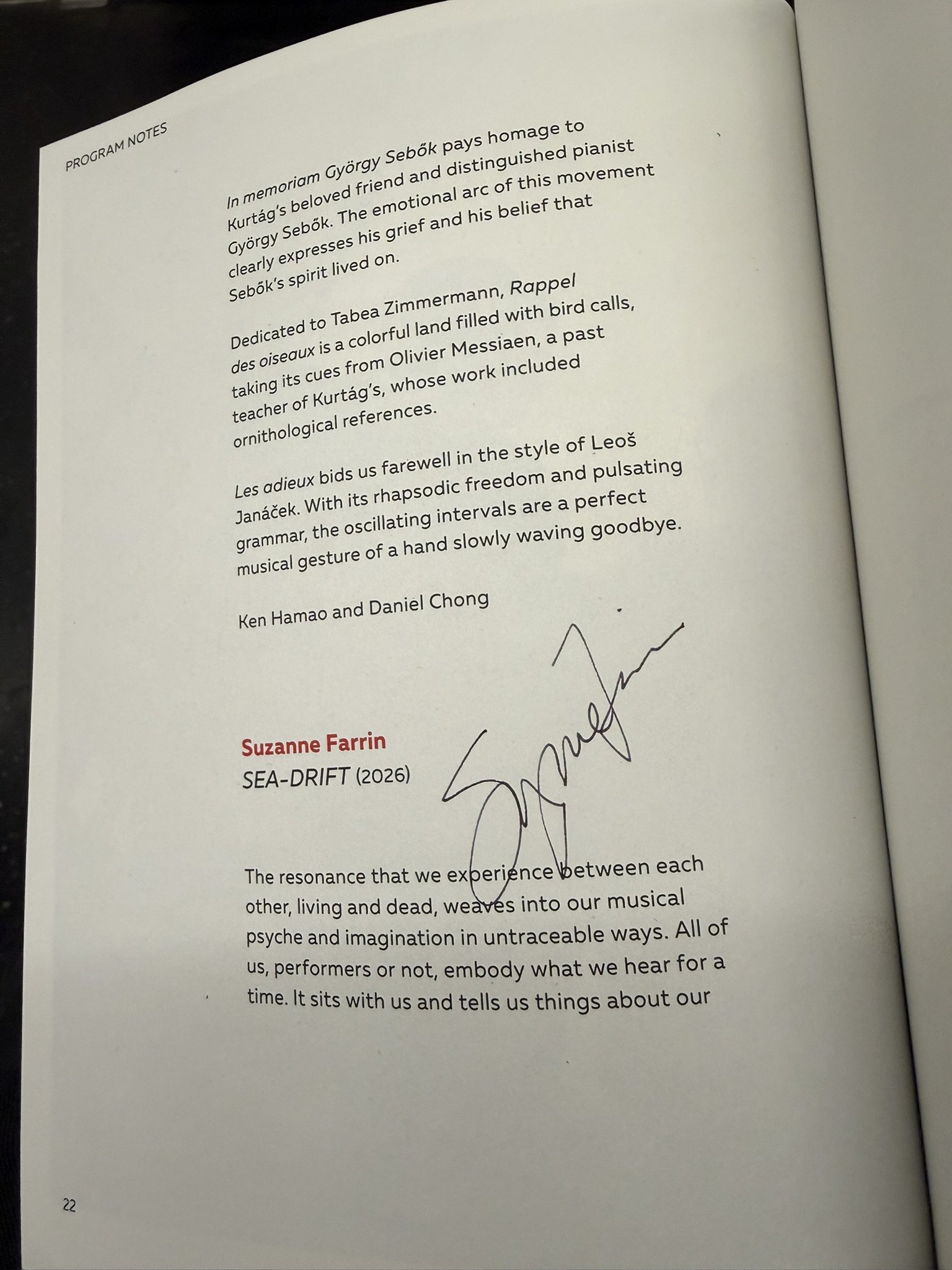
The final Kurtág work of this centenary program was Six Moments Musicaux. The first movement is an invocation. It has an almost symphonic resonance, and Kurtág's sharp sensibility of the 2000s seems to leap through it. From there come an Adagio, a poet, a short capriccio, and an homage to a beloved friend: deep sorrow, but also the spirit of a friend continuing to live. Rappel des oiseaux, dedicated to Tabea Zimmermann, evokes birdsong and draws inspiration from Olivier Messiaen, who was also one of Kurtág's teachers. In Les adieux, the freely rhapsodic quality of Leoš Janáček and the pulse-like grammar of his music create intervals that seem to waver. They become a distinctly musical gesture, like the slow movement of a hand waving goodbye.
Following this wavering, wave-like sound, Suzanne Farrin's SEA-DRIFT (2026) began. From Szervánsky to Webern, from Webern to Kurtág, and beyond Kurtág to Farrin in 2026: a chain of musical memory. A letter from one composer to “translucence,” with no reply. The work is Farrin's response to the music of György Kurtág and to the particular attention the Parker Quartet brings to his expressivity.
Suzanne Farrin — SEA-DRIFT (2026)
I. To the space in the door...
II. perdendosi
III. ...that opens and shuts.
Farrin writes:
The resonance that we experience between each other, living and dead, weaves into our musical psyche and imagination in untraceable ways. All of us, performers or not, embody what we hear for a time. It sits with us and tells us things about our humanity that were previously unconscious, and then it dives back down again. When its passage is complete, each vessel has been changed uniquely and forever. How do we experience, store, and speak through this new knowledge? What does it sound like when one composer shapes another? The love I have for other people's music feels like a series of imprints, heard in what is left behind: the sound of our momentary togetherness.
For me, musical experience is like a meeting of the minds: the composer’s thought, living or dead, the player who filters and colors the message, and the listener, who finds their own liminal space in the dreams of others. This ‘meeting’ can come as a shock as it can stretch across hundreds of years and vast physical boundaries. It can include people I never knew I understood, or ideas that I didn’t think were consonant with my own. The power of this connection keeps my antennae up, searching the waves for a spiritual legato: the tiny thread to something beautiful or bewildering.
This work is a response to the music of György Kurtág and the Parker Quartet’s particular attention to his expressivity. It reads like one composer’s unanswered letter to translucence. References to his works visit in fleeting citation, but its essentialness comes through hollowed-out reverberations of what is left behind.
After listening to Kurtág, Farrin seems to take what remains and hollow it out into another piece of music. As the title suggests, she dug and dug into it. Like Kurtág, the sound's energy opens and closes. It drifts. In particular, the consciousness of perdendosi—the feeling of a person's soul gradually disappearing—felt like a reverberation of Kurtág.
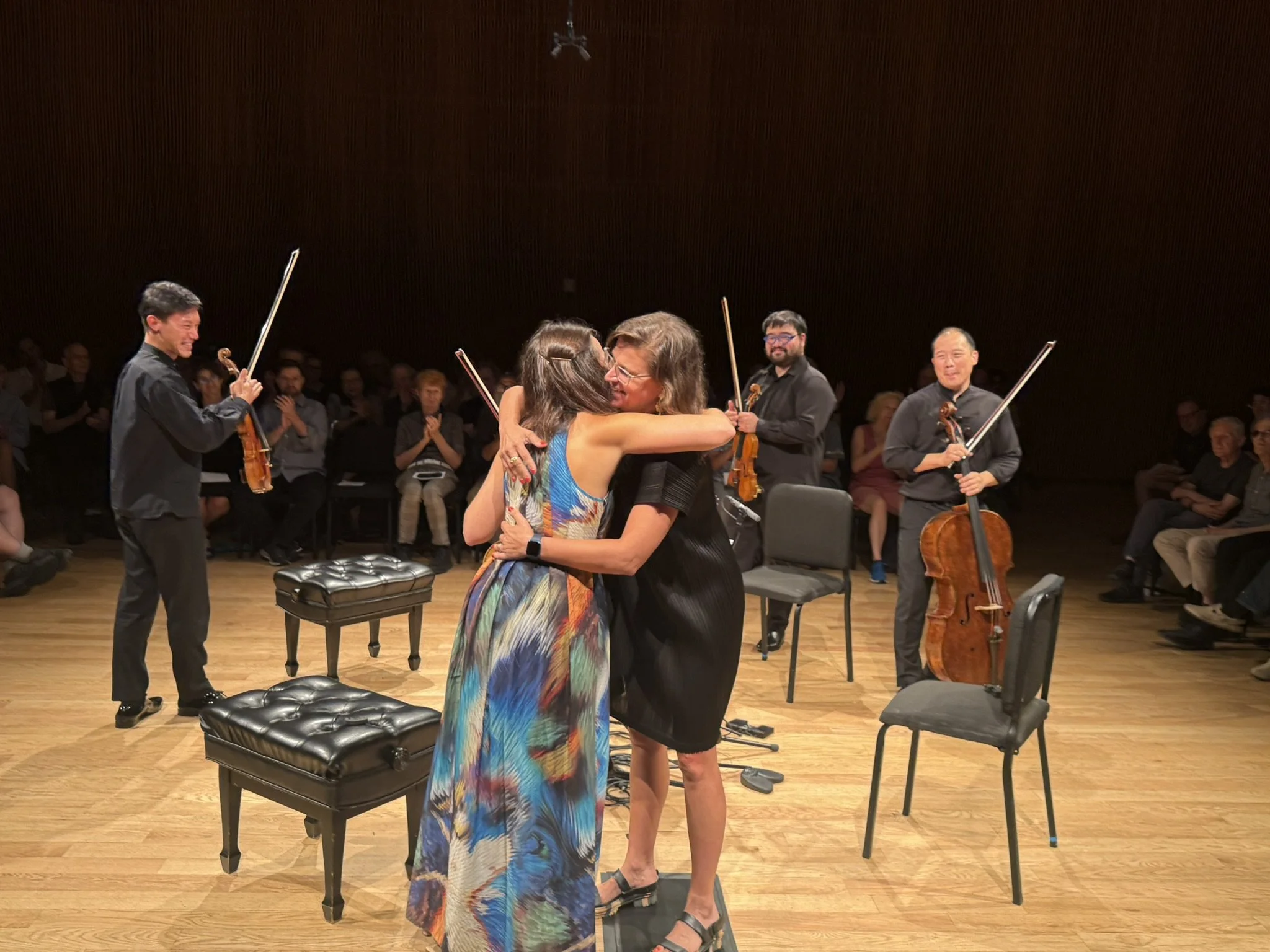
I sat there, and I never became uncomfortable. I felt my body gradually disappear. After the concert, I got Suzanne's autograph. When I got home, I listened to one of Suzanne's recordings. I slept very well.
Suzanne Farrin
Suzanne Farrin (b. 1976) is an American composer and ondes Martenot performer. She was born in North Yarmouth, Maine, and moved during her adolescence first to coastal Massachusetts and later to Colorado. Her experiences in Massachusetts, in particular, have influenced her subsequent work as a composer.
She received her bachelor's degree from the University of Colorado Boulder in 1998, followed by a master's degree (2000), MMA (2003), and DMA (2008) from the Yale School of Music. Her teachers included Martin Bresnick, Ezra Laderman, Joseph Schwantner, and Evan Ziporyn.
Around 2007, she began developing her career as a composer in earnest, producing works such as Corpo di Terra (2012), inspired by the poetry of Petrarch, and Dolce la Morte, based on poems by Michelangelo. In 2019, she received a Guggenheim Fellowship.
Farrin considers composition a “way of getting closer to life” and “a way of seeing the world.” Her works often draw inspiration from literature, visual art, places, and memory, including a strong interest in Rome. She is also known for her creative use of electronic instruments.
In addition to composing, she performs on the ondes Martenot and has contributed to film music. She is currently Frayda B. Lindemann Professor of Music at the CUNY Graduate Center and Hunter College.
8.10.2026 Timespans 3回目
雨。スタジオの中央にスタンドが向かい合うように設置され、客席が四角に囲む。ざっと200席。オーケストラが入る大きなスタジオ。まるで自分の中で音楽が鳴っているような感覚になる。
8.10.2026
Program
https://timespans.org/concert/parker-quartet-farrin-kurtag/
György Kurtág
Officium breve in memoriam Andreae Szervánsky, Op. 28(1989)
https://www.youtube.com/watch?v=K-6_z4ry8nU
15の短い音楽《Officium breve》。音楽が少しずつ小さくなっていく。音。響き。身振り。パーカーカルテットはとても繊細な演奏だった。19世紀の音楽が持っていた身振りが、音の形がの空間にくっきり表れて消えていく。時には空間いっぱいに4人の音色が広がるのを感じた。パーカーはロマン派のレパートリーもとてもうまいんだろうと思った。
この曲はKurtágが、Webernからも影響を受けたEndre Szervánskyに敬意を捧げ、2人のレクイエムとして作った。タイトルにはSzervánskyのファーストネームをラテン風にしたAndreaeが用いられている。曲の両端にSzervánsky、中央にWebernの引用が見られる。
音が鳴り、消え、次の音までのわずかな時間を凝視した。何か起こるか期待せず、ただじっと聴いた。SzervánskyからWebernへ、そしてKurtágへ。4人の演奏家の意識が、私たちの雑音を吸い上げ、無音の時の空間の認識がとても敏感になっていった。短い断片がひとつのアートのように、空間にくっきり表れた。また、スタジオを四角で囲んだ聴衆の意識そのものに触れ、ギャラリーで作品に没頭するオーディエンスを眺めていた。中央の演奏家たちの所作や意識の流れが見えた。彼らが次にどんなアクションで何を奏でるか。そういった一瞬の出来事がスローモーションのように現れては消えていった。誰かからのどういった引用という前に、パーカーカルテットの抒情豊かな音色がクルターク世界と見事に結実していた。
なぜなら、このプログラムの始めは違う時代のクルタークの作品を扱っていて、その曲ごとの音色も表現も違っていたからだ。
Aus der Ferne III (1991)
Aus der Ferne V (1999)
Aus der Ferne――「遠くから」。冷戦時代、ウィーンの出版社Universal Editionは、西ヨーロッパでKurtágの音楽を広めていた。当時Universalを40年間にわたって率いたのがAlfred Schlee。Aus der Ferne IIIは、彼の90歳の誕生日を祝うために、Aus der Ferne Vは、亡くなったときの追悼として書いた。
パーカーの音色がとても実体があった。Officium breveの誰かの引用を感じない、独特の立体感のある演奏だった。1991年のIIIでは、チェロの鼓動のような刻みにバイオリンの高音がゆったり漂ったり、高い音の意識が突然鋭くなったりする。Schleeに会ったことがない人でも、彼の人柄を感じると思った。1999年のAus der Ferne Vは、チェロの刻みも内側に向かっている。高音の魂の揺らぎが、細くてぎこちないエネルギー。ひとりの人間の個性と魂が抜けていく。最後は細い音階が昇っていって停止する。
音を追っていると、演奏者のスタンドの楽譜が見えたので、見ながら聴いた。楽譜は模様のようにしか見えないが、4つの声部が延ばしたり刻んだりするのはわかった。ビオラが落ちない限り、ページがめくられて追うことができたので、見失わなかった。多分パーカーはクルタークを世界でも最もよくわかっているグループのひとつで、それぞれの曲を奏でる音色や、音の形や、彼らの音を生む意識、開いたり閉じたりする、そういう目には見えない4人のエネルギーが全然違うので、彼らがすごくクルタークをこだわって演奏していることがわかってきた。
Hommage à Mihály András: 12 Microludes for string quartet, op. 13 (1977)
ハンガリーのチェリスト、アンドラーシュ・ミハーイの60歳の誕生日を記念した、12のmicro preludeは、ひとつは短く集中して、全部違う性格だった。これは1977年の作品だが、もっとも抽象性が高く、a distilled reality。超現実の何かに触れ続けていて、すごく新鮮な感覚を持った。音が輝いていた。
クルターク100周年記念、最後のクルタークは
Six Moments Musicaux, op. 44 (2005)
1楽章は、invocation。交響曲のような響きで、クルタークの2000年代の鋭い感性が跳躍している。そこから、アダージョの詩人、短いカプリチオ、敬愛した友人へのオマージュである。深い悲しみと、友人の生き続ける精神。
Tabea Zimmermannに捧げられた《Rappel des oiseaux》は、鳥の鳴き声。Kurtágの師でもあったOlivier Messiaenから着想を得ている。Les adieuxは、Leoš Janáčekのラプソディックな自由さと脈打つような音楽の文法の中で、揺れ動く音程は、ゆっくりと手を振って別れを告げる仕草を思わせる、まさに音楽的な身振りとなっている。
この揺れる波のような音色に続き、Suzanne FarrinのSEA-DRIFT (2026)がはじまった。
SzervánskyからWebernへ、そしてKurtágの先にFarrinが2026年に書いた、音の記憶の連鎖。ある作曲家から「透き通ったもの」へ宛てられた、返事のない手紙。この作品は、György Kurtágの音楽と、Parker Quartetが彼の表現力に向ける応答である。
I. To the space in the door...
II. perdendosi
III. ...that opens and shuts.
以下は作家の言葉。
The resonance that we experience between each other, living and dead, weaves into our musical psyche and imagination in untraceable ways. All of us, performers or not, embody what we hear for a time. It sits with us and tells us things about our humanity that were previously unconscious, and then it dives back down again. When its passage is complete, each vessel has been changed uniquely and forever. How do we experience, store, and speak through this new knowledge? What does it sound like when one composer shapes another? The love I have for the music of other people feels like a series of imprints, which are heard in what is left behind: the sound of our momentary togetherness.
For me, musical experience is like a meeting of the minds: the composer’s thought, living or dead, the player who filters and colors the message, and the listener, who finds their own liminal space in the dreams of others. This ‘meeting’ can come as a shock as it can stretch across hundreds of years and vast physical boundaries. It can include people I never knew I understood, or ideas that I didn’t think were consonant with my own. The power of this connection keeps my antennae up, searching the waves for a spiritual legato: the tiny thread to something beautiful or bewildering.
This work is a response to the music of György Kurtág and the Parker Quartet’s particular attention to his expressivity. It reads like one composer’s unanswered letter to translucence. References to his works visit in fleeting citation, but its essentialness comes through hollowed-out reverberations of what is left behind.
私たち、生きている者と亡くなった者との間に生まれる共鳴は、たどることのできない形で、私たちの音楽的な精神と想像力の中へ織り込まれていく。演奏する者であれ、そうでない者であれ、私たちは皆、しばらくの間、自分が聴いたものを身体の中に宿す。それは私たちとともにあり、それまで無意識だった人間性について何かを教えてくれる。そして、やがて再び深いところへ沈んでいく。
その通過が終わったとき、それぞれの器は、それぞれに異なる形で、永遠に変えられている。
私たちは、この新たに得た知識をどのように経験し、蓄え、そして語っていくのだろうか。
一人の作曲家が別の作曲家を形づくるとき、それはどのような音になるのだろう。
私が他者の音楽に抱く愛は、一連の「刻印」のように感じられる。それは、そこに残されたものの中に聴こえてくる――私たちが一瞬だけともに存在した、その痕跡として。
私にとって、音楽を経験することは、心と心が出会うことに似ている。
生きている者であれ、亡くなった者であれ、作曲家の思考。
そのメッセージを濾過し、色づける演奏者。
そして、他者の夢の中に、自分自身の境界的な空間を見つける聴き手。
この「出会い」は、ときに衝撃的なものになる。何百年という時間を越え、広大な物理的距離を越えることがあるからだ。
それは、自分が理解できるとは思っていなかった人々や、自分自身の考えとは調和しないと思っていた思想を含むことさえある。
このつながりの力によって、私は常にアンテナを張り、波の中に「精神的なレガート」を探している。
それは、美しいもの、あるいは途方に暮れるようなものへとつながる、小さな糸である。
この作品は、György Kurtágの音楽と、Parker Quartetが彼の表現力に向ける特別な注意への応答である。
それは、ある作曲家から「透き通ったもの」へ宛てられた、返事のない手紙のように読める。
Kurtágの作品への参照は、束の間の引用として姿を現す。しかし、この作品の本質は、そこに残されたものの、くり抜かれたような残響を通して現れてくる。
クルタークを聴いてきた後に残ったものをくり抜いて音楽にする。タイトル通り、ぐりぐりしていた。
クルタークのように音のエネルギーが開いたり閉じたり。漂ったり。特にperdendosiの人の魂が消えていくような意識は、クルタークの残響のようだった。
座っていて、全然つらくならなかった。体の感覚がなくなっていった。
公演が終わって、スザンヌからサインをもらった。家に帰ってスザンヌの録音を聴いた。よく眠れた。
Suzanne Farrin(1976年生まれ)は、アメリカの作曲家、オンド・マルトノ奏者。メイン州North Yarmouthに生まれ、10代で沿岸部のマサチューセッツ州、続いてコロラド州へ移り住む。特にマサチューセッツでの経験は、後の作曲活動に影響を与えている。
1998年にUniversity of Colorado Boulderで学士号を取得後、Yale School of Musicで修士号(2000)、MMA(2003)、DMA(2008)を取得。Martin Bresnick、Ezra Laderman、Joseph Schwantner、Evan Ziporynらに師事した。
2007年頃から本格的に作曲活動を展開し、ペトラルカの詩に触発された《Corpo di Terra》(2012)、ミケランジェロの詩に基づく《Dolce la Morte》などを発表。2019年には、作曲家としてGuggenheim Fellowshipを受賞した。
Farrinは、作曲を「人生に近づく方法」「世界を見る一つの方法」と考えている。作品にはローマへの強い関心など、文学、美術、場所や記憶から着想を得たものが多い。また、電子楽器を創造的に用いる作曲家としても知られている。
作曲家としてだけでなく、オンド・マルトノの演奏家としても活動し、映画音楽にも参加している。現在はCUNY Graduate CenterとHunter CollegeでFrayda B. Lindemann Professor of Musicを務めている。
2026年には、György Kurtágの音楽とParker Quartetへの応答として、弦楽四重奏曲《SEA-DRIFT》を作曲した。