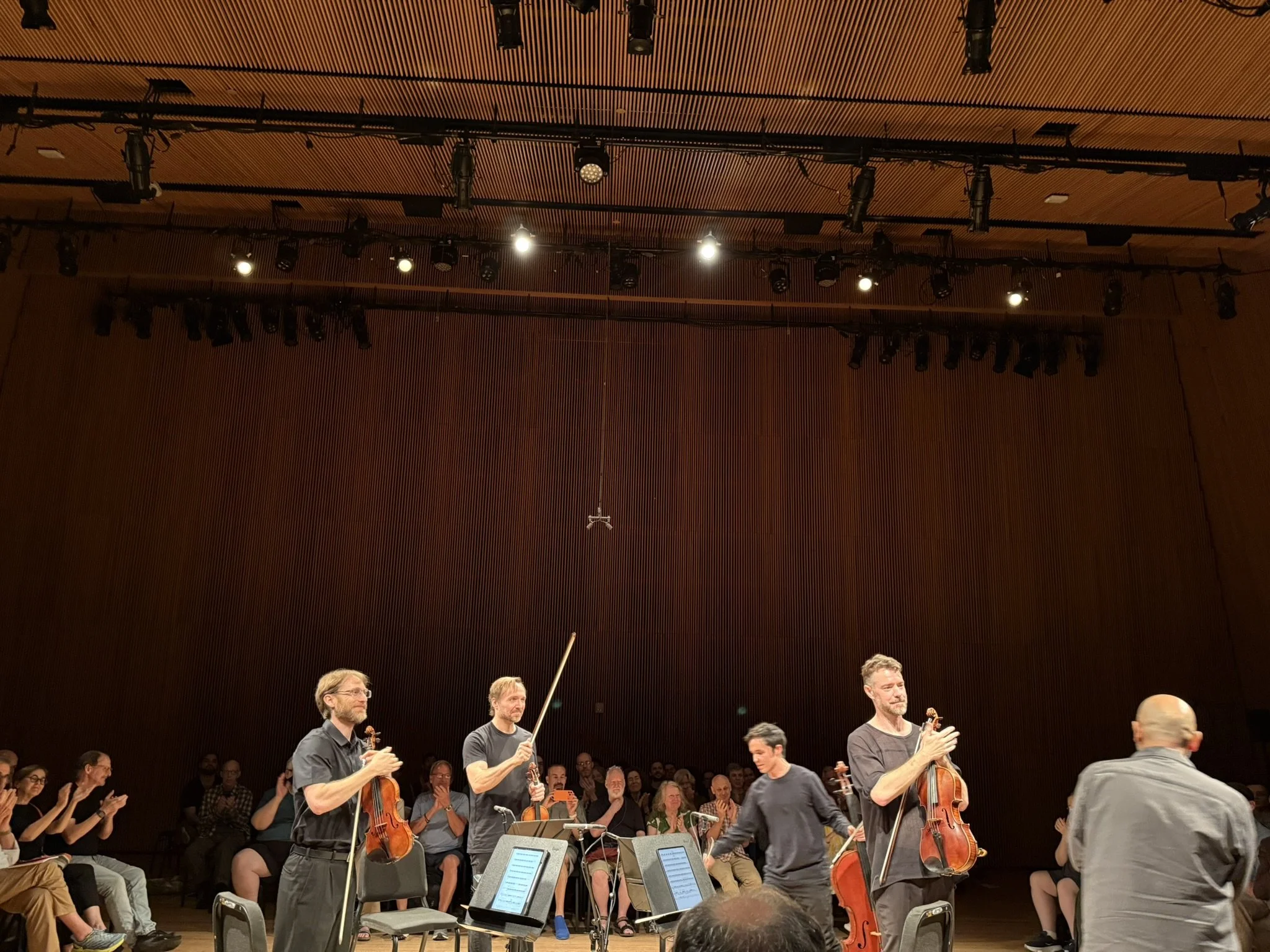
A Sunday night in New York in August.
Cenk Ergün
Celare, 2014–15
Georg Friedrich Haas
String Quartet No. 8, 2014
Cenk Ergün
Sonare, 2014–15
JACK Quartet
Christopher Otto, violin
Austin Wulliman, violin
John Pickford Richard, viola
Jay Campbell, cello
Cenk Ergün, a Turkish-American composer, wrote Celare (2014–15) and Sonare (2014–15) in the same period. Between these two works, I heard a piece Haas also wrote in 2014. Ergün is interested in static sonic spaces, islands of sound made up of short sonic events surrounded by silence, with repetition and sustained tones. These two works pursue that interest through opposite approaches. Sonare creates a sonic world through the repetition of fast, loud, dissonant patterns, at times evoking a swarm of wasps. Celare, by contrast, is a calm and sparse environment in which simple, transparent harmonies resonate, with early European music and Turkish modal music faintly intersecting.
For Sonare, JACK Quartet performed and recorded several scores consisting of repeating patterns. Ergün then used audio software to cut those recordings into tiny fragments and create countless patterns. He says the piece results from repeating that process over and over again.
Sonare places noise on top of a rhythmic grid, forming a continuous sequence of quasi-mechanical patterns.
Haas wrote his Eighth String Quartet in 2014. It feels like it swells upward, but it is impossible to grasp. Once it reaches a peak, the sound does not resolve; instead, it slides sideways. Haas’s distinctive pitch shifts create a series of betrayals and mischievous gestures, with an almost weightless quality that plays with the faint traces of familiarity left behind in those who have listened to the music of the nineteenth and twentieth centuries.
It is as if, on a hot summer day, an eel you are trying to catch is crying out, “Don’t catch me.” The moment you think you have caught it, the eel twists its body and slips out of your hands.
The eel that has slipped away plunges into the surface of the river with a splash. The sound is like watching the spray rise in slow motion, or like an afterimage, remembering a conversation with the eel somewhere beyond the view.
The initial weightless shifts become more intense, then slide sideways, and sometimes suddenly begin to glow. After that comes an interweaving of sounds, slowly rising like thin trails of smoke. I wonder what it would feel like to practice yoga while listening to this.
Music that deliberately refuses to go where it seems to be heading.
Beautiful Mischief
I encountered Ergün’s sound fragments in an acoustic space where they seemed to bounce back and forth; then I immersed myself in Haas’s weightless sensation, and finally returned to Ergün’s Sonare, where the fragments seemed to fuse together with increasing intensity.
8.9.2026
8月のニューヨークの日曜の夜。タイムスパンズ2回目。
Cenk Ergün
Celare, 2014-15
Georg Friedrich Haas
String Quartet No. 8, 2014
Cenk Ergün
Sonare, 2014-15
JACK Quartet
Christopher Otto, violin
Austin Wulliman, violin
John Pickford Richard, viola
Jay Campbell, cello
Cenk Ergün(ジェンク・エルギュン) Celare(2014–15)/Sonare(2014–15) トルコ系アメリカ人作曲家エルギュンが同じ年に作った2曲の間に、ハースが同じ年に作った曲を聴いた。エルギュンは反復や持続音が沈黙に囲まれた短い音の出来事からなる静止したような音響空間、音の島に興味がるという。 この2曲は、その関心を正反対のアプローチで追求している。Sonare は、速く、大きく、不協和なパターンの反復によって、ときにスズメバチの群れを思わせる音の世界を作り出し、Celareは穏やかで希薄な環境であり、初期ヨーロッパ音楽とトルコの旋法音楽がぼんやりと交差する単純で透明なハーモニーが響く。
Sonareは、JACK Quartetといくつかの反復パターンの楽譜を演奏、録音し、エルギュンはオーディオ・ソフトウェアを使って、その録音を小さな断片に切り分け、無数のパターンを作り出した。この曲は、その工程を何度も繰り返した結果だという。
Sonareは、ノイズをリズムの格子の上に置き、準機械的なパターンの連続を形成している。
ハースが2014年に書いた弦楽四重奏8番。うねりあがっていくつかみどころがない感覚。一度頂点を迎えると、解決しないまま、音は横に滑り出す。ハース独特のキーのずれが、19-20世紀の音楽を聴いてきた人たちは、ほんのり残っている感覚に、力がはいらない音の裏切りといたずらの連続。
まるで、暑い夏に掴もうとしたウナギが捕まえないでくれと鳴いているようだ。捕まえたと思った瞬間、ウナギは身体をくねらせて、手の中から逃げていく。
滑り落ちたうなぎは、川の水面にじゃぼんと飛び込んで、上がった水しぶきをスローモーションで眺めているような、眺めの向こうにうなぎとの会話を思い出している残像のような響。
初めの力が入らないズレが激しくなったり横に滑ったり、そのまま輝きだしたり、あとはゆっくりと煙の筋が昇っていくような音の交わり。これを聴きながらヨガをするとどんな気持ちになるんだろう。
向かおうとしている先にわざといかない音楽。
Beautiful Mischief
エルギュンの音の断片が反射し続けるような音響に触れ、ハースの力が入らない感覚に浸り、再びエルギュンのSonareで、音の断片が激しく融合していく感覚に触れた。