Metamorphosen—while dealing with collapse and loss, it is a black amusement park where sound constantly transforms its shape.
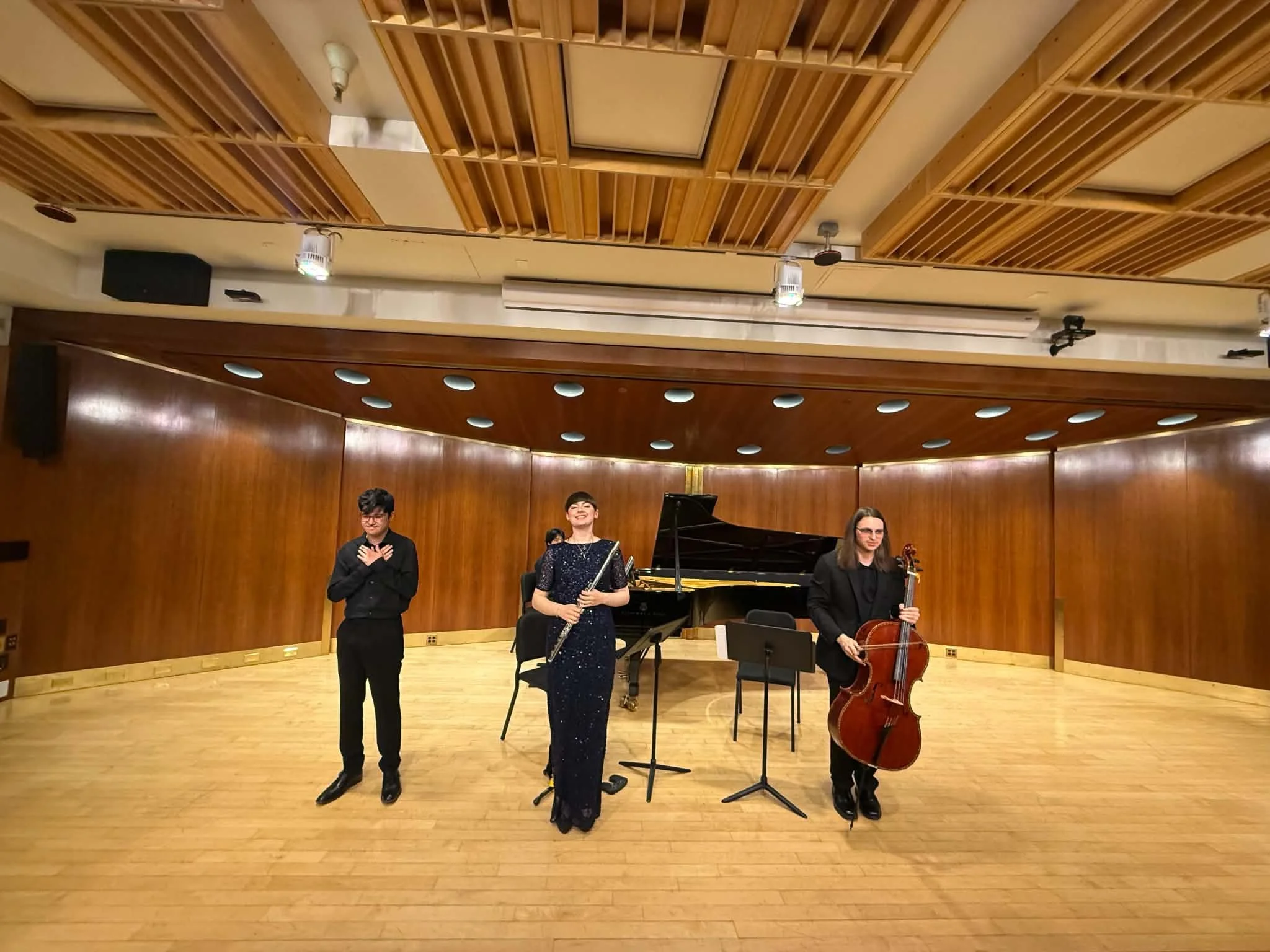
At Morse Hall at Juilliard, Nikka’s arrangement of Shostakovich’s piano trio for flute trio became a pleasure of transformation. Elliot’s cello opens the theme with harmonics, followed by Nikka’s flute and Cosmo’s piano. Their sense of sound, presence, and timing is truly distinctive. Morse feels like they are inside a small speaker. Even when Cosmo plays with the piano lid fully open, the sound never becomes muddy. The other two remain clearly visible in the sonic space.
Nikka’s tapping, Elliot’s articulated bowing, and Cosmo’s rhythmic figuration intertwine closely within the piece, yet without sentimentality. Performances by artists such as Argerich or Maisky evoke fear and anger. In contrast, these three individual voices move in the same direction, allowing the pure interplay of sounds that Shostakovich wrote to be experienced as such.
To cover the range, Nikka switches to piccolo in certain passages and at times modifies the flute to extend its lower register. In Allegro con brio, Shostakovich’s manic drive emerges through Cosmo’s looping patterns, Nikka’s breath-like articulation, and Elliot’s slightly strained bowing. Their world of Shostakovich feels like being inside a vast amusement ride.
At the opening of the Largo, Cosmo holds a chord, within which Nikka’s flute gently floats. A wide, irregular vibrato—another signature of Nikka’s approach—expands through the texture. Elliot’s cello seems to share Nikka’s singular sonic world, as if a screw had come loose, revealing a reality only he can perceive. Even in an ensemble, there is neither domination nor resistance—only co-existence.
Cosmo supports this intertwining of two voices with pure sound. From the Allegretto, the dance begins: a dance of death. Yet in the hands of these three musicians, it becomes a sonic amusement park that adults and children alike can enjoy.
They seem to delight in the angles of sound, overtones, harmonies, and the musical magic that emerges from Shostakovich’s language. Musical gestures suddenly fracture into chaotic motion, return to folk-like dances, or exchange roles between instruments. Despite this constant fluctuation, they remain grounded, drawing each other into a continuously engaging ensemble.
Even a work filled with darkness becomes, in their hands, a joyful sound amusement park. They explore how sound transforms, collides, and becomes distorted—playing fully within Shostakovich’s grotesque sense of motion.
In the end, one can only smile at their skill and their sense of play.
Dmitri Shostakovich: Piano Trio No. 2 in E Minor, Op. 67
Arranged for Flute, Cello, and Piano by Nikka Gershman
5.3.2026 Morse Hall
Nikka Gershman, Flute
Elliot Lippy, Cello
Cosmo Coen, Piano
I. Andante – Moderato
II. Allegro con brio
III. Largo
IV. Allegretto – Adagio
Metamorphosen 崩壊や喪失を扱いながら、音が絶えず姿を変えるブラックな音の遊園地。
ジュリアードのモーズホールでニッカがフルートのトリオに書き換えたショスタコのトリオは変容の快楽だった。エリオットのチェロはフラジオレットでテーマをはじめ、ニッカのフルートとコスモのピアノが加わる。彼らの音の気配や間の感じ方は本当に独特だ。モーズは小さなスピーカーの中に彼らがいるような感じ。ピアノの蓋を全開でコスモが鳴らしても全く濁らない。他の2人もよく見える。ニッカのタッピングとエリオットの刻み、テーマを弾いていたコスモの刻み、3人がこの曲の中でよく絡み合い、その感傷を感じない。アルゲリッチやマイスキーの演奏は恐怖や憎しみを感じる。でも、この3つの個性は、純粋なショスタコービチが描いた音の交わりを楽しんでいる。ニッカは音域をカバーするために、場所によってピッコロを使ったり、フルートに管を足して低い音を出したりしていた。Allegro con brioではショスタコの暴走が、コスモのループやニッカの息使い、エリオットの上ずったボウイング。彼らのショスタコの世界は、まるで一つの巨大なアトラクションの中にいるように感じる。ラルゴの冒頭でコスモが掴むコード、そして、その中にそっとニッカのフルートが浮かぶ。幅の広いビブラートが不規則にかかっていて、これもニッカの独特の描き方だと感じる。エリオットのチェロは、ニッカの独特の世界を共有している。ねじが外れているというか、彼にしか見えない、聴こえない世界が広がっている。誰かと共演してもそれは生かすも殺すもなくて、ただそこに一緒に存在している。この2人交錯を純粋な音の響きでコスモは支える。アレグレットからダンスが始まる。これは死のダンス。でもこの3人が繰り広げると、大人から子供まで楽しめる音の遊園地になってしまう。この人たちは音の角度や倍音、和声とそこから引き出されるショスタコの音楽のマジックを楽しんでいる。音の動き、怪しい動きが突然、壊れた暴走を始めたり、民謡ダンスに戻ったり、楽器が入れ替わってそれが繰り広げられていくが、ようは目まぐるしく変わっても彼らはぶれないし、相手と惹き合いながら楽しいアンサンブルを繰り広げていく。こんなダークが詰まった曲すら楽しい音の遊園地にしてしまう。音が変形し、接触し、どう狂っていくか、その現象をショスタコーヴィチの持つグロテスクな運動性を使って彼らは遊び倒しているのだ。だから、彼らのうまさ、面白さににっこりするしかない。終わった後、外でコーヒーを買っていたら、聴きに来ていたお客さんが、まったく面白くなかったといっていた。ショスタコを知っている人には特殊な世界だ。