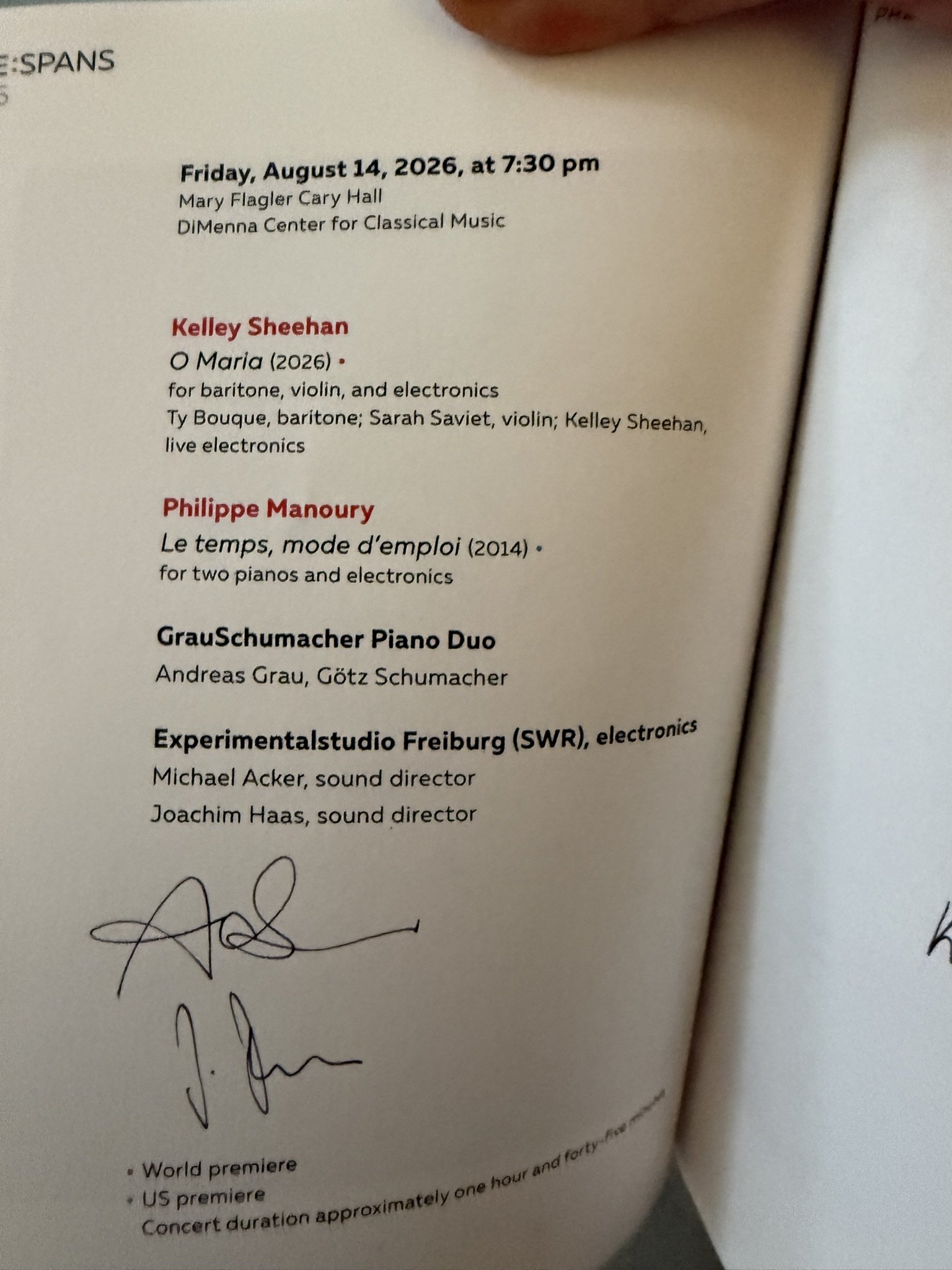
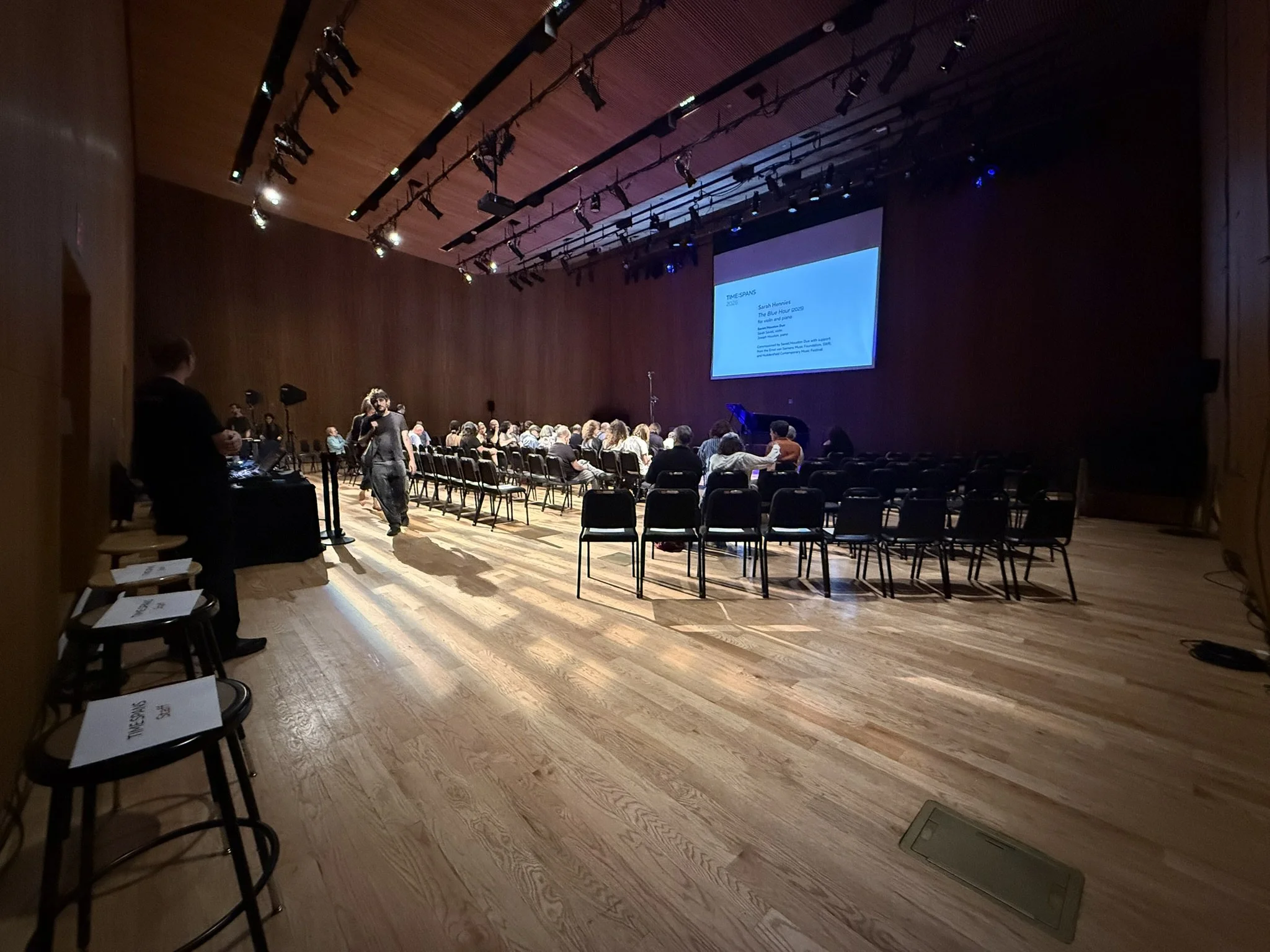
Sarah Hennies's 90-minute sonicscape, written in 2025 for Sarah Saviet (violin) and Joseph Houston (piano), at the Dimenna Center’s Cary Hall. The work received its world premiere at the Donaueschinger Musiktage in October 2025 and its U.S. premiere at TIME:SPANS 2026.
Sarah Hennies
The Blue Hour, 2025*
*U.S. premiere
Commissioned by Saviet/Houston Duo with support from the Ernst von Siemens Music Foundation, SWR, and Huddersfield Contemporary Music Festival.
Saviet/Houston Duo
Sarah Saviet, violin
Joseph Houston, piano
“I simply followed my intuition, putting down the sounds that I felt they needed,” Sarah said after the performance.
As she wrote the piece using scales and melodies, elements that had rarely appeared in her music before, she realized that what she was writing was connected in some way to the dreams she repeatedly has.
Being chased.
Being pursued for a crime she did not commit.
Being unable to reach a destination no matter how hard she tries.
The feeling of repeating, yet never arriving.
Repetition is one of the defining characteristics of Sarah’s music. The Blue Hour was, she said, a major challenge for her because she had never really written melodies before.
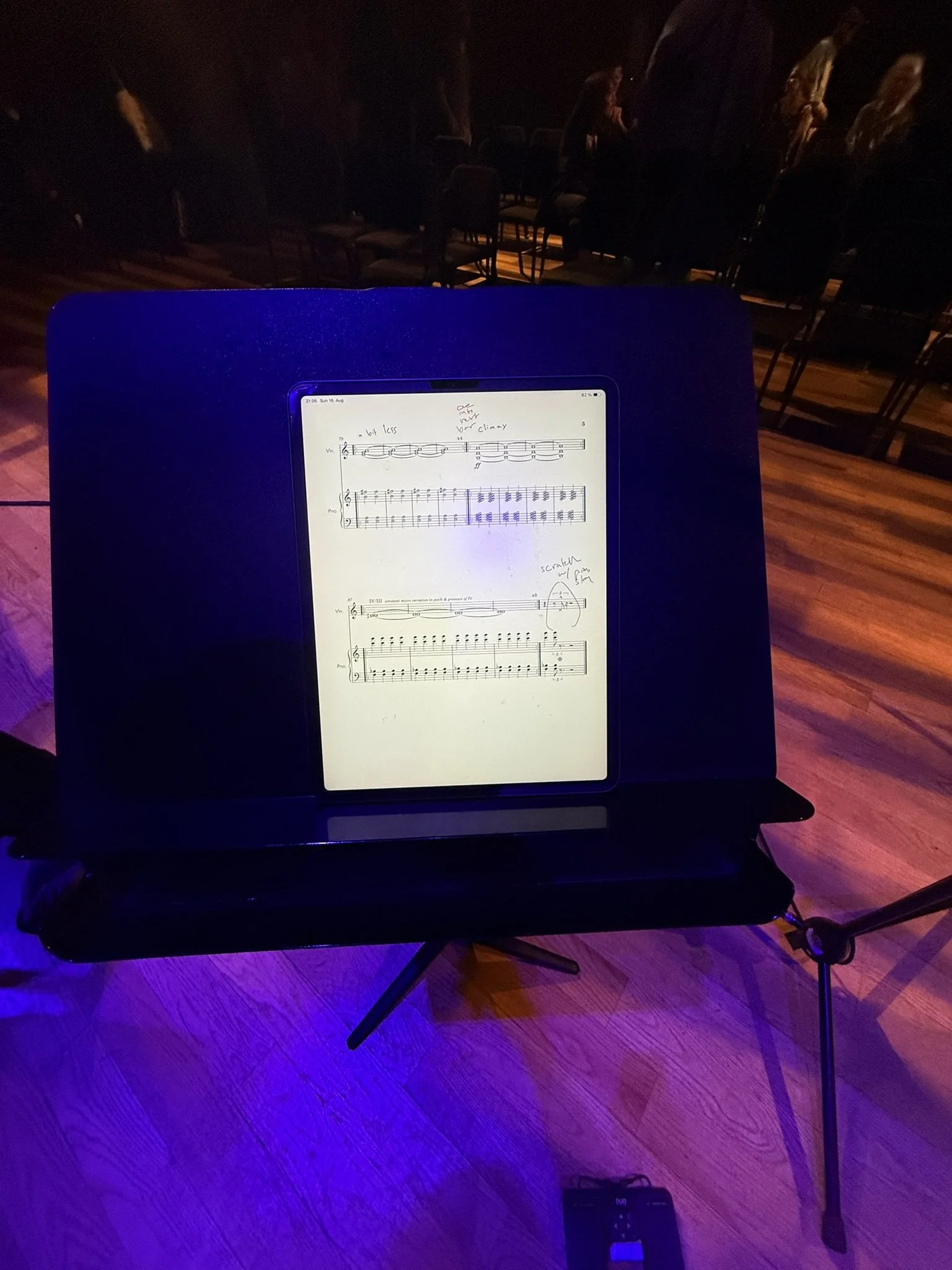
Sarah Saviet’s broken scale repeatedly rises again and again. The scale sounded emotionless. Against it, Joseph Houston’s monotonous piano sounds repeat. Slightly out of sync with the violin’s movement, they create distinctive overtones. I had no idea how long it would continue, but if you keep listening intently, something suddenly changes. Saviet’s violin begins to sound less like an instrument being played and more like the instrument's body itself has begun to make a sound. The same happens with the piano. At times, it was the body of the piano itself, especially its metallic resonance, that seemed to float beautifully through the space.
Before I knew it, everything became silent, and the silence continued for a while. Then that same broken scale returned. It was like one of the canons from Bach’s Goldberg Variations. Or perhaps it could be thought of as an episode in an opera, moving from recitative into a solo aria. This happened several times.
Sarah wanted to take the dream out, turn it into music, and in doing so experience it from outside herself. The outside of Sarah’s dreams was a sonicscape. At one point, several clusters of piano sounds continued at regular intervals, while within that membrane of sound, the horsehair of the bow rubbing against the violin strings produced various overtones, drawing a distinctive line through the space. You really have to hear it to understand it, but anyone who loves the world of sound and is interested in contemporary abstract painting should experience this. I could not tell where the place was, but Saviet’s violin gave me the sensation of standing in a vast landscape, gazing at a distant trail of smoke rising into the sky. It was a solitary world, like a Prokofiev sonata.
At another point, Houston directly touched the body of the piano. What emerged was an incredibly tribal sense of movement, unfolding through tiny, minute gestures of sound and turning Cary Hall into an entire universe. Within it, fragments of Saviet’s sound appeared and disappeared—something I cannot put into words, something I had never experienced before.
At times, Saviet’s scales became tangled, turning into something like an incomprehensible mass of wire. But as she and Houston began to interact, that tangled mass became sonic, transforming once again into a vast energy of sound and unfolding an entire universe with the piano.
Because of the strange combinations of sounds, I had no sense of time. Yet at one point the sound suddenly swelled into an enormous pressure, and my eyes, which had been vaguely closed, snapped open. I found myself staring at the intense focus of the two performers as they produced that pressure. For ninety minutes, they remained in an almost frightening state of concentration, connecting with Sarah’s inspiration, unfolding the world outside her dreams, and overwhelming the audience by taking hold of our senses. Their way of drawing different timbres out of the piano and violin was unique. This sonicscape surpassed everything I had experienced at TIME:SPANS—the way Rihm layered his themes, Mark Andre’s way of drawing out overtones, Haas’s way of removing the expected keys, Kurtág’s treatment of silence and space, and Manoury’s shifting of time.
What Sarah was doing with the resonance of Mark Andre, where the boundary between instruments and electronics seemed to disappear, she was achieving here through the violin and piano—the combination of instruments that dominated the nineteenth century. In one episode, I experienced a sonicscape in which the two instruments seemed to exchange their respective timbres.
Then another enormous pressure arrived, and it suddenly ended.
The astonishing ninety minutes were over. Yet it did not feel as though it had ended, nor did it feel as though ninety minutes had passed.
Every day, people with all kinds of interests gather here—people interested in jazz, other forms of art, sound itself, audio, and, of course, contemporary art. Watching the people around me, I realized that this feeling of drawing all of them into the experience—that ability to involve everyone—may be precisely what it means to be contemporary.
Sarah Hennies is a composer and percussionist born in Louisville, Kentucky, in 1979. She began playing drums at an early age and, after performing punk and experimental music, studied percussion and composition at university. She is currently based in upstate New York, where she works across composition, performance, improvisation, video, and performance art, and teaches at Bard College. Repetition, time, sonic perception, and physicality are central themes in her work. Her major works include Contralto and, most recently, The Blue Hour.
The composer’s own words:
Sarah Hennies
The Blue Hour (2025)
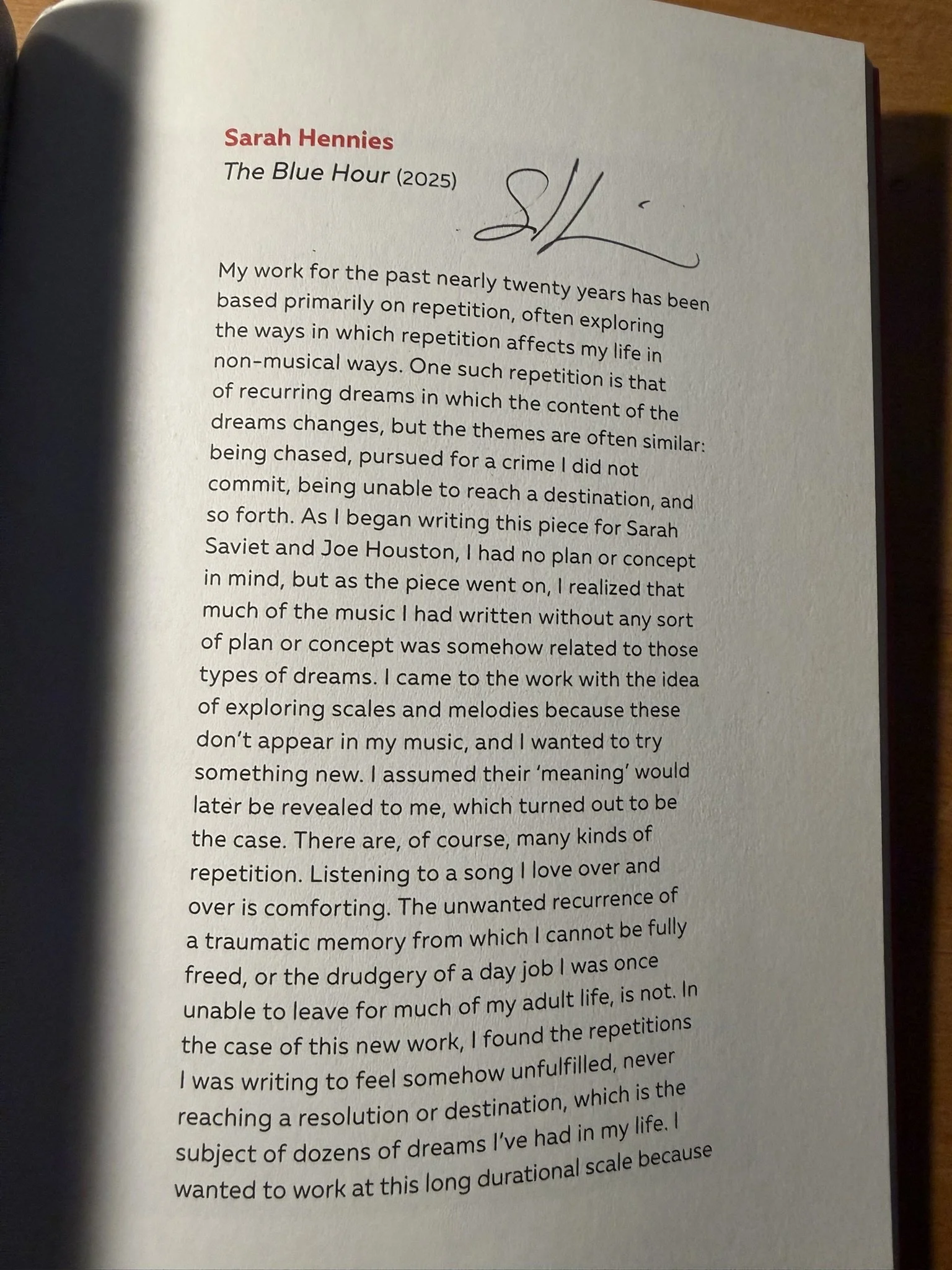
My work for the past nearly twenty years has focused primarily on repetition, often exploring how repetition affects my life in non-musical ways. One such repetition is recurring dreams in which the content changes, but the themes are often similar: being chased, pursued for a crime I did not commit, being unable to reach a destination, and so forth. As I began writing this piece for Sarah Saviet and Joe Houston, I had no plan or concept in mind, but as the piece went on, I realized that much of the music I had written without any sort of plan or concept was somehow related to those types of dreams. I came to the work wanting to explore scales and melodies because they don’t appear in my music, and I wanted to try something new. I assumed their ‘meaning’ would later reveal itself, which turned out to be the case. There are, of course, many kinds of repetition. Listening to a song I love over and over is comforting. The unwanted recurrence of a traumatic memory from which I cannot be fully freed, or the drudgery of a day job I was once unable to leave for much of my adult life, is not. In the case of this new work, I found the repetitions I was writing to feel somehow unfulfilled, never reaching a resolution or destination, which is the subject of dozens of dreams I’ve had in my life. I wanted to work at this long durational scale because I’ve found from my earlier piece, Reinvention of Romance (2018), that something happens to my consciousness onstage when I go beyond seventy minutes or so of focused playing. It somehow becomes more casual and ‘normal’ for me, but also reaches a new kind of focus that can only be achieved over such long durations. It is here I also think of my recurring dreams, which are so frequent and span such a long period of time. Although these dreams are often tense and occasionally upsetting, their occurrence is now commonplace and expected for me—always taking place early in the morning, just before I wake up—and often extremely vivid and, sometimes, lucid so that I am consciously aware that I am dreaming while experiencing the dream. David Lynch once said that what happens in your dreams is no less real than anything else in your waking life; it is all consciousness, but one’s reality is simply experienced differently in dreams than when awake. It’s not my goal necessarily to analyze my dreams as a psychologist might, but to take the material qualities of my dreams and place them into this new context as music, to experience them in a different way and outside of myself.
8.16.2026
Sarah Henniesが2025年にSarah Saviet(ヴァイオリン)とJoseph Houston(ピアノ)のために書いた、90分のソニックスケープをディメンナのカーリーホールで体験した。2025年10月にドナウエッシンゲン音楽祭で初演され、TIME:SPANS 2026でアメリカ初演となった。
Sarah Hennies
The Blue Hour, 2025*
* US premiere
Commissioned by Saviet/Houston Duo with support from the Ernst von Siemens Music Foundation, SWR, and Huddersfield Contemporary Music Festival.
Saviet/Houston Duo
Sarah Saviet, violin
Joseph Houston, piano
「私はただ、直感を、彼らにはこれが必要なんだと思う音を置いていった。」終演後、サラはそういった。
そうしてそれまでほとんど使ってこなかった音階とメロディーを使って書いているうちに、自分の繰り返し見る夢と結びついていることに気づいたそうだ。
追いかけられる
やっていない犯罪のために追われる
目的地にどうしてもたどり着けない
繰り返しているのにたどり着けない感覚
サラの作曲の特徴は反復。The Blue Hourではメロディを書いてこなかった彼女の大きな挑戦となったという。
Sarah Savietのバイオリンの壊れたスケールが繰り返し何度も上昇する。そのスケールは無感情に聴こえた。そこにJoseph Houstonの単調なピアノの響きが繰り返される。バイオリンの動きと微妙にずれながら、それらが独特の倍音を生む。それがどのくらい続くのかわからないが、じっと聴き続けると、ある時何かが変わってサビットのバイオリンは弾くというよりは、その楽器の箱そのものが音を立て始める。ピアノも同じように、ある時はピアノのボディ、特に金属の響きそのものが美しく空間に漂っていた。
気が付くと無音となり、その間がしばらく続く。するとまた、あの同じ調子の壊れたスケールがやってくる。バッハのゴルトベルクのキャノンのようだ。または、オペラのレティタティーボからソロのアリアへ続く一つのエピソードといえる。これが数回続いた。
夢を取り出して音楽にし、つまり自分の外側から体験したい。サラの夢の外側は、ソニックスケープだった。ある時はいくつかのピアノの音色の塊が一定の間隔で続き、その音の膜に、弓の毛がバイオリンの絃に擦れて様々な倍音を響かせて独特の音のラインを描いていた。これは聴かないとわからなが、音の世界が好きな人で現代抽象画に興味がある人はぜひ体験してもらいたい。場所はわからないが、サビットのバイオリンは広大な場所で遠くに上る煙の筋を眺めているような感覚になった。プロコフィエフのソナタのような、孤独な世界だった。
ある時は、ハウストンがピアノのボディの現に直接触れて、これは物凄くトライバルな躍動をごく小さな音の細かな動きでディメンナを一つの宇宙にして繰り広げ、そこに、これも言葉にはできないが、いままで味わったことがないサビットの音の断片が現れては消えていった。
ある時は、サビットのスケールはこんがらがってよくわからない針金の塊のようになってしまう。しかし、ハウストンと掛け合っていくうちに、その塊そのものがソニックとなり、これもまた広大な音のエネルギーとなり、ピアノと一つの宇宙を繰り広げる。
不思議な音の組み合わせで時間の感覚はないが、一度、とんでもない音圧に膨れ上がって、ぼんやり閉じていた目が、ぱっと開きその圧力を奏でる2人のフォーカスを凝視した。彼らは90分、鬼のような集中でサラのインスピレーションと繋がり、夢の外側を繰り広げ、聴衆の感覚を奪い圧倒した。そのピアノとバイオリンから音色を引き出す方法は独特で、そのソニックスケープは、私がこのタイムスパンズで体験したリームのテーマの重ね方、マークアンドレの倍音の引き出し方、ハースのキーの外し方、クルタークの間の見せ方、マヌーリの時間のずらしかた。すべてを凌駕している。
楽器とエレクトロニクスの境目が解らなくなったマークアンドレの響きを、彼らはバイオリンとピアノという、19世紀を席巻した楽器の組み合わせでサラはやっていた。あるepisodeではそれぞれの楽器の音色を交換しているスケープを味わった。
また物凄い圧力がやってきてそれは突然終わり。圧巻の90分が終わった。まるで終わった気がしなかったし、90分経っている気がしなかった。連日、ジャズやほかのアートやサウンドその物、オーディオ、もちろん現代アートそのもの、いろんな関心をもった人が集まる。その人たちを全て巻き込んでしまう感覚こそがコンテンポラリーだと、周りの人たちを見てて気が付いた。
Sarah Hennies(サラ・ヘニーズ)は、1979年アメリカ・ケンタッキー州ルイビル生まれの作曲家・打楽器奏者。幼い頃からドラムを始め、パンクや実験音楽の演奏を経験した後、大学で打楽器と作曲を学んだ。現在はニューヨーク州北部を拠点に、作曲、演奏、即興、映像やパフォーマンスなど幅広く活動し、Bard Collegeで教えている。反復、時間、音の知覚、身体性を主要なテーマとし、代表作に《Contralto》や今回の《The Blue Hour》がある。
以下、作家の言葉
サラ・ヘニーズ《The Blue Hour》(2025)
私がこの20年近く取り組んできた作品は、主として「反復」を基盤としている。そして私は、反復が音楽以外の場面で、自分の人生にどのような影響を与えているのかを探究してきた。
その一つが、繰り返し見る夢である。夢の具体的な内容は毎回変わるものの、そのテーマは驚くほど似通っている。誰かに追いかけられること、自分が犯していない罪によって追われること、目的地にたどり着けないことなどである。
サラ・サヴィエットとジョー・ヒューストンのためにこの作品を書き始めたとき、私は特別な計画やコンセプトを持っていたわけではなかった。しかし、作曲を進めるうちに、無意識のうちに書いていた音楽の多くが、こうした夢と何らかの形で結びついていることに気づいた。
私はこの作品で、音階や旋律を探究してみようと考えていた。これらはこれまでの私の音楽にはほとんど現れなかった要素であり、新しい試みをしてみたかったからだ。そして、それらの「意味」は後になって自然に明らかになるだろうと考えていたが、実際にその通りになった。
もちろん、反復にはさまざまな形がある。好きな曲を何度も繰り返し聴くことは心地よい。しかし、トラウマ的な記憶が望まない形で繰り返しよみがえったり、成人後の人生の大半を抜け出せなかった単調な仕事を繰り返したりすることは、決してそうではない。
この新作の場合、私が書いていた反復には、どこか満たされない感覚があった。決して解決に至らず、目的地にも到達しない。その感覚は、私が人生の中で何度も見てきた夢の主題そのものだった。
私はこの作品を、長大な時間軸の中で展開したかった。2018年の作品《Reinvention of Romance》を書いた経験から、70分を超えるような長時間にわたって集中して演奏していると、自分の意識の状態に変化が起こることを知っていたからだ。
ある時点を超えると、演奏は私にとってより自然で日常的なものになる。しかし同時に、その長い時間の中でしか到達できない、新しい種類の集中が生まれるのである。
ここで私は、自分が繰り返し見る夢のことも思い出す。こうした夢は非常に頻繁に現れ、しかも長い年月にわたって続いている。
これらの夢はしばしば緊張感に満ち、ときには不快なものでもある。しかし今では、その出現は私にとってごく当たり前で、予想できるものになっている。夢はいつも早朝、目覚める直前に現れ、その内容は非常に鮮明だ。時には明晰夢となり、自分が夢を見ていることを自覚しながら、その夢を体験することさえある。
デヴィッド・リンチはかつて、「夢の中で起こることは、目覚めているときに起こることと比べて、決して現実性が劣るわけではない」と語った。それらはすべて意識の働きであり、ただ夢と覚醒では、現実の経験のされ方が異なるだけなのだ。
私の目的は、心理学者のように夢を分析することではない。むしろ、夢が持つ素材としての性質を取り出し、それを音楽という新しい文脈の中に置き直すことである。そして、その夢を別の形で、つまり自分自身の外側から体験したいのである。