
TIME:SPANS 2026 #8 — International Contemporary Ensemble
The eighth TIME:SPANS concert featured the International Contemporary Ensemble performing works by four composers from very different backgrounds, presenting what was meant to be a portrait of contemporary music's diversity today.
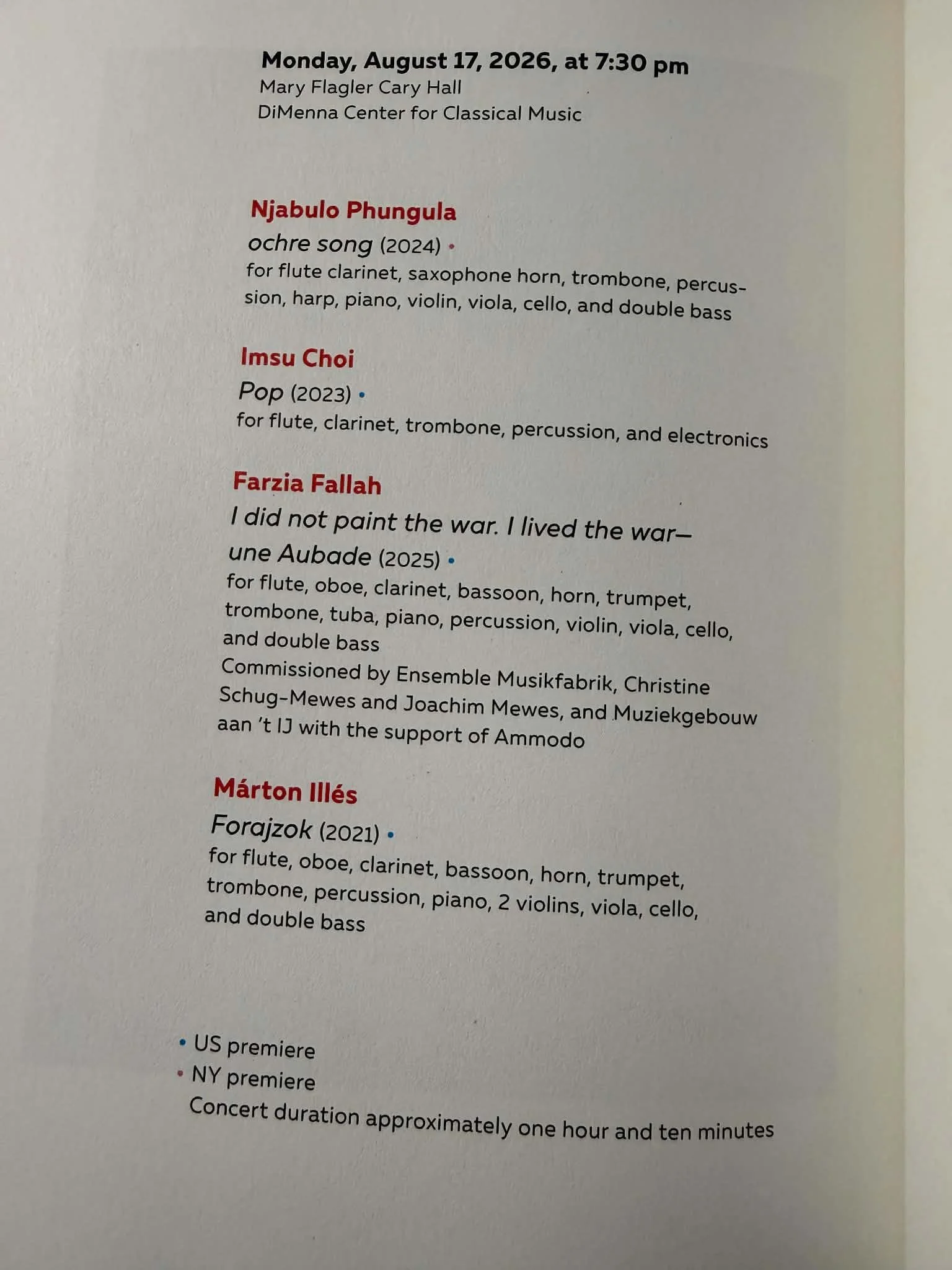
Imsu Choi
Pop, 2023*
for flute, clarinet, trombone, percussion, and electronics
* US Premiere
Njabulo Phungula
ochre song, 2024*
for flute clarinet, saxophone horn, trombone, percussion, harp, piano, violin, viola, cello, double bass
* NY Premiere
Farzia Fallah
I did not paint the war. I lived the war. - une Aubade, 2025*
for flute, oboe, clarinet, bassoon, horn, trumpet, trombone, tuba, piano, percussion, violin, viola, cello, and double bass
* US Premiere
Commissioned by Ensemble Musikfabrik, Christine Schug-Mewes and Joachim Mewes, and Muziekgebouw aan ’t IJ with the support of Ammodo.
Márton Illés
Forajzok , 2021*
for flute, oboe, clarinet, bassoon, horn, trumpet, trombone, percussion, piano, 2 violins, viola, cello, and double bass
* US Premiere
International Contemporary Ensemble
Rebekah Heller, conductor
Isabel Lepanto Gleicher, flute
Jasmine Daquin, oboe
Emmalie Tello, clarinet
Alexander Davis, bassoon
Erin Rogers, saxophones
Nicolee Kuester, horn
Gareth Flowers, trumpet
Michael Lormand, trombone
Marcus Rojas, tuba
Modney, violin
Leah Asher, violin
Wendy Richman, viola
Irène Han, cello
Nuiko Wadden, harp
Ross Karre and Clara Warnaar, percussion
Erika Dohi, piano
Countless unusual sounds and extended techniques emerged: forceful blowing, noise, split tones, extreme registers. Yet I felt no sense of sonic necessity—no sense of why these particular sounds had to be there. Concepts and techniques were present, and it often felt as though the performers were putting together a puzzle: understanding a work's concept and then producing the corresponding sounds. What came through in those sounds was their technical ability, and little else. I did not hear the sound that belonged specifically to that work. The sounds did not feel as though they were coming from the body or from the senses. I did not sense that the performers were experiencing the work's world through their own bodies.
In all four works, structure and technique seemed to come to the foreground, and even the way sounds and timbres were constructed felt similar. I could clearly hear the difference between implementing a concept and truly taking responsibility for those sounds with one's own body.
Choi's Pop was created by capturing bodily movements with motion sensors and connecting them to triggers, modulation, and sound transformation. Short "popping sounds" gradually develop into textures that fill the space. But the starting point—the idea of having "found an interesting sound"—did not come across to me as music. I didn't feel like I was hearing music that could only have been created electronically. An interesting mechanism and interesting music are two different things. And honestly, I cannot say exactly why Pop did not click with me. The interest of a work only becomes visible when its particular individuality rises to the surface through performance.
Phungula's ochre song uses a large ensemble of flute, clarinet, saxophone, horn, trombone, percussion, harp, piano, and strings. A wide range of instrumental colors and unusual sonic phenomena appear, but they never seemed to form a singular, distinctive world. Normally, when the composer changes, the way sound is touched, the way time moves, and the way instruments are treated should change as well. Yet here too, what came to the foreground was "the sound of contemporary music," and I could not hear why this had to be Phungula's music.
Farzia Fallah's I did not paint the war. I lived the war. – une Aubade was inspired by Pablo Picasso's words and written against the backdrop of war and crisis, as an aubade—a morning song—for the act of living. Yet I did not feel a sense of urgency that had penetrated into the performers' bodies.
The final work, Illés's Forajzok, also felt to me like nothing but gestures. The scores of the four works are different. The composers are different. The ensembles differ in detail. And yet the timbres, gestures, and ways of creating tension that I heard in the performances were remarkably similar.
I could hear how the performers produced their sounds—their individual habits, gestures, and effort. But I did not feel that the conductor was drawing out the differences between the composers from the performers.
I did not hear the particular character of each composer in the respective performances. What I heard was contemporary sound. If the individuality of a work does not emerge through its performance, it is impossible to discover what is interesting about that work.
What I heard this time was less four different worlds by four composers than four works homogenized by a single performance style. And rather than feeling that I was listening to music, I felt as though I was being shown how contemporary music is constructed.
What remained in question for me after this concert was not only the performance by ICE, but also the judgment behind the programming itself: who chose these works, with what intention, and why were they paired with these particular performers?
Especially when presenting works in which timbre and the treatment of time are so important, I believe programming must consider not only who will perform them, but also who can draw out their differences.
Those responsible for programming need to consider whether the characteristics of the composers and the performers truly fit together. Otherwise, in the name of diversity, ICE risks becoming simply an extension of the Met or the New York Philharmonic.
Diversity as an ideology can erase individuality, reproducing the very institutional culture it was supposed to move beyond.
8.17.2026
タイムスパンズ8回目。International Contemporary Ensembleが違う背景の4人の作曲家の作品を演奏し、多様な現代音楽の現在を披露した。
珍しい音や特殊奏法の数々。息を強く吹く、ノイズを出す、音を割る、極端な音域を使う。しかし、なぜこの音でなければならないのかという音の必然性を全く感じなかった。そこにはコンセプトや技法があり、まるでパズルを組み合わせるように作品のコンセプトを理解し、それに対応する音をだす。その音から彼らのうまさ以外伝わってこない。その作品のその音がしない。身体や感覚から出ているようには感じられない。作品の世界を自分の身体で感じている気配を感じなかった。
4つの作品は、どの作品も構成や技法が前面に出て、音色や音の組み立て方まで似ていた。コンセプトを実装するのと、その音を自分の身体で本当に引き受ける違いがはっきり聴こえてしまった。
Choiの《Pop》は、身体の動きをモーションセンサーで捉え、それを音のトリガーや変調、変形へとつなげる制作プロセスから生まれた作品だという。短い「ポッピング・サウンド」が次第に空間を満たすテクスチャーへ変化していく。その「面白い音を見つけた」という出発点が、音楽として迫ってこなかった。電子音響でなければ生まれない音楽を聴いている、という感覚がなかった。面白い仕組みと、面白い音楽は別だと思う。そして、私がこの作品にぴんと来なかった理由は正直、判断できない。作品の面白さは、演奏の中にその作品固有の個性が立ち上がって初めて見えてくるからだ。
Phungulaの《ochre song》は、フルート、クラリネット、サクソフォン、ホルン、トロンボーン、打楽器、ハープ、ピアノ、弦楽器という大きな編成で、さまざまな楽器の音色や特殊な音響が現れるが、それらが一つの固有の世界として立ち上がってこない。本来なら、作曲家が違えば、音の触り方も、時間の進み方も、楽器の扱い方も変わるはずだ。それなのに、ここでも「現代音楽らしい音」が前面に出て、Phungulaの音楽でなければならない理由が聴こえてこなかった。
Farzia Fallah《I did not paint the war. I lived the war. – une Aubade》は、Pablo Picassoの言葉に着想を得、戦争や危機を背景に、生きることへの「aubade(朝の歌)」として書かれているが、それが演奏者の身体にまで入り込んでいるような切迫感を私には感じられなかった。
最後のIllésの《Forajzok》も、全部ジェスチャーにしか感じなかった。4作品の楽譜は違う。作曲家も違う。編成も細部では異なる。それでも、演奏から聞こえてくる音色、身振り、緊張の作り方が似ている。
演奏者がどのように音を出すのか、その癖や身振り、一生懸命さは伝わってくる。しかし、指揮者が演奏家から作曲家ごとの違いを引き出しているようには感じられなかった。
作家それぞれが持っている癖をそれぞれの演奏から感じなかった。演奏から聞こえてきたのは現代的な音だった。作品の個性が演奏の中に現れなければ、その作品が持っている面白さを知ることもできない。
今回、私が聴いたのは4人の作曲家の4つの世界というより、一つの演奏スタイルによって均質化された4つの作品だった。そして、音楽を聴いているというより、音楽がどのように作られているのかを見せられているようだった。
今回の公演で感じたのは、ICEの演奏そのものだけでなく、このプログラムを誰が、どのような意図で組み、どのような演奏家と組み合わせるのかという判断にも疑問が残ったということだ。
特に、これほど繊細で、音色や時間の扱いが重要な作品を並べるのであれば、誰が演奏するのか、誰がその違いを引き出すのかということまで含めて、プログラムを考える必要があるのではないかと思う。
プログラムを組んだ人は作家と演奏者の特性が本当に噛み合っているのかを考えないと、多様性の名のもとにこのICEがただのメットやニューヨーク・フィルの延長になっている。
多様性とは、違う作品を並べることではない。違うものが、違うものとして聴こえることだ。
今回、4人の作曲家を並べたはずなのに、私に聞こえてきたのは一つの演奏スタイルだった。
多様性という理念は、個性を消し去り、乗り越えようとしていたはずのものと同じ制度的文化を生み出してしまうことがある。