TIME:SPANS 2026 #9 — Pamela Z
August 18, 2026
A program that condensed nearly 40 years of Pamela Z’s work into a single performance, from works dating from 1986 to 2024.
Pamela Z performed a program of short solo voice works with real-time electronic processing, sampled sounds, and wireless gesture controllers.
Quatre Couches, 2015
Flare Stains, 2010
Typewriter, 199
Declaratives, 2005
Badagada, 1988
Syrinx, 2003
Flock, 2024
Bone Music, 199
Pool, 2015
Pop Titles ‘You’, 1986
Le Corps, 2019
Unknown Person (from Baggage Allowance), 2010
Other Rooms, 2018
Meredith Monk"s Scared Song, live version (1986), arr. Pamela Z
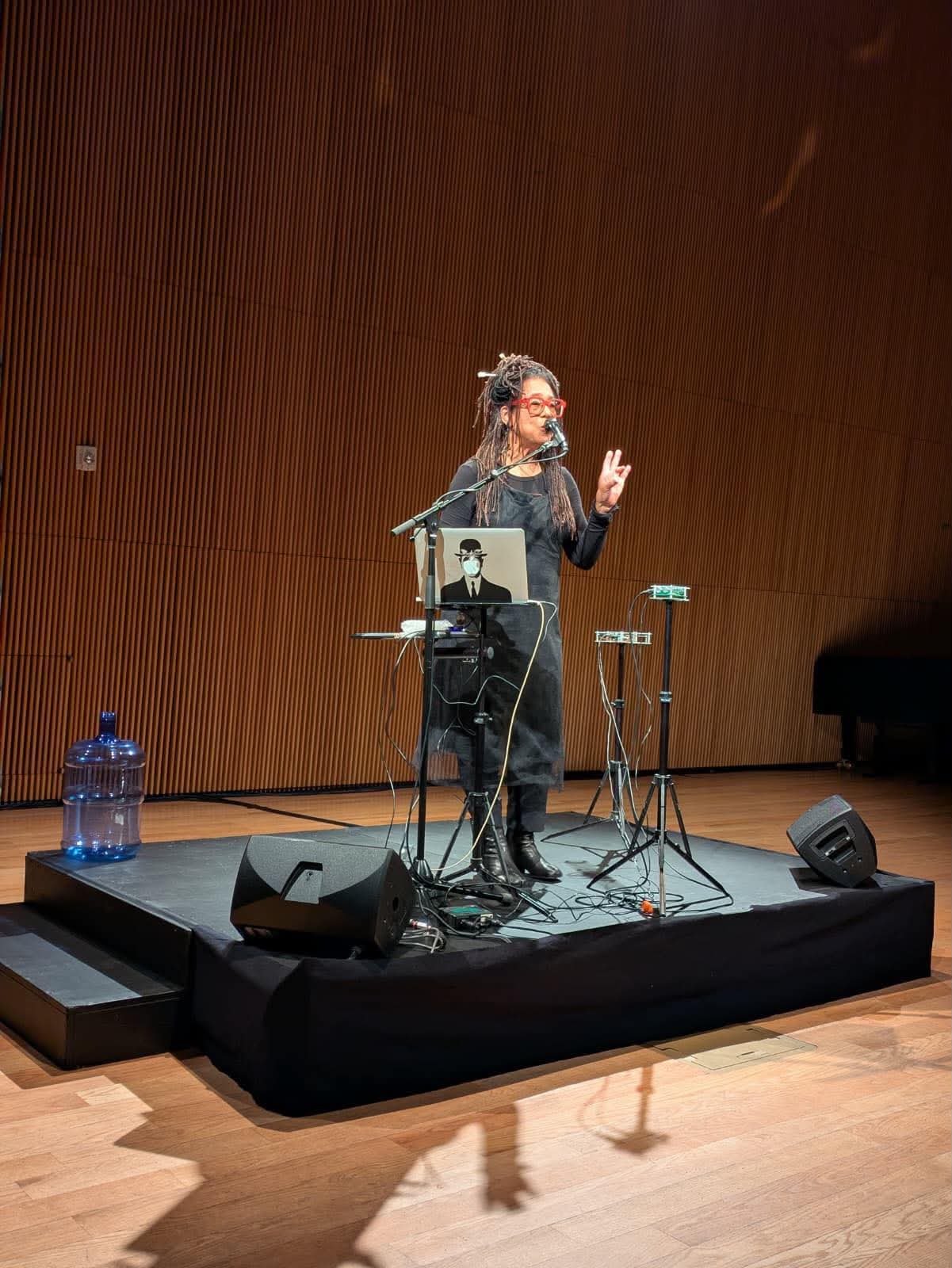
On the small stage were a laptop and two small circuit-board-like devices connected by cables. When Pamela began Quatre Couches (2015), she first held her hand next to one of the devices and produced a sound. These were gesture controllers: sensors detected the movements of her hands and fingers and sent that information to the computer in real time. Adding echo to her voice, changing its pitch, moving sounds through space, calling up recorded voices and sampled sounds—her body movements controlled the sound. Pamela conducted the acoustics of her own voice in real time.
Flare Stains (2010) began with the ringing of a tuning fork. She picked up the sound with a microphone, sampled it, and created echoes. One sound would appear and disappear, followed by another resonance, like a flame suddenly emitting an intense burst of light, leaving behind smoke drifting through the air.
Typewriter (1995). The synchronization between the performance of typing on a typewriter and the sound was remarkable. It seemed as if the movements of her hands themselves were becoming sound.
Declaratives (2005). Fragments of voice overlapped in layer after layer, creating a distinctive world.
Badagada (1988). The voice was wonderful. By layering and reflecting her own voice, she expanded a single voice into multiple layers. Although this was one of her early works from 1988, it did not sound particularly old. On the contrary, I found it fascinating how she electronically reflected the voice and allowed it to multiply within the space. Live electronics at the time must have been completely different, both in technology and environment, from what they are today. Listening while imagining that difference made the freshness of the work’s conception stand out even more. It is one of her early works using digital delay to create rhythm, harmony, and melody from delayed voices.
Syrinx (2003). At the beginning, Pamela imitated the sound of a bird, and when she pressed the keyboard she was holding, the sound of a bird’s singing came out. This was later mixed into the piece. The sound was then stretched until it became slow and low enough that a human voice could reproduce it accurately, and it was blended with the bird sounds. It sounded like a new language.
Flock (2024) filled the space with multiple voices moving around. Thinking back to how Pamela layered and reflected her own voice in Badagada in 1988, it sounded as if, 36 years later, that idea had expanded into something even freer.
Bone Music (1992). She struck a large water bottle. She echoed the sound while layering her voice over it. The percussion sound and the voice merged, and the simple act of striking an object gradually transformed into a complex acoustic space. From here, the world of sound seemed to become more prominent than gesture or singing.
Pool (2015). Repeating the word “pool” again and again gradually turned it into a distinctive echo.
Pop Titles ‘You’ (1986). She spoke, one after another, the titles of songs beginning with the word “You.” Her voice was layered through delay, and a single voice gradually became like a flock. Although the work dates from 1986, I did not feel that the idea of electronically multiplying the voice sounded old. Rather, the seeds of what would become Pamela Z’s later work were already there in this early piece.
Le Corps (2019) sampled the voice of a French choreographer.
Unknown Person (from Baggage Allowance) (2010). Unknown Person takes the seemingly mundane questions repeatedly asked when boarding an airplane, turns them into voice, and electronically layers and transforms them. I found it fascinating how everyday language gradually became music itself.
Other Rooms (2018). Fragments of someone’s speaking voice were electronically cut apart, layered, and made to appear and disappear as different voices. She treated the human voice like fragments of memory, manipulating it through the movements of her own body. The boundary between recording a voice and producing one in the moment blurred.
Listening to Pop Titles ‘You’ (1986), Badagada (1988), Other Rooms (2018), and finally Flock (2024), one can see how, over nearly 40 years, Pamela Z has continued to explore the question of how to multiply the voice and how to connect it with the body and electronic sound.
The last, Scared Song, composed by Meredith Monk for her 1987 album Do You Be. Pamela Z created her own studio arrangement of the piece in 2012 for the tribute CD Monk Mix. Tonight, we heard a version that further reconstructed that studio arrangement as a live performance with voice and electronics. Pamela Z layered samples of her own voice, transforming Monk’s original into an entirely different acoustic space made from her own voice. The 1987 work by Monk, Pamela Z’s 2012 arrangement, and the live performance of 2026 seemed to overlap within a single voice.
Rather than “playing a melody on an instrument,” Pamela Z makes music by sampling the voice, fragmenting it, looping it, applying delay, pitch shifting, and granular processing, and then manipulating it through bodily gestures. That is why, in Syrinx, she stretches the sound of a bird until it can be reproduced by the human voice; in Typewriter, she turns the sound of a typewriter itself into musical material; and in Le Corps, she treats the speaking voice of a choreographer as an instrument. Listening to her work raises the question: What is the voice, and how far can you transform it before it becomes music?
At this TIME:SPANS 2026, I had recently seen Kelley Sheehan pick up a voice with a microphone, send it through a speaker onto a metal plate, and use the resulting resonance to create another kind of sound. Listening to Pamela Z’s work this time, I found myself thinking that she had already been exploring this kind of experiment—the idea of putting the voice through another medium to create a resonance that is no longer quite a voice—as early as the 1980s. To think she used her own voice to explore ideas that connect to what is being done in live electronics today nearly 40 years ago is deeply moving.
TIME:SPANS 2026 #9 — Pamela Z
8.18.2026
https://timespans.org/concert/pamela-z/
1986年の作品から2024年の作品まで、約40年にわたる活動を1回の公演に凝縮した内容
Pamela Z will perform a program of short solo voice works with real-time electronic processing, sampled sounds, and wireless gesture controllers.
Pamela Z
Quatre Couches, 2015
Pamela Z
Flare Stains, 2010
Pamela Z
Typewriter, 1995
Pamela Z
Declaratives, 2005
Pamela Z
Badagada, 1988
Pamela Z
Syrinx, 2003
Pamela Z
Flock, 2024
Pamela Z
Bone Music, 1992
Pamela Z
Pool, 2015
Pamela Z
Pop Titles ‘You’, 1986
Pamela Z
Le Corps, 2019
Pamela Z
Unknown Person (from Baggage Allowance), 2010
Pamela Z
Other Rooms, 2018
Meredith Monk
Scared Song, live version (1986), arr. Pamela Z
小さなステージには、ラップトップと、ケーブルで接続された小さな回路基板のような装置が二つ置かれていた。パメラが《Quatre Couches》(2015)を始めると、まずその装置の横に手をかざして音を発生させる。これはジェスチャー・コントローラーと呼ばれるもので、手や指の動きをセンサーが検知し、その情報をリアルタイムでコンピューターに送る仕組みだ。声にエコーを加えたり、音程を変化させたり、音を空間の中で移動させたり、録音した声やサンプル音を呼び出したりするなど、身体の動きそのものが音響を操作していた。パメラは自分の声をリアルタイムで化工してその音響をコントロールする指揮者だった。
Flare Stains, 2010は、音叉を鳴らし、その音をマイクで拾ってサンプリングし、エコーを作り、ひとつの音が現れては消え、また別の残響が、まるで炎が一瞬だけ強烈な光を放ち、その煙が漂っていくようだった。
https://www.youtube.com/watch?v=9_d6UFZZ8ck
Typewriter, 1995。タイプライターを打つ演技と音の同期が見事だった。手の動きがそのまま音になっているようだった。
Declaratives, 2005。声の断片が何層にも重なって独特の世界だった。
Badagada, 1988。声が素晴らしかった。自分の声を重ね、反射させることで、一人の声が幾重にも広がっていく。1988年という彼女の初期の作品だが、聴いていてそれほど古さを感じなかった。むしろ、声を電子的に反射させ、空間の中で増殖させていく感覚がとても面白い。当時のライブ・エレクトロニクスは、現在とは技術も環境もまったく違っていたはずだ。そんなことを想像しながら聴くと、この作品が持つ発想の新しさがいっそう際立って感じられた。初期に制作したデジタル・ディレイ作品のひとつ。ディレイした声でリズムや和声やメロディを作っている。
Syrinx, 2003。初めにパメラが、鳥の鳴き声を真似して、手に持ったキーボードを押すと鳥のさえずりを鳴らした。それが後でミックスされている。それを引き伸ばして、人間の声でも正確に発声できるほど、ゆっくりと低くなるまで引き延ばされて、鳥の鳴き声とブレンドされていて、新しい言語のようだった。
https://soundcloud.com/pamela-z/syrinx
Flock, 2024では、いくつもの声が空間を動き回る。1988年のBadagadaで自分の声を重ね、反射させていたことを思うと、36年後のこの作品では、その発想がさらに自由に広がっているように聴こえた。
Bone Music, 1992。大きな水のボトルを叩く。その音をエコーさせながら、声を重ねていく。打撃音と声が混ざり合い、単純な物を叩く行為が、次第に複雑な音響空間へと変わっていった。ここから、ジェスチャーや歌より音響の世界が濃くなっていった。
Pool, 2015。プールと何度も繰り返していくうちに独特のエコーになっていった。
Pop Titles ‘You’, 1986。“You”という言葉から始まる曲名を次々と声にしていく。自分の声がディレイによって重なり、一人の声が少しずつ群れのようになっていく。1986年の作品だが、声を電子的に増殖させるという発想には古さを感じなかった。むしろ、後のPamela Zの作品につながるものが、すでにこの初期作品の中にあった。
Le Corps, 2019では、フランス人振付師の声をサンプリング。
Unknown Person (from Baggage Allowance), 2010。Unknown Personは、飛行機に乗るときに繰り返し聞かれる何気ない質問を声にし、それを電子的に重ね、変形させていく。日常の言葉が、いつの間にか音楽そのものへと変わっていくのが面白かった。
Other Rooms, 2018。誰かの話し声の断片が電子的に切り取られ、重なり、別の声として現れては消えていく。人の声を記憶の断片のように扱い、それを自分の身体の動きによって操作していく。声を録音することと、声をその場で生み出すことの境界が曖昧になっていた。
Pop Titles ‘You’(1986)からBadagada(1988)、Other Rooms(2018)、そしてFlock(2024)へと聴いていくと、Pamela Zが40年近くにわたって、「声をどう増殖させ、どう身体や電子音と結びつけるか」という問いを探り続けてきたことが見えてくる。
最後は、Meredith Monkが1987年のアルバム『Do You Be』のために作曲した Scared Song。Pamela Zはこの作品を、2012年にMonkへのトリビュートCD『Monk Mix』のために自らスタジオ・アレンジした。今夜演奏されたのは、そのスタジオ・アレンジをさらに声とエレクトロニクスによるライブ・パフォーマンスとして再構築したバージョンである。Pamela Zは自分の声をサンプルとして重ねることで、Monkの原曲を自らの声によるまったく別の音響空間へと変えていく。1987年のMonkの作品、2012年のPamela Zによるアレンジ、そして2026年のライブ演奏。その三つの時間が、一人の声の中で重なり合っているように聴こえた。
Pamela Zは、「楽器でメロディーを演奏する」というよりも、声をサンプリングし、断片化し、ループさせ、ディレイやピッチ変更、グラニュラー処理を施し、さらに身体のジェスチャーによって操作することで音楽を作っている。だからこそ、Syrinx では鳥の声を人間が歌えるところまで引き伸ばし、Typewriter ではタイプライターの音そのものを演奏素材にし、Le Corps では振付家の「話す声」そのものを楽器として扱う。彼女の作品を聴いていると、**「声とは何か、そして声をどこまで加工すると、それは音楽になるのか」**という問いが浮かんでくる。
このTIME:SPANS 2026では、この間、Kelley Sheehanが声をマイクで拾い、それを金属の板にスピーカーで鳴らして反響させ、別の響きを作っていたのを見た。今回Pamela Zの作品を聴いていると、こうした「声を別の媒体に通すことで、声ではない響きを作る」という実験を、彼女はすでに1980年代から続けていたのだと思う。現在のライブ・エレクトロニクスで行われていることにつながる発想を、40年近く前から自分の声を使って探っていたのかと思うと感慨深い。