8.19.2026
TIME:SPANS 2026 #10 — American Modern Opera Company
Sciarrino’s Stupori and Hersch’s Carrion-Miles to Purgatory made me hear disappearance. In Sciarrino, meaning gradually peeled away from language until voice, breath, overtones, resonance, and silence became a single sonic entity. In Hersch, the world expanded from death, Purgatory, and Hell to the body, the earth, God, and finally the city itself, until that world collapsed.
From beyond the silence left at the end of Sciarrino, I could hear Hersch’s cry. And after the city collapsed at the end of Hersch, Sciarrino’s silence seemed to return.
While Sciarrino ends with Readable Silences, Hersch ends with the cries of canaries and the collapse of a city. From silence to cries, from the disappearance of sound to the collapse of the world—this contrast connected the two works into one vast listening experience.
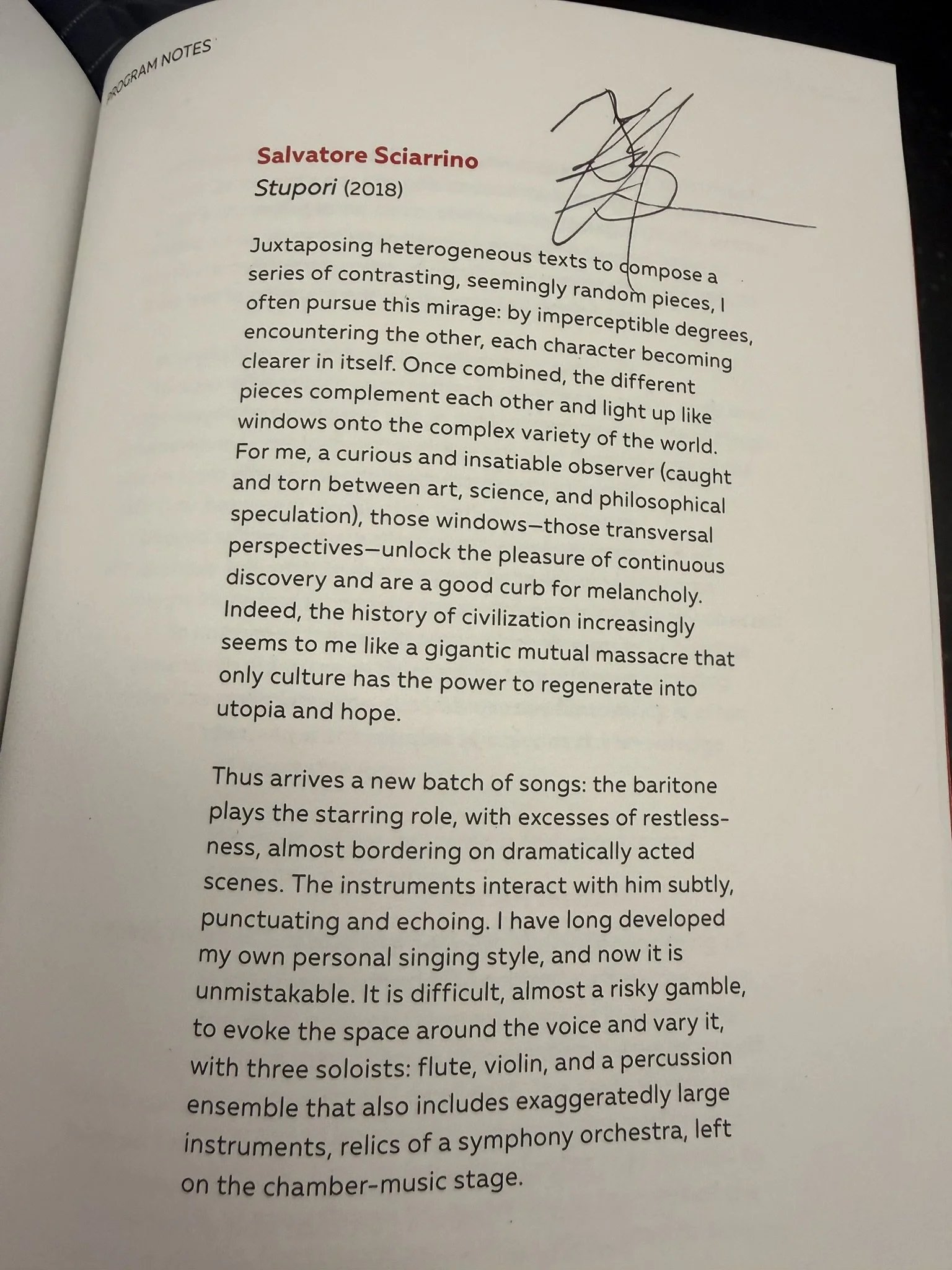
Salvatore Sciarrino
Stupori, 2018
for baritone, flute, violin, and percussion
featuring Ty Bouque, baritone soloist
Whispers and murmurs. The friction and trembling of breath connect to the tapping and overtones of the violin and flute. The vibrations of the throat and lips produced by the human voice seem to pass into the violin and flute, becoming an ensemble.
One of the distinctive characteristics of Sciarrino’s sound is the way he stretches a single tone into a long crescendo and then gives it a distinctive melisma, a peculiar wavering shape. That shape seems to spread into the other instruments, leaving the listener with the impression of a strange movement of shadows even after the sound has ended.
Sciarrino has an extraordinary way of drawing out overtones and harmonics and layering them together. Yet what remains after these sounds disappear is just as important. It creates the feeling that something like a soul has entered the sound’s shadow.
Salvatore Sciarrino, born in Italy in 1947, is a master of contemporary music. He began composing on his own at the age of twelve and had his first work performed at fifteen. He has followed his own path ever since. He seems to see sound within stillness.
In his 2018 work Stupori, he composes with sound, breath, noise, silence, the disappearance and resonance of sound, and the tension of waiting for the next sound. Their succession seems to compose the listener’s perception itself. Short fragments of sound suddenly appear and disappear, while silence and resonance constantly intersect. The result is a continuous state of quiet tension.
The work consists of six sections:
Domande al vento — Questions to the Wind
Stupori — Wonders
L’ultimo haiku di Basho — Basho’s Last Haiku
La nostra mente — Our Mind
Graffito — Graffito
Silenzi leggibili — Readable Silences
The work has six sections and was sung in Italian. At the back center of the stage was the percussion setup, with the violin on the left and the flute on the right. Two flutes were used, including an alto flute that appeared toward the end. Five music stands were arranged around the instruments, surrounding the stage, and baritone Ty Bouque moved from one position to another for each section. He was barefoot.
The performers, including those in the second work on the program, were members of the American Modern Opera Company (AMOC), founded in New York in 2017.
1. Domande al vento — “Questions to the Wind”
Ty Bouque began singing outside the flute on the far right. The traces of Miranda Cuckson’s violin, sometimes imitating his voice and sometimes resisting it, were extraordinary. It was as if wind and temperature were rising from the music, much as they do in Schubert’s Winterreise.
The marimba player rubbed the strings, spreading overtones into the space. The timing of these sounds was exquisite: they blended with the violin’s harmonics and overlapped with the breath and tapping of the flute. By following the voice’s movement like a shadow, the instruments acquired their distinctive resonance.
The violin was not so much playing notes as drawing the contours of Sciarrino’s sonic world into space with the body and the bow. Bouque’s voice was extremely fragile, and Cuckson’s violin followed the tremors and fluctuations of that voice with a precise understanding of Sciarrino’s musical language, sometimes accompanying it and sometimes confronting it.
2. Stupori — “Wonders”
Bouque, who had been standing outside the flute, moved toward the center-right of the stage. As his position changed, the music’s spatial shape changed as well.
Here, the violin and flute surrounded the voice’s leaps, reflecting them and expanding their drama. The voice seemed not to come from a single point, but to be reflected throughout the entire space by the surrounding instruments.
3. L’ultimo haiku di Basho — “Basho’s Last Haiku”
The lighting turned red. As a Japanese listener, I have my own sense of Basho’s worldview. That made me listen, wondering why Sciarrino chose to portray this poem this way.
The percussion was especially striking. Against the immobility of a body unable to move because of illness, there was a strange sense of movement, as if only the soul were still moving through a withering landscape.
4. La nostra mente — “Our Mind”
Here Bouque’s voice moved to the far left. The violin and flute continued as an ensemble for some time.
By this point, the silence in the hall seemed to have changed. The air seemed motionless. Everything was extraordinarily still. I could hear the contours of the sounds and Bouque’s inflections emerging with remarkable clarity in the space.
I could feel the resonance in his throat, and even the heat of his body as he forced each inflection from his voice according to the text.
There were stretches without sound, and traces remaining after sounds had ended. Sciarrino’s sonic image was formed from the remnants of sounds that had already disappeared. Within this world, the performers gradually moved away from simply producing sound and began reflecting one another’s resonances.
The air between sounds itself seemed to begin moving, and Sciarrino’s world emerged from it.
5. Graffito — “Graffito”
The text is taken from graffiti left on the walls of the Palazzo Ducale in Urbino.
These ancient graffiti produced the work’s most intense section. Both voice and instruments suddenly became far more kinetic than in the preceding sections. Sounds collided, chased one another, and piled up with increasing force. Tiny traces left on an ancient wall were transformed onstage into violent movement.
The instruments entered as if pursuing the voice, sometimes overlapping with it and sometimes piling onto it, imitating or confronting Ty Bouque’s distinctive melismas.
Here, performance itself became a kind of acting, with the instruments and voice acting against and alongside one another.
6. Silenzi leggibili — “Readable Silences”
The final section uses an ancient Messapian inscription preserved in Ugento, Italy, as its text. The voice brings sounds resembling language back into the present.
Bouque’s baritone here left the strongest impression of the six sections. The resonance of his voice, his breath, the contours of language, and the disappearance of sound became one. His voice itself seemed to dominate the space.
Sciarrino does not make the Italian language sound conventionally lyrical, nor does he make it sound as though he were simply singing in Italian. Yet, paradoxically, when I could no longer understand what was being said, the dialogue between the voice and the instruments became clearer to me.
It made perfect sense.
By moving away from the concept of Italian as a “language,” my perception began to hear Bouque’s voice and the instruments not as carriers of meaning, but simply as a single sound, a single sonic image.
Michael Hersch
Carrion-Miles to Purgatory: thirteen pieces after texts of Robert Lowell (2014)
Carrying death and decay, the journey moves toward Purgatory—a passage through suffering and purification toward another place.
The suffering that begins with the revenge and confinement of a single human being passes through Purgatory and Hell, expands through the memories of the dead, time, and the power of God, and gradually encompasses the body, the earth, and the world itself. In the end, even the order of Heaven and Hell collapses, and while the cries of trapped life remain, the city itself falls apart. What begins as one individual’s suffering expands through death and the underworld into the collapse of the entire world—a journey in thirteen stages.
The program notes explained that Hersch has incorporated Robert Lowell’s poetry into his music for many years, drawn strongly to the restrained intensity and urgency of Lowell’s writing and sensing that it continues to speak to the present. Hersch also used Lowell’s texts in his 2025 work Oaks Cut for the Pyre, which included fragments adapted from poems by Eugenio Montale.
Carrion-Miles to Purgatory is a cycle of thirteen pieces for violin and cello. Hersch places fragments of Lowell’s poetry alongside each piece, creating a kind of dialogue in which the music and poetry respond to one another. The texts are printed in the score for the performers to read while playing, and for this performance, the complete texts were also included in the program.
Michael Hersch, born in Washington, Pennsylvania, in 1971, is an American contemporary composer whose music often explores death, loss, solitude, and memory through tense, introspective writing. Robert Lowell (1917–1977) was one of the major American poets of the twentieth century. His poetry addressed subjects including World War II, psychological suffering, family, death, politics, and religion, often with an intensely personal and charged voice.
Lowell’s poetry contains death, loss, and despair. Yet at the same time, an energy reaches outward from that darkness toward the world. Hersch captures this tension, in which despair and hope exist simultaneously, through the dialogue between violin and cello.
Carrion-Miles to Purgatory — After the Texts of Robert Lowell
1. Revenge and Confinement
To hang the Furies by their itching ears,
And the green needles nail us to the wall.
The Furies, goddesses of vengeance, can be understood as forces that pursue us from our sins and past. The green needles suggest the force of nature, or perhaps a painful reality, while being “nailed to the wall” evokes a state in which there is no possibility of escape or movement.
The journey begins with human beings trapped by the past, guilt, and the forces of nature, unable to flee or move.
2. Death on the Road to Purgatory
. . . and the snow
Blazes its carrion-miles to Purgatory.
Here, the beauty of snow is immediately fused with the image of carrion. Something beautiful becomes a road carrying the dead toward Purgatory.
Even when the world appears beautiful, death and decay lie behind it. Everything seems to be moving toward some terminal, otherworldly place.
3. The World of Hell
. . . Now how the weary waters swell,
The tree is down in blood!
All the bats of Babel flap about
The rising sun of hell.
The swelling waters suggest a flood or an uncontrolled force of nature. The tree lying in blood suggests that nature itself has been stained by death and violence.
Babel, with its biblical association with the Tower of Babel, evokes a fractured and confused human world. Its bats circle around the “rising sun of hell,” transforming what would normally symbolize life and hope into an image of damnation.
Nature and human society alike have entered a violent, chaotic, apocalyptic landscape.
4. The Monument to the Dead
. . . and the oak
Splatters and splatters on the cenotaph . . .
The oak, traditionally a symbol of strength and enduring life, splatters across a monument to the dead like blood.
The repetition of “splatters and splatters” creates a sense of repeated impact and violent movement. Life itself seems to be violently breaking apart over the monument to death.
5. Time and the Knife of God
Again and then again . . . the year is born
To ice and death . . . the snake-tailed sea-winds coughed and howled
For alms outside the church whose double locks
Wait for St. Peter
Time and the grindstone and the knife of God . . .
Another year begins, but what awaits it is not renewal but ice and death.
Even the church is locked. Humanity seeks divine salvation, but the doors remain closed. Time, the grindstone, and the knife of God gradually wear the human being down.
6. The Dead Body Carried to the Underworld
. . . drowned face downward . . .
Until the thaw he waited, then the flood
Roared like a wounded dragon over shoal
And reef . . .
And rolled his body like a log to Styx;
Two angels fought with bill-hooks for his soul.
The dead body is carried by the flood toward the Styx, the river separating the world of the living from the underworld.
Even after death, there is no certainty of salvation. Two angels fight over the dead man’s soul, suggesting a world in which the boundary between redemption and damnation has become unstable.
7. Sacred Earth Becomes a Curse
. . . my bones are trembling and I hear
The earth’s reverberations and the trumpet
Bleating into my shambles . . .
O Mary . . .
Our sacred earth in our day is our curse.
The speaker approaches death, reduced almost to bones, and hears the trembling of the earth and the sound of death within his own body.
The earth, which should sustain life, has become a curse. The place that ought to support life has turned into a place of death.
8. The Fall of the Body
. . . I saw you wiry, bed-ridden . . . Half inaudible . .
It is all
A moment.
The trees
Grow earthward: neither good
Nor evil, hopes nor fears,
Repulsion nor desire . . .
Will serve to stay the fall.
The frail body lying in bed is placed alongside the image of falling.
Neither good nor evil, hope nor fear, repulsion nor desire can stop the fall. Human emotions and moral distinctions cannot resist the larger movement toward the earth.
9. The Erosion of the World
Time smiling on this sundial of a world
Sweltered about the snowman and the worm . . .
This winter all the snowmen turn to stone . . .
May the snow recede and red clay furrows set
In the grim grin of their erosion, in
The caterpillar tents and roadslides, fat
With muck and dropsy . . .
Into this eldest of the seasons.
Time continues to move, but the world does not regenerate beautifully. Snowmen turn to stone, the earth erodes, and everything becomes covered in mud and decay.
Everything returns to a world of death and disintegration, far older than human time.
10. Death Engraved in Stone
. . . and the laugh of Death is hacked in sandstone . . .
Death’s laughter is no longer a temporary sound that disappears. It is carved into sandstone and made permanent.
Death itself becomes a monument.
11. The Collapse of Heaven and Hell
Hell is burned out, heaven’s harp-strings are slack.
Mother, run to the chalice, and bring back
Blood on your finger-tips . . .
Hell has burned itself out, while heaven has lost even the music of its harp.
The chalice, traditionally associated with salvation, yields only blood. The systems that once promised punishment or redemption have both lost their meaning.
Earlier, angels fought over the soul of the dead; sacred earth became a curse; death was carved into stone. Now even heaven and hell themselves collapse.
12. The Cry of Imprisoned Life
. . . Canaries beat their bars and scream . . .
For the first time, an unmistakable image of living beings appears: canaries beating against the bars of their cage and screaming.
But life is not free. It remains trapped, unable to escape or be saved. After the collapse of heaven and hell, what remains is the cry of life itself.
13. The Collapse of the City
. . . and black-windowed blocks
Recoil against a Gothic church.
The clocks
Are tolling . . .
The shocked stones
Are falling like a ton of bricks and bones
That snap and splinter and descend in glass . . .
At the end, the city itself collapses. Buildings fall, and stones descend together with what resemble human bones, shattering through glass.
Yet the clocks continue to toll.
What began with an individual’s revenge and confinement expands through death, Purgatory, Hell, memory, time, God, the earth, and the body, until the entire world is consumed by erosion. Death becomes engraved in stone; heaven and hell collapse; and finally even the city built by human beings falls apart.
The carrion-miles that began as the journey of an individual toward Purgatory ultimately become a journey toward the collapse of the human world itself.
8.19.2026
Timespans2026の10回目
Sciarrinoの《Stupori》とHerschの《Carrion-Miles to Purgatory》は消滅が聴こえた。Sciarrinoでは、言葉から意味が剥がれ、声や息、倍音、残響、沈黙が一つの音響となり、Herschでは、死、煉獄、地獄、身体、大地、神、そして都市へと世界が拡大、最後には、その世界が崩壊する。Sciarrinoの最後に残った沈黙の向こうからHerschの叫びが聞こえ、Herschの最後に都市が崩れ落ちたあと、再びSciarrinoの静寂が戻ってくる。
そして、Sciarrinoの最後が「読むことのできる沈黙」で終わるのに対し、Herschはカナリアの叫びと都市の崩壊で終わる。沈黙から叫びへ、音の消滅から世界の崩壊へ。 この対照によって一つの大きな聴覚体験としてつながっていた。
8.19.2026
Salvatore Sciarrino
Stupori, 2018
for baritone, flute, violin and percussion
featuring Ty Bouque, baritone soloist
ささやきやつぶやき。その息の擦れや震えが、バイオリンやフルートのタッピングや倍音に繋がっている。人の声が生む、喉や唇の震えが、バイオリンやフルートに伝わってアンサンブルになっている。シャリーノの音の形の特徴は、一つの音をロングトーンでクレッシェンドで引き伸ばして、その後に独特のメリスマ、独特の揺れを持たせた音型で、それが、他の楽器にも伝染して、鳴り終えた後に聴き手に独特の影の動きのような印象を与えている。シャリアーノは本当に独特のオーバーノートやハーモニクスを引き出す動きと音の重ね方をするが、それらの後の鳴り終えた後の印象が、まるで音の影に魂が宿っているような感覚をもたらす。
1947年にイタリアに生まれた巨匠、Salvatore Sciarrino。12歳から独学で作曲を始め、15歳で自作を初演。その後も独自の道を歩む現代作曲家。静の中にサウンドを見る人だ。2018年の作品、Stuporiでも、音、息、ノイズ、沈黙、音の消え際や残響、次の音を待つ緊張感、その連続が産む、聴き手の知覚を作曲するような音楽。短い音の断片が突然現れては消え、沈黙と響きが交錯するため、静かな緊張の連続だった。
1. Questions to the Wind, 2. Wonders, 3. Basho's Last Haiku, 4. Our Mind, 5. Graffito, 6 Readable Silences for baritone, flute, violin, and percussion
作品は6パートあり、イタリア語で歌われた。ステージ中央の奥に打楽器のセット、左にバイオリン、右にフルート。フルートはアルトと2本。アルトは最後の方で使っていた。楽器セットの外側には、5台の譜面台がステージを取り囲むように配置され、バリトンのタイ・ブークが曲のパートごとに移動して歌った。彼は裸足だった。このプログラムでは、2曲目を含めて、2017年にニューヨークで発足したAmerican Modern Opera Company(AMOC)のメンバーが演奏した。
1. Domande al vento — 「風への問い」
タイブークは右端のフルートの外側に立って歌い始めた。彼の声を模倣したり、対抗したりするMiranda Cucksonのヴァイオリンの残像がすごかった。シューベルトの《冬の旅》のように、音楽から風や温度が立ち上がってくるようだった。マリンバは弦を擦って倍音を空間に広げ、その入るタイミングも絶妙で、ヴァイオリンの倍音とブレンドしたり、フルートの息やタッピングと重なったりする。ボーカルの動きを影のように追うことで、それぞれの音が独特に響いた。ヴァイオリンは音符を演奏するというより、Sciarrinoが作った音響の輪郭を、身体と弓によって空間の中に描いていた。タイブークの声はとても壊れやすく、その震えや揺らぎに、ミランダのヴァイオリンがシャリーノの音型を確かな理解で寄り添ったり、時には対抗したりしていた。
2. Stupori — 「驚き/驚愕」
フルートの外側にいたボーカルが、ステージ中央右へ移動した。位置が変わると、音楽の立体も変わっていった。この曲では、声の跳躍をバイオリンとフルートが取り囲み、反響させながら、そのドラマをさらに拡大していく。声が一つの場所から発せられるのではなく、周囲の楽器によって空間全体に跳ね返されるようだった。
3. L'ultimo haiku di Basho — 「芭蕉最後の俳句」
照明が赤かった。私は日本人なので、芭蕉の世界観をそれなりに持っている。だからこそ、シャリーノがこの唄をこんなふうに描いたのかと思いながら聴いた。パーカッションが印象的だった。病で動けない身体とは対照的に、枯れていく野を魂だけが動いているような、独特の動きがあった。
4. La nostra mente — 「私たちの心/精神」
ここでタイブークの声が左の外側へ移動した。バイオリンとフルートのアンサンブルがしばらく続く。この辺までくると、会場の静けさが変わった気がした。空気が動かない。とてもしんと静かだった。音の輪郭やタイブークの抑揚が、とてもくっきりと空間に立ち上がっていくのがわかった。彼の喉の響き、そして声をひねり出すとき、テキストに合わせて抑揚を絞り出していく、その身体の熱まで感じられた。
音のない時間や、音が鳴り終わった後に残る気配。鳴り終わった音の残骸によって形づくられるSciarrinoの響きの像。その中で彼らは、音を鳴らすことから少しずつ離れ、互いの音の余韻を映し合うようになっていった。そこでは、音と音の間にある空気そのものが動き始め、Sciarrinoの世界が描かれていった。
5. Graffito — 「落書き」
ウルビーノのドゥカーレ宮殿の壁に残された落書きをテキストとして使っている。大昔の落書きが作品中で最も激しかった。声も器楽も、それまでの微細な音響から一気に運動性を増し、音が互いにぶつかり、追いかけ、畳みかけてくる。壁に残された小さな痕跡が、舞台上では激しい運動へ変わっていった。
ボーカルを追うように、あるいは重なりながら畳みかけるように楽器が入り、Ty Bouqueの独特のメリスマを模倣したり、対抗したりする。そこでは、演奏そのものが演技になり、楽器と声が互いに演じ合う。
6. silenzi leggibili — 「読むことのできる沈黙」
最後は、イタリア・ウジェントに残る古代メッサピア語の碑文をテキストとして使う。言葉のような音が声によって現在によみがえる。ここのバリトンが、6つのエピソードの中で最も強く印象に残った。声の響き、息、言葉の輪郭、音の消え際が一つになり、声そのものが空間を支配する。シャリーノはイタリア語も、イタリア語のように聴こえるような歌唱ではない。でも、この最後の何言ってるかわからないときのほうが、楽器との対話がよく伝わってきた。とても腑に落ちる。イタリア語という「言葉」の概念から離れたことで、私の認識は、タイブークの声や楽器の音を、意味を持った言葉としてではなく、最後には一つの音響、ひとつの音像として捉えていた。
Michael Hersch
Carrion-Miles to Purgatory: thirteen pieces after texts of Robert Lowell (2014)
死や腐敗を背負い、煉獄へ向かって進んでいく
苦しみと浄化を経て、別の場所へ向かう道のり
一人の人間の復讐と拘束から始まった苦しみが、煉獄と地獄を通り、死者の記憶や時間、神の力にさらされながら、身体、大地、世界そのものへと広がっていく。そして最後には、天国と地獄という秩序さえ崩れ、閉じ込められた生命の叫びを残したまま、都市そのものが崩壊する。個人の苦しみから始まったものが、死と冥界を経て、世界全体の崩壊へと拡大していく13の行程。
プログラムには、Herschが長年にわたってRobert Lowellの詩を作品に取り入れ、その詩がもつ抑制された強烈さと切迫感に強く惹かれ、それが現代にも通じるものだと感じているとあった。2025年の《oaks cut for the pyre》でもLowellのテキストを扱っており、そこではEugenio Montaleの詩を翻案した断片が掲載されていた。
私たちは皆、制御できないいくつかの叫び声を、
自分の歩みの中で受け止めながら生きていかなければならない。
この部分にくぎ付けになった。
《Carrion-Miles to Purgatory》は、ヴァイオリンとチェロのための13曲からなる連作。Herschは、Lowellの詩の断片をそれぞれの曲に置き、音楽と詩が互いに反応し合う、ある種の対話として作品を作った。詩のテキストは演奏者が楽譜の中で読むために置かれており、今回の公演ではその全文がプログラムにも掲載されていた。
Michael Hersch(マイケル・ハーシュ)は、1971年にペンシルベニア州ワシントンで生まれたアメリカの現代作曲家。死、喪失、孤独、記憶などをテーマに、緊張感の強い内省的な音楽を書いている。Robert Lowell(1917–1977)は、20世紀アメリカを代表する詩人の一人で、第二次世界大戦、精神的な苦悩、家族、死、政治、宗教などを題材に、非常に個人的で緊張感のある詩を書いた。
Lowellの詩には、死や喪失、絶望がある。しかし同時に、その暗闇から世界へ向かおうとするエネルギーもある。Herschはその絶望と希望が同時に存在する緊張を、ヴァイオリンとチェロの対話で描いた。
そして、「私たちは皆、制御できないいくつかの叫び声を、歩みの中で受け止めながら生きていかなければならない」という感覚が、この作品全体を貫いている。
『煉獄へ向かう死肉の道程――ロバート・ローウェルのテキストによる』
1. 復讐と拘束
To hang the Furies by their itching ears,
And the green needles nail us to the wall.
耳のかゆみに耐えかねる復讐の女神たちを吊るし、
緑の針葉が私たちを壁に釘づけにする。
**Furies(復讐の女神)**は、罪や過去から追いかけてくるものの象徴である。緑の針葉は自然の力、あるいは痛みを伴う現実を思わせる。そして「壁に釘づけにする」とは、身動きが取れない状態である。
過去や罪、自然の力に捕らえられ、人間は逃げることも動くこともできない。旅はまず、拘束された人間の身体から始まる。
2. 煉獄へ向かう死
. . . and the snow
Blazes its carrion-miles to Purgatory.
……そして雪は、
死肉の道程を、煉獄へ向かって燃え上がる。
ここでは、美しい雪と死肉のイメージが一つに重ねられている。美しいはずの雪が、死肉を煉獄へ運ぶ道程となる。
世界が美しく見えていても、その背後には死や腐敗があり、すべてがどこか終末的な場所へ向かっているのである。
3. 地獄の世界
. . . Now how the weary waters swell,
The tree is down in blood!
All the bats of Babel flap about
The rising sun of hell.
……いま、疲れ果てた水がどのように膨らんでいくことか。
木は血の中に倒れている!
バベルのすべての蝙蝠が羽ばたき回る、
地獄の昇る太陽のまわりを。
weary waters swell――「疲れ果てた水が膨らむ」は、洪水や自然の暴走を思わせる。
The tree is down in blood!――「木が血の中に倒れている」は、自然そのものが死や暴力に染まっているイメージである。
**Babel(バベル)**は旧約聖書のバベルの塔を指し、人間が神に近づこうとして、言語を分断された場所である。その「バベル」の蝙蝠は、混乱した人間世界を思わせる。
さらに、the rising sun of hell――「地獄の昇る太陽」では、本来なら希望や生命を象徴する太陽が、地獄のものへと反転している。
洪水が膨らみ、木は血の中に倒れ、混乱した世界の蝙蝠が地獄の太陽の周りを飛び回る。自然も人間社会も、すべてが暴力と混乱の中にある終末的な風景である。
4. 死者の記念碑
. . . and the oak
Splatters and splatters on the cenotaph . . .
……そして樫の木は、
慰霊碑の上に、何度も何度も飛び散る……
生命の象徴である樫の木が、死者を記念する慰霊碑の上で、血のように飛び散っている。
樫の木は本来、何十年、何百年も生きる強い木である。それが死者の記念碑の上で「飛び散る」。
さらに、splatters and splattersと同じ言葉が繰り返されることで、何度も何かが叩きつけられ、飛び散るような暴力的な運動が生まれている。
5. 時間と神のナイフ
Again and then again . . . the year is born
To ice and death . . . the snake-tailed sea-winds coughed and howled
For alms outside the church whose double locks
Wait for St. Peter
Time and the grindstone and the knife of God . . .
また、そしてまた……一年が生まれる、
氷と死へ向かって……蛇の尾を持つ海風が咳き込み、吠える、
二重の鍵がかかった教会の外で、
聖ペテロへの施しを求めながら。
時間と砥石と、神のナイフ……
また一年が始まる。しかし、その先にあるのは再生ではなく、氷と死である。
神の救いを求めても、教会の扉は閉ざされている。そして人間は、時間と砥石と神のナイフによって、少しずつ削られていく。
6. 死体が冥界へ運ばれる
. . . drowned face downward . . .
Until the thaw he waited, then the flood
Roared like a wounded dragon over shoal
And reef . . .
And rolled his body like a log to Styx;
Two angels fought with bill-hooks for his soul.
……うつ伏せに溺れ死んで……
雪解けまで彼は待った。そして洪水が、
浅瀬と岩礁の上を、傷ついた竜のように
轟きながら……
彼の身体を丸太のようにステュクス川へと転がしていった。
二人の天使が、鉤付きの鎌を手に、彼の魂を奪い合った。
ここでは死体が、洪水によってステュクス川へ運ばれていく。ステュクス川は、生者の世界と冥界を隔てる川である。
さらに、二人の天使が一人の魂を奪い合う。死後の世界でさえ、救済と破滅のどちらに向かうのか定まっていない。
7. 聖なる大地が呪いになる
. . . my bones are trembling and I hear
The earth’s reverberations and the trumpet
Bleating into my shambles . . .
O Mary . . .
Our sacred earth in our day is our curse.
……私の骨は震え、私は聞く、
大地の反響を、そしてトランペットが
私の屠殺場へと、羊のように鳴きながら入ってくるのを……
おお、マリア……
私たちの時代の聖なる大地は、私たちの呪いだ。
死に近づき、身体が骨だけになっていく。その身体の中で、大地の震えと死の音を聞いている。
本来なら生命を支えるはずの聖なる大地が、今の私たちにとっては呪いとなっている。生命を支える場所そのものが、死を生み出す場所へと反転しているのである。
8. 身体の落下
. . . I saw you wiry, bed-ridden . . . Half inaudible . . .
It is all
A moment.
The trees
Grow earthward: neither good
Nor evil, hopes nor fears,
Repulsion nor desire . . .
Will serve to stay the fall.
……私はあなたを見た、痩せ細り、病床に横たわるあなたを……ほとんど聞き取れないほどに……
すべては
一瞬だ。
木々は
大地へ向かって成長する。善も
悪も、希望も
恐れも、
嫌悪も欲望も……
落下を止めることはできない……
ここでは、病床に横たわる身体と「落下」が重ねられている。
善も悪も、希望も恐れも、嫌悪も欲望も、落下を止めることはできない。人間の倫理や感情を超えて、すべてが大地へ向かって落ちていく。
9. 世界の侵食
Time smiling on this sundial of a world
Sweltered about the snowman and the worm . . .
This winter all the snowmen turn to stone . . .
May the snow recede and red clay furrows set
In the grim grin of their erosion, in
The caterpillar tents and roadslides, fat
With muck and dropsy . . .
Into this eldest of the seasons.
時間は微笑みながら、この日時計のような世界の上で
雪だるまと蛆虫の周りを灼熱させていた……
この冬、すべての雪だるまは石へと変わる……
雪が後退し、赤い粘土の畝が姿を現しますように、
その厳しい笑みのような侵食の中で、
毛虫のテントや土砂崩れの中で、
泥と浮腫に満ちた……
この、最も古い季節の中へ。
時間は流れ続ける。しかし世界は、美しく再生していくのではない。雪だるまは石になり、大地は侵食され、泥と腐敗に覆われていく。
すべては、人間の時間よりもはるかに古い、死と崩壊の世界へ戻っていく。
10. 死が石に刻まれる
. . . and the laugh of Death is hacked in sandstone . . .
……そして死の笑い声は、砂岩に刻み込まれている……
死の笑い声は、一時的に響いて消える音ではない。それは石に刻み込まれ、永久に残される。
ここでは、死そのものが記憶として固定される。
11. 天国と地獄の崩壊
Hell is burned out, heaven’s harp-strings are slack.
Mother, run to the chalice, and bring back
Blood on your finger-tips . . .
地獄は焼け落ち、天国の竪琴の弦はたるんでいる。
母よ、聖杯へ走り、
指先に血をつけて戻ってきて……
地獄は燃え尽き、天国も音楽を失っている。救済を象徴する聖杯から持ち帰るのは、聖なるものではなく血だけである。
6番では天使が魂を奪い合い、7番では「聖なる大地」が呪いになり、10番では死が石に刻まれた。そして11番では、ついに天国と地獄そのものが壊れてしまう。
12. 閉じ込められた生命の叫び
. . . Canaries beat their bars and scream . . .
……カナリアたちは檻の格子を叩き、叫んでいる……
ここで初めて、明確な生命の叫びが現れる。
しかし、その生命は自由ではない。檻に閉じ込められ、格子を叩きながら叫んでいる。天国と地獄が崩壊した後に残るのは、救済されることも逃げることもできない生命の声である。
13. 都市そのものの崩壊
. . . and black-windowed blocks
Recoil against a Gothic church.
The clocks
Are tolling . . .
The shocked stones
Are falling like a ton of bricks and bones
That snap and splinter and descend in glass . . .
……そして黒い窓の建物群が、
ゴシック様式の教会に向かって身を引く。
時計が
鳴り響いている……
衝撃を受けた石々が
レンガと骨の塊のように落ちてくる、
ガラスの中で砕け、裂けながら……
最後には都市が崩壊する。建物が倒れ、人間の骨のようなものまで一緒に砕け落ちていく。
それでも時計だけは鳴り続けている。
最初は復讐と拘束という一人の人間の苦しみから始まったものが、煉獄、地獄、死者の記憶、時間、神、大地、身体へと広がり、やがて世界そのものを侵食していく。死は石に刻まれ、天国と地獄という救済の秩序さえ崩壊する。そして最後に残るのは、檻の中で叫ぶ生命と、崩れ落ちる都市である。
個人の苦しみから始まった「死肉の道程」は、最後には人間が築いた世界そのものの崩壊へと到達するのである。