
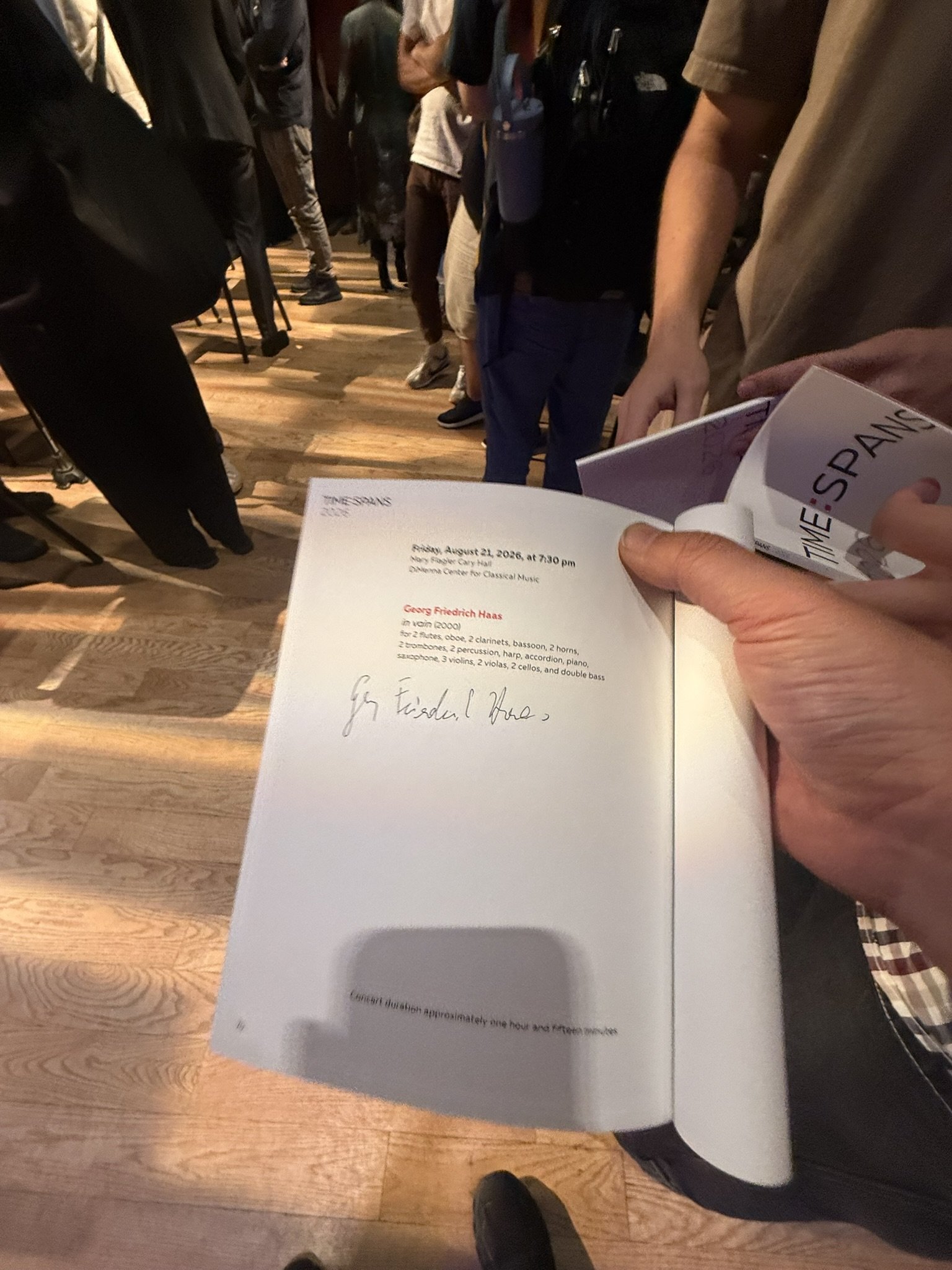
TIME:SPANS 2026 #11 — Georg Friedrich Haas in vain, 2000
Haas’s in vain: a precisely broken orchestra unfolds strange sounds for 60 minutes, moving between darkness and light.
Mary Flagler Cary Hall
Georg Friedrich Haas
in vain, 2000
for 2 flutes, oboe, 2 clarinets, bassoon, 2 horns, 2 trombones, 2 percussion, harp, accordion, piano, saxophone, 3 violins, 2 violas, 2 cellos, and double bass
Alarm Will Sound
Alan Pierson, conductor
Erin Lesser, flutes
Brandon Patrick George, flute
Christa Robinson, oboe
Bill Kalinkos, clarinet
Madison Greenstone, clarinets
David Bennette, saxophones
Michael Harley, bassoon
Laura Weiner, horn
Nicolee Kuester, horn
Michael Clayville, trombone
Tim Albright, trombone
Chris P. Thompson, percussion
Matt Smallcomb, percussion
John Orfe, piano
Courtney Orlando, violin
Christopher Otto, violin
Austin Wulliman, violin
Andrew Griffin, viola
John Pickford Richards, viola
Irène Han, cello
Jordan Bartow, cello
Pat Swoboda, bass
Jacqui Kerrod, harp
William Schimmel, accordion
Daniel Neumann, Audio Engineer
Concert duration: approx. one hour and fifteen minutes
The strings sit in front, with the wind players standing behind them. The piece begins with repeating descending scales played by percussion and piano. As different scales from the clarinet and glockenspiel mingle with them, the sound gradually begins to waver, producing a spectral quality that reminded me of the sound I experienced in Saariaho’s Innocence.
Eventually, trombones and trumpets enter with buzzing long tones played through mutes. Other instruments slowly slide through pitches like drones, repeating long sustained tones. Eventually, only the accordion’s high, piercing sound remains. Then the lights go out. In the darkness, a low drone repeats, like an airplane passing directly overhead. From there, strange sonorities continue to unfold.
Georg Friedrich Haas (b. 1953) is an Austrian composer from Graz. Having studied composition in Graz and Vienna, he has carried the spiritual and sonic explorations of the German-Austrian musical tradition—from Wagner, Mahler, Schoenberg, and Webern—into the 21st century, developing a distinctive sound world through microtones, just intonation, overtones, and complex chords. This piece also reflects Haas’s own history: he grew up in a family with Nazi sympathies, later rejected those beliefs, and confronted his own past.
A succession of unsettling sounds. Different instruments layer their sounds together, creating tones that seem to glow dimly—sounds that seem to be shining, even though it is impossible to tell where the light is coming from. Then highly distinctive rhythms begin to repeat, the winds start moving rapidly, and a deeply confused ensemble unfolds. For a brief moment, an extraordinarily clear orchestral harmony emerges. But after about forty minutes, a microtonal world reminiscent of Steve Reich emerges. In the end, the descending scales return, creating a world in which everything seems to fall apart, before the piece suddenly stops.
In this piece, the lights go out twice, in the first and second halves, and a precisely broken symphony unfolds in complete darkness. When you cannot see, the way you hear changes dramatically. When you can see, your attention naturally focuses on the direction a sound is coming from. Or, when the performers bring a particular part into relief, your attention is drawn toward it. The same thing happens in darkness. Different parts of the strings in front seem to emerge from the sound, while all kinds of ensemble activity unfolds around them.
When the horns and trombones at opposite ends collide, a distinctive wave-like sound appears. In the darkness, I became even more aware of these directions of sound and of the wave-like phenomena created when sounds collide.
Looking at the score, I could also see that the microtonal intervals are precisely specified. Each instrument layers its sound at those particular pitches, creating these distinctive sonorities. It felt as though the music were recording both Haas’s relentless exploration of sound itself and the history and inner life of the composer intertwined within those sounds.
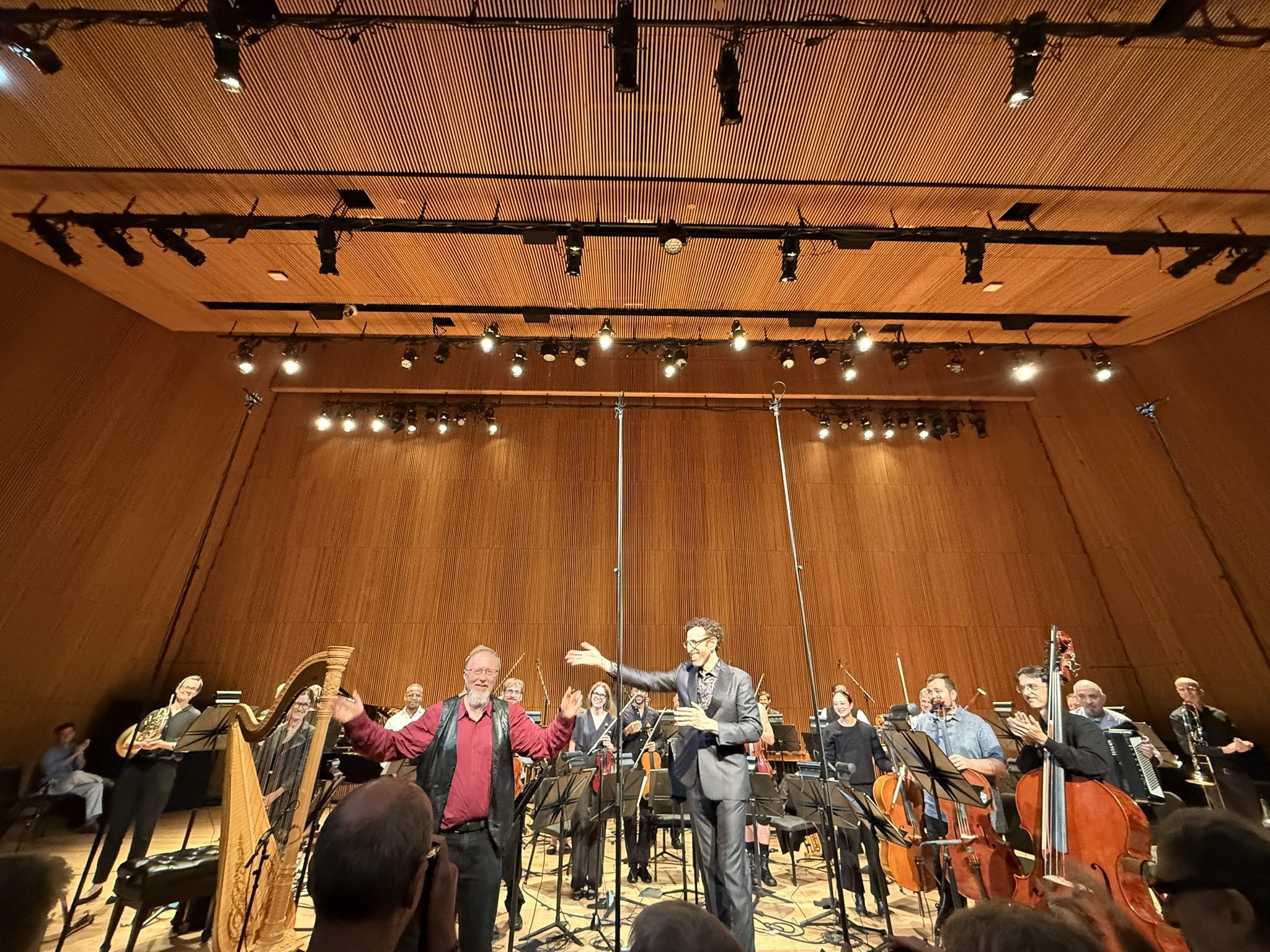
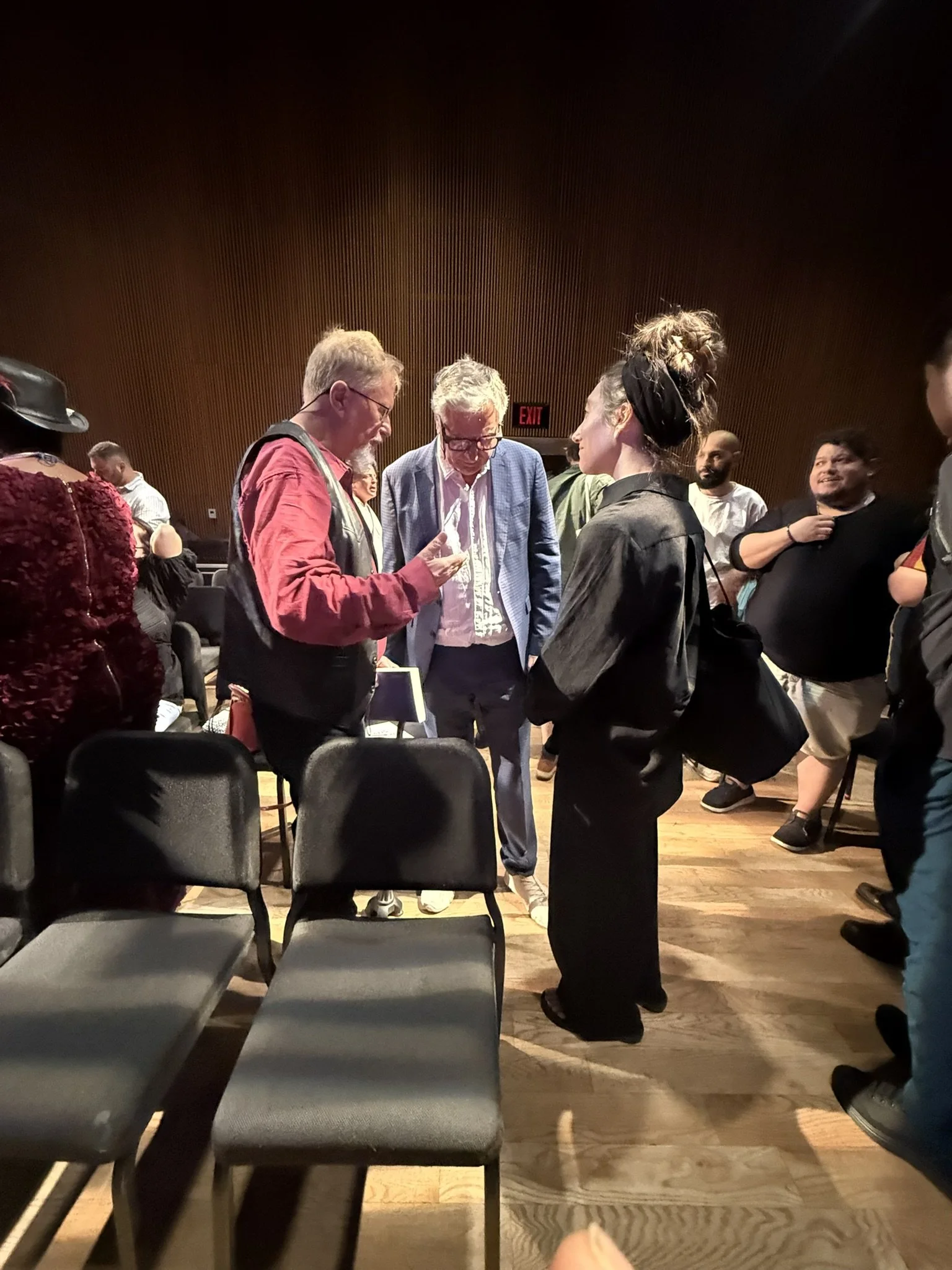
When the piece ended, we applauded Haas, who was in the hall. He then told us, “If you end up in that kind of confusion again at the end, you should stop.” We all seemed to understand, and then we dispersed.
The distinctive sonorities Haas has pursued. Sounds connected to the world's confusion and violence. Sounds that evoke politics and ideology.
Sixty minutes of confronting the crises of the 21st century through sound itself.
Alarm Will Sound’s performance of Georg Friedrich Haas’ in vain is made possible with the friendly support of the Ernst von Siemens Music Foundation.
Alarm Will Sound gratefully acknowledges our individual donors and the following foundations for their support: Aaron Copland Fund for Music, Amphion Foundation, Alice M. Ditson Fund of Columbia University, BMI Foundation, Cheswatyr Foundation, Fan Fox and Leslie R. Samuels Foundation, Howard Gilman Foundation, New Music USA’s 2026-27 Organization Fund, and the Sinquefield Charitable Foundation.
Additional support provided by public funds from the New York City Department of Cultural Affairs in partnership with the City Council; the New York State Council on the Arts with the support of the Office of the Governor and the New York State Legislature; and the National Endowment for the Arts.
正確に壊れたオーケストラが暗闇になったり、明かりがついたりしながら60分、不思議な響きを繰り広げるハースのイン・ヴェイン。
手前に弦楽器が座り、その後ろに管楽器が立って演奏する。開始すると、打楽器やピアノの下降スケールが繰り返される。そこにスケールにクラリネットや鉄琴の別のスケールが混ざり合うと、響きが次第に揺らいでいき、サリアホのInnocenceで味わったスペクトラムの響きがした。
やがて、トロンボーンやトランペットがミュートをつけたビリビリとしたロングトーンを加え、他の楽器もドローンのように音をゆっくりスライドさせながら、長い音を繰り返す。やがてアコーディオンの高い、キーンという音が残る。すると電気が消え、暗闇の中で、飛行機が頭上を通り過ぎていくような低いドローンが繰り返される。そこからは、不思議な響きが続いた。
ゲオルク・フリードリヒ・ハース(1953–)は、オーストリア・グラーツ出身で、グラーツとウィーンで作曲を学び、ワーグナー、マーラー、シェーンベルク、ヴェーベルンへと続くドイツ・オーストリア音楽の精神性と音響探究を21世紀に引き継ぎながら、微分音、純正律、倍音、複雑な和音による独自の音響世界を発展させ、国際的に評価されている。この曲では、美しい純正律の響きとその崩壊、下降と暗闇を通して、ナチ的思想を持つ家庭で育ち、後にその思想から離れ、自らの過去と向き合ったハースの歴史が反映されている。
怪しい響きの連続。いろんな楽器が音を重ねて、鈍く輝くような音色、どこで光っているかわからないけど光っているような音色、そのうち、とてもクセのあるリズムが繰り返されたり、管楽器が細かく動き出して、とても混乱した合奏が続く。少しだけ、とても澄んだオーケストラのハーモニーの時間がやってくるが、40分を過ぎると、スティーブライヒのような微分音の世界が繰り広げられる。最後は、また下降スケールがバラバラな世界を繰り広げると突然終わる。
この曲では前半と後半に電気が消えて、真っ暗な中で、正確に壊れたシンフォニーが繰り広げられた。見えないと、音の聴こえ方がはっきり違った。見えると音が出ている方向にフォーカスしてしまう。または、彼らがそのパートを浮かび上がらせて演奏しているとそこに注意がいく。暗闇でも同じことが起きる。手前の弦楽器の様々な部分が浮いて聴こえる。そこにいろんな合奏が繰り広げられる。両端にいるホルンとトロンボーンの音がぶつかると、独特の波のような響きが現れる。暗闇の中では、そうした音の方向や、音と音がぶつかって生まれる波のような現象が、むしろ強く感じられた。
さらに楽譜を見ると、微分音の音程が細かく指定されている。それぞれの楽器がその高さで音を重ねることで、独特の響きが生まれている。そこには、音そのものへのハースの徹底した探究と、彼自身の歴史や心が重なった音色が記録されているように感じた。
曲が終わると、会場にいたハースに拍手を送った。そして、ハースは「もし最後にまたあのような混乱した状態になったら、そこでやめることだ」と私たちに言って、みんなで納得し解散した。彼が追求してきた独特の響き。世界の混乱や暴力につながる響き。政治や思想を連想させる響き。21世紀の危機を音の響きで解く60分。