TIME:SPANS 2026 #12 — Talea Ensemble and conductor James Baker in the U.S. premieres of Rebecca Saunders’s Scar (Triptych II) and Skull (Triptych III). These two works are the second and third parts of Saunders’s Triptych. The first work, Skin, was performed by the same Talea Ensemble two years ago. In other words, this time, Scar and Skull, following Skin, were performed, completing Saunders’s three-part cycle, written between 2016 and 2023, in performances by the same Talea Ensemble. It was a journey into Saunders’s world, exploring scars shaped by sound, and then the skull beneath them.
8.21.2026
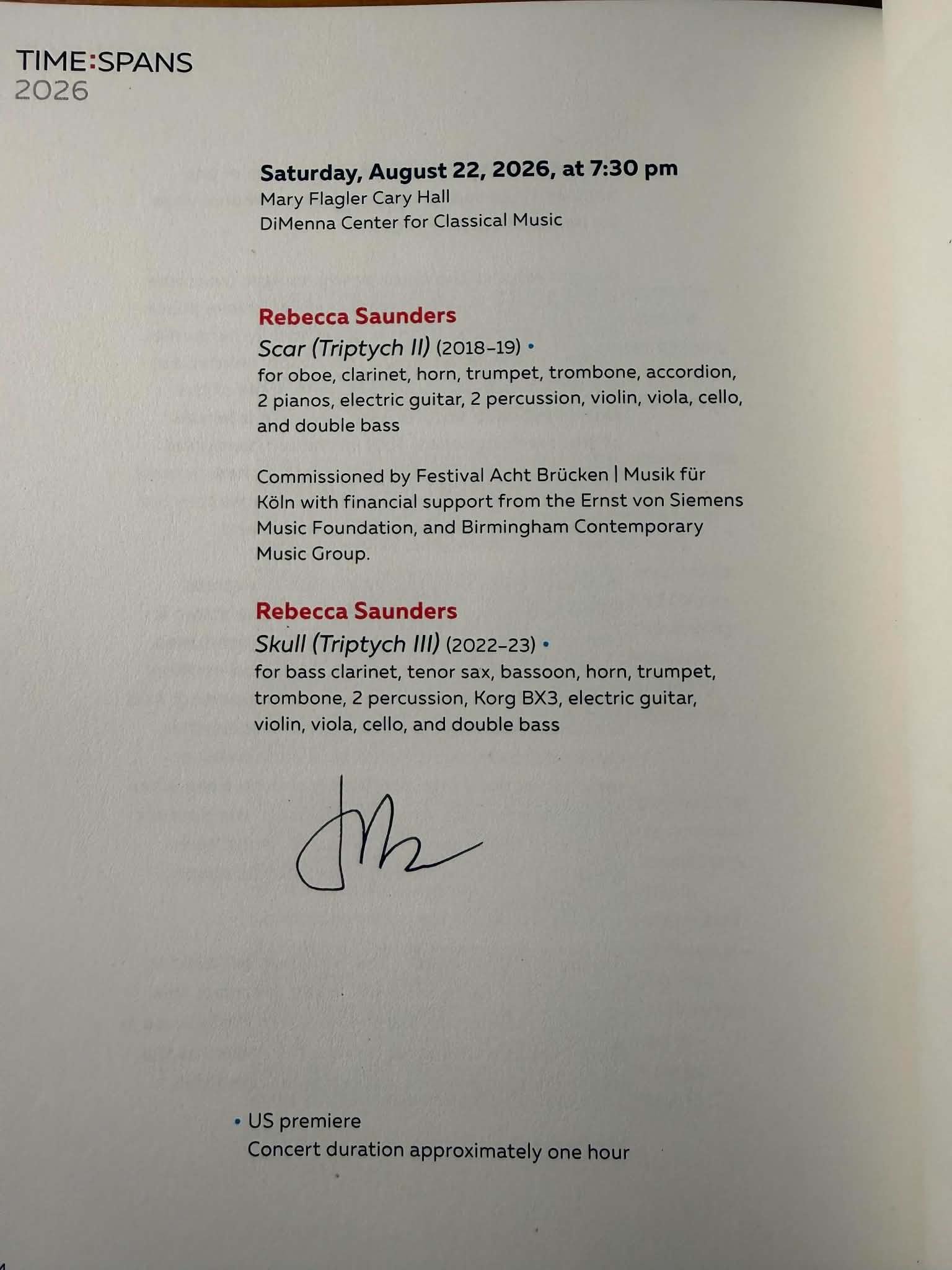
Rebecca Saunders
Scar (Triptych II), 2018-19*
for oboe, clarinet, horn, trumpet, trombone, accordion, 2 pianos, electric guitar, 2 percussion, violin, viola, cello, and double bass
* US Premiere
Commissioned by Festival Acht Brücken | Musik für Köln with financial support from the Ernst von Siemens Music Foundation, and Birmingham Contemporary Music Group.
Rebecca Saunders
Skull (Triptych III), 2022-23*
for bass clarinet, tenor sax, bassoon, horn, trumpet, trombone, 2 percussion, Korg BX3, electric guitar, violin, viola, cello, and double bass
* US Premiere
Talea Ensemble
James Baker, conductor
Michelle Farah, oboe
Rane Moore, clarinet
Erin Rogers, tenor sax
Adrian Morejon, bassoon
Karl Kramer-Johansen, horn
Sam Jones, trumpet
Mike Lormand, trombone
Ivan Filipchyk, accordion
Reed Puleo, percussion
Sae Hashimoto, percussion
Steve Beck, piano
Peggy Kampmeier, piano
Oren Fader, electric guitar
Karen Kim, violin
Martine Thomas, viola
Chris Gross, cello
Greg Chudzik, bass
Victoria Cheah, Production Manager
David Adamcyk, Director of Production
Rebecca Saunders was born in London in 1967. She began studying violin at an early age and wrote songs as a child. She grew up listening to singers accompanied by her parents, loved Brahms, and played violin sonatas with her father. While studying violin and composition at the University of Edinburgh, she heard Wolfgang Rihm’s Chiffre. She was struck by the existence of sound not as a means of expression, but as something that exists in and of itself. She felt, “I have to go there,” and became Rihm’s student. There, she learned to listen closely and discover music through her own ears. Rihm is said to have asked her about her compositions: What kind of face does it have? Does it have eyes or a mouth? In this way, Saunders began to enter into the interior of sound, exploring the body, shape, and energy contained within timbre and resonance. Gradually, she moved away from melody and established musical languages, placing timbre, noise, resonance, silence, the weight of sound, and the action that occurs at the moment sound is born at the center of her music.
In the 2000s, with works such as Chroma, she began to perceive space through sound. She explored how multiple instruments and ensembles could be positioned within space, where sound originates, where it moves, and how it reaches the listener’s body. Later, her attention turned toward the interior of instruments and the bodies of performers. In works such as Skin and Yes from the 2010s, voice, breath, words, and the body itself became musical materials. And then came Scar and Skull.
In Scar, sound tears through the surface of silence and enters inward, as if peeling away the skin. In Skull, by contrast, something resembling melody begins to emerge, and what Saunders calls the “kernel of melody” appears within the work. After spending many years distancing herself from melody in its conventional sense and exploring the body, space, and silence contained within sound, Saunders can be said to have rediscovered, in Skull, something she calls the “kernel of melody” within her own music.
In 2019, she received the Ernst von Siemens Music Prize, and in 2024 she was awarded the Golden Lion for Music at the Venice Biennale. This cycle symbolizes more than thirty years of exploration: Saunders began with melody, moved away from it, delved into the qualities of sound and its effects on the body, and then found melody again in a different form.
In the sound of Saunders played by Talea, sound seems to wound the body, become a bruise, and eventually enter inside it. Saunders has said, “Silence is the canvas on which the weight of sound leaves its traces.” In Scar, sound tears through the surface of silence, or peels away the skin, zooming inward and falling toward the underworld. It searches for what is hidden, what lies beneath the surface.
Saunders’s sounds are created through the collision, compression, and disappearance of the acoustic qualities of instruments: friction, noise, breath, impact, resonance. When sound disappears, the resonance and silence that remain take on their own distinctive presence. Sound appears in space as if wounding the body, leaving a sonic image behind.
For example, at the beginning of Scar, a very small percussion sound appears alongside the low, hard timbre of the piano, over which several curved, drone-like timbres are layered. Suddenly, the metallic sound of percussion passes by with a sharpness that seems to cut into the body. A thin chain hanging from a gong continues to resonate, rubbing faintly against the metal. The sound of metal scraping and the curves of a dull, reverberant resonance gradually disappear. The density of Talea’s sound and their concentration in shaping Saunders’s timbres scratched into the interior of the sound she had written, creating a resonant dome in a strange way and inviting us inside the world of Saunders’s sound.
Saunders’s music is written in measured notation. The timing of sounds is specified, but the timing of their disappearance and the way the sounds are treated are left to the performers. The action or state that produces a sound is specified, but the actual physical process by which that sound is brought into being is entrusted to the performer.
There are no melodies or chords in the conventional sense. Instead, movements and shapes of sound produced through rubbing, sliding, and other actions seem to spread from one instrument to another. One of Saunders’s characteristics is avoiding unisons. The same movement may be relayed from one instrument to another, but they do not simply sing the same thing together. Saunders gives different instruments slightly different overtones, attacks, and resonances, drawing her orchestration through lines of sound.
To my ears, this sometimes sounded like a musical language reminiscent of the Renaissance motets of Josquin des Prez. Several instruments play a single line, with different articulations bringing out complex expressions. Multiple voices remain independent while overlapping and responding to one another, creating a single sonic body. In Renaissance music, those voices were human voices. In Saunders, the individual voices of the instruments coexist in the same way, creating a single sonic body.
In Skull, the ensemble had more emotional character than in Scar, and it felt like a web woven from polyphonic lines. Its contemporary sound was built around vertical rhythms and finely detailed textures. Saunders quotes Haruki Murakami’s The End of the World and Hard-Boiled Wonderland, describing the skull's silence as something ghostly, remaining inside like smoke. The lids of the two pianos were closed, and there was no oboe. Instead, the electric guitar and the Korg BX3 electronic organ resonated through the ensemble.
While Scar seemed to enter inward from the surface, as though sound were wounding the body, Skull seemed to explore what remains inside, what lies beneath the wound.
When one listens closely to a single sound—the state of sound simply existing there, which so profoundly shocked her when she heard Rihm—one begins to sense a much larger continuity. On the five-line staff, the marks of the value Saunders has pursued in sound are clearly inscribed. It was a masterpiece, performed by a highly accomplished and intensely focused Talea Ensemble.
After the concert, I received an autograph from conductor James Baker. I definitely preferred Scar. The concentration and density of the work, and the precision of the performance, were extraordinary. Baker simply told me, “This piece is difficult.” I am deeply grateful to Talea Ensemble and to James Baker for performing such a difficult work with such clarity, and for allowing us to hear the power of Saunders’s music.
TIME:SPANS 2026の12回目は、Talea Ensembleと指揮者James BakerがRebecca Saundersの《Scar (Triptych II)》と《Skull (Triptych III)》をアメリカで初演した。この2つはSaundersのTriptych(三部作)の2.3作目にあたる。1作の《Skin》は、2年前に同じTalea Ensembleによって演奏されている。つまり今回は、《Skin》に続く《Scar》と《Skull》が演奏され、Saundersが2016年から2023年にかけて書いた3曲を同じTalea Ensembleによる演奏で完成させることになった。それは、音によって形づくられた傷跡、そして骸骨を探る、Saundersの世界への旅だった。
レベッカ・サンダース(Rebecca Saunders)は、1967年ロンドンに生まれ、幼い頃からヴァイオリンを学び、歌曲を書いていた。両親が伴奏する歌手たちの歌を聴いて育ち、ブラームスを愛し、父親とはヴァイオリン・ソナタを演奏した。エディンバラ大学でヴァイオリンと作曲を学んでいた頃、ヴォルフガング・リームの《Chiffre》を聴き、表現するためではなく、それ自体として存在する音に衝撃を受け、「そこへ行かなければならない」と感じリームの弟子となった。そこで学んだのは、耳を澄ませ、自分の耳で音楽を発見することだった。リームはサンダースの作品、どんな顔をしているのか、目や口はあるのかと尋ねたという。こうしてサンダースは音の内部へ入り込み、音色や響きが持つ体、形、エネルギーを探っていった。やがてメロディーや既成の語法から距離を置き、音色、ノイズ、響き、沈黙、音の重さ、そして音が生まれる瞬間の作用を中心に据えていく。
2000年代には《Chroma》などで、音によって空間を捉えるようになる。複数の楽器やアンサンブルを空間に配置し、音がどこから発生し、どこへ移動し、どのように聴き手の身体に届くのかを探究した。その後、関心は楽器の内部や演奏者の身体へ向かい、2010年代の《Skin》《Yes》などでは、声、息、言葉、身体そのものが音楽の素材となっていく。そして、ScarとSkullが生まれた。
《Scar》では、音が沈黙の表面を引き裂き、皮膚を剥ぐように内側に入り込む一方、《Skull》では、メロディーらしい響きが姿を現し、サンダースのいう「メロディーの核」が作品の中に現れた。長い間、従来の意味でのメロディーから距離を置き、音がもつ身体、空間、沈黙を探究してきた彼女は、《Skull》で再び「メロディーの核」と呼ぶものを、自分の音楽の中に見出したと言える。
2019年にはエルンスト・フォン・ジーメンス音楽賞を受賞し、2024年にはヴェネツィア・ビエンナーレ音楽部門の金獅子賞を受賞した。この連作は、サンダースがメロディーから出発し、それを捨て、音の質と身体への影響を掘り下げ、再びメロディーそのものを別の形で見出していく、30年以上にわたる探究を象徴している。
ターレアが奏でるサンダースは、音が身体を傷つけ、あざとなり、やがて身体の内部へ入ってくる。サンダースは、「沈黙とは、音の重さが痕跡を刻み込むキャンバスだ」と言う。《Scar》では、音が沈黙の表面を引き裂き、あるいは皮膚を剥がすように、その内側へとズームインし、冥界へと落ちていく。隠されているもの、つまりその内側に横たわっているものを探し求める。
サンダースの音は、摩擦、ノイズ、息、打撃、共鳴など、楽器が持っている音響が衝突し、圧縮され、消えていく。その瞬間、音が消えたあとに残る残響や沈黙にも独特の気配がある。音は空間に身体を傷つけるように現れ、その後に音像を残す。
例えば、スカーの冒頭では、とても小さな打楽器音にピアノの低くて硬い鍵盤の音色が現れて、そこにドローンのような湾曲な複数の音色が重なる。打楽器の金属音楽が突然、傷をつける様に尖った音色で通り過ぎる。銅鑼につるされvた細い鎖がかすかにこすりながら響きが続く。金属が擦れる音や鈍く反響した残響の音のカーブが消えていく。ターレアの音の密度とサンダースの音色を奏でる集中は、彼女が書いた、音の内部をひっかいた入り、不思議な方法で響きのドームを作ったり、私たちをサンダースサウンドの内側へ招待してくれた。
サンダースの作曲は定量記譜である。音のタイミングは指定されているというが、消えていくタイミングや音の扱いは演奏者に任せているという。音を生む行為や状態は指定するが、そこから実際の音を立ち上げる作動は演奏者にゆだねられる。
メロディや和音はなく、擦ったりスライドさせたりして生まれる音の動きと形が、別の楽器へ感染していく。サンダースの特徴のひとつが、ユニゾンを組まないことだ。同じ動きを別の楽器でリレーしたり、同時に歌ったりはしない。サンダースは別の楽器に少し違う倍音、アタック、共鳴を与え、線でオーケストレーションを描いていく。
私には、ときにルネサンスのジョスカン・デ・プレのモテットのような書法にも聴こえた。一つの線を複数の楽器で演奏し、さまざまなアーティキュレーションを施すことで複雑な表情を引き出す。複数の声部が独立したまま重なり、反応し、ひとつの音響を作る。当時は声だったが、サンダースも楽器が発する固有の声が同時に存在することで、ひとつの音響体を作っている。
《Skull》では、《Scar》よりも曲に情緒があり、ポリフォニーが織りなす網目のようなアンサンブルだった。縦のリズムが中心の細かなテクスチャの現代的な響きだったが、村上春樹の『世界の終りとハードボイルド・ワンダーランド』から、骸骨がもっている静寂は、煙のように内部に留まる、幻影のようなものだとサンダースは引用している。2台のピアノは蓋が閉じられて、オーボエもなかった。代わりにエレキギターやKorgのMX3という電子オルガンが響いた。
《Scar》では音が身体に傷をつけるように表面から内部へ入り込んでいくのに対し、《Skull》では、その内部に残るもの、傷のあとに横たわるものを探っているように聴こえた。
彼女がリームから衝撃を受けた、ただ音がそこにある状態を究極に追究した、一つの音をじっくり聴くと、大きな連なりを感じる。5線の上に彼女が追求してきた音の価値の痕が確かに刻まれている傑作で、完成度の高い、とても集中したターレア・アンサンブルの演奏だった。
公演後、指揮者のジェームス・ベイカー氏からサインをいただいた。私は《Scar》の方が断然好きだった。作品の集中と密度、演奏の精密さ。すばらしかった。ベイカー氏はただ、「この曲は難しい」と言っていた。その難しい曲をとてもクリアに演奏し、サンダースの魅力を教えてくれたこのアンサンブルと指揮者のベイカー氏に、心から感謝いたします。