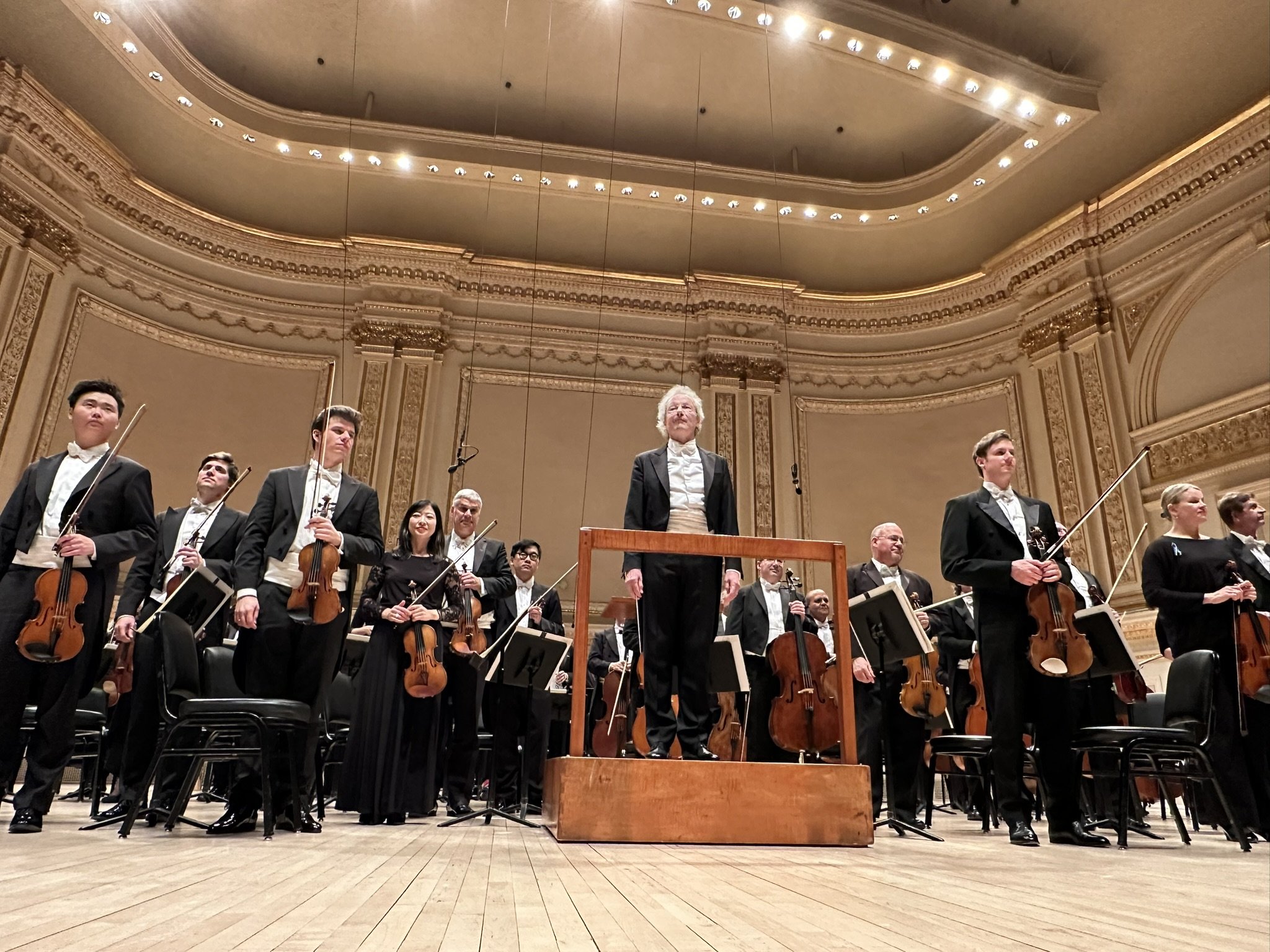

Franz Welser-Möst and the Cleveland Orchestra performed at Carnegie Hall on March 19th. Following Beethoven's Symphony No. 5, Janáček's House of the Dead, and Leonore the day before, they played Stravinsky's Petrushka and Tchaikovsky's Symphony No. 5. These are Russian pieces. Petrushka is a marionette known by many names across Europe: Punch in England, Polichinelle in France, Pulcinella in Italy, Kasperle in Germany, and Petrushka in Russia. He is a mischievous man, a rebel, and a wife-beater. He enforces moral justice with a wooden club, speaks in a high-pitched squeal, and argues with the devil. Mösto's sincere passion guides the orchestra, as if fate, formula, and
subversion are repeated. Then, the Russian marionette is dragged away by a dog, a policeman, or the devil. The 1947 version, in which Stravinsky re-arranged the orchestra, was vivid and delicate. The tempo was calm, and the orchestra played every detail with precision. The piccolo phrasing and the percussion have a tasteful effect. The voices and ensembles that are usually inaudible are played accurately. This is the maestro and Cleveland's masterful performance, a culmination of 23 years of work. The beauty of the unison, the tremolo's smoothness, the staccato's lightness, and the outstanding solos were played faithfully. You can enjoy the refinement of Cleveland, who brings every Petrushka episode to life in the notes. The tempo and dynamics are straightforward to understand; each instrument understands the work well. Stravinsky's character depiction and story development are played so well that it makes you laugh. The faces and personalities of the performers are well conveyed in the solos and ensembles. The opening theme has the same pattern as Janacek's previous day: a captured prisoner, a marionette. These keywords come to mind when Mesto's two programs include them. Tchaikovsky wrote his Symphony No. 4 in 1888, ten years after his previous work, at the age of 48. The first sketches included a verbal program that depicted the individual's reaction to an unchanging fate, encompassing stages of resignation, defiance, and triumph. In other words, Tchaikovsky was hesitant to acknowledge his homosexuality publicly. Here, too, the common theme of fate appears in different forms, much like Beethoven's Symphony No. 5. A British musicologist notes that this theme is a quote from Glinka's aria, with the lyrics "Do not give yourself over to sorrow." In contrast to Stravinsky, despite the vague theme and the fuzzy personal feelings, this performance is also apparent, and the emotions are conveyed directly, showing how the notes depict an inescapable fate. At the beginning of the fate, the clarinet sighs as if dragging each note. As the strings begin Allegro con anima, they move forward slightly, but undoubtedly, and the clarinet and bassoon play in unison. The following pianissimo passage on the flute was modest and light, yet could be heard clearly. It is as if he is beginning to accept his fate and confessing his homosexuality. When the theme moves to the strings, the woodwind scales start, but since they are abundant in Stravinsky, they seem incredibly comfortable to play. This is the magic of Most's program. It is as if the members of Cleveland in front are destined to be Cleveland members, and the most essential qualities, such as scales and legato, are fundamental. Cleveland is conscientious and loving, and such tradition and refinement are revived as vivid, delicate, and passionate tones, even the chaotic personal emotions, as if they were just born and performed. Fate is affirmed in the finale with a magnificent orchestration. In Most and Cleveland's two-day program, we experienced the present we live in and the feelings that individuals are heading towards through the works of Beethoven, Janáček, Stravinsky, and Tchaikovsky. The thunderous applause refers to what happened after Most and Cleveland's live in Carnegie Hall..
フランツ・ウェルザー=メストとクリーブランド管弦楽団が、3月19日にカーネギーホールで、前日のベートーベンの交響曲5番とヤナーチェクの死者の家から、そして、レオノーレの救済から翌日に、ストラビンスキーのペトルーシュカとチャイコフスキーの交響曲5番を演奏した。ロシアの作品だ。ペトルーシュカは操り人形でヨーロッパ中でさまざまな名前で知られている。イギリスではパンチ、フランスではポリチネル、イタリアではプルチネッラ、ドイツではカスペルレ、ロシアではペトルーシュカ。いたずら好きで、反逆者で妻を殴る男。彼は棍棒で道徳を強制し、甲高い金切り声で悪魔と口論する。メストの真摯な情熱がオーケストラを導き、運命、定型、転覆が繰り返され、ロシアの操り人形は犬か警官か悪魔に引きずり出される。ストラヴィンスキーがオーケストラを編曲し直した1947年版は鮮やかで繊細。テンポは穏やか、オーケストラは細部まで見事。ピッコロのフレージングやパーカッションが味わい深い。普段は聴こえない声やアンサンブルも緻密に演奏される。メストとクリーブランドの23年にわたる努力の結晶ともいえる名演。ユニゾンの美しさ、トレモロの滑らかさ、スタッカートの軽やかさ、忠実に奏でられる卓越したソロたち。音符に込められたペトルーシュカのエピソードに命を宿し奏るクリーブランドの洗練を味わう。テンポとダイナミクスがわかりやすく、それぞれの楽器が作品をよく理解していて、ストラビンスキーのキャラクター描写とストーリー展開が笑ってしまうくらいよく演奏され、ソロやアンサンブルは楽員の顔や性格を伝える。冒頭のあるテーマは前日のヤナーチェクのそれと音型が同じで、捕らわれた囚人、操り人形といったキーワードがメストの今回の2つのプログラムには含まれてくる。
後半。チャイコフスキーは交響曲5番をスランプから抜け出し前作から10年後の1888年に48歳で書いた。最初のスケッチには不変の運命に直面した反応を描写した言葉のプログラムが含まれ、そこには諦め、挑戦、そして勝利の段階が含まれている。彼らは、チャイコフスキーの同性愛を公に語ることを許されなかった運命の葛藤を卓越した理解と技術で奏でる。ここにもベートーベンの5番同様に共通した運命のテーマが形を変え登場する。イギリスの音楽学者は、このテーマがグリンカのアリア、悲しみに身を任せるな の引用という。ストラビンスキーとは対照でテーマのはっきりしないもんもんとした感情に、演奏も最高に鮮明で、逃れられない運命がストレートに伝わってくる。運命の冒頭のクラリネットら、一音一音を引きずるように奏でる溜息。アレグロ・コン・アニマに入り弦は少し確実に歩み始めクラリネットとファゴットのユニゾンが始まる。続くフルートのピアニッシモは控えめで軽やかだがはっきりと、自分の運命を受け入れ始め告白している様に。主題が弦に移ると木管のスケールがストラビンスキーで山ほど出てきたため快適。メストのプログラムマジック。みなさんが演奏家であることが運命だといわんばかりにオケの大事な資質であるスケールやレガートなどがクリーブランドは丁寧で愛情があり、そういった伝統と洗練が、人のもやもやももたった今生まれた鮮やかで繊細な音色となり甦る。その運命はフィナーレで壮大に肯定され終わる。メストとクリーブランドの2日間のプログラムで、私たちが生きる今と個人持つ気持ちを、ベートーベン、ヤナーチェク、ストラビンスキー、そしてチャイコフスキーを通じて体験した。割れんばかりの拍手で終わるメストとクリーブランドのカーネギーライブだった。
このリンクからライブ録音が聴けます。Listen live from the link
The Cleveland Orchestra
Franz Welser-Möst, Music Director and Conductor
Program
STRAVINSKY Pétrouchka (1947 version)
TCHAIKOVSKY Symphony No. 5