
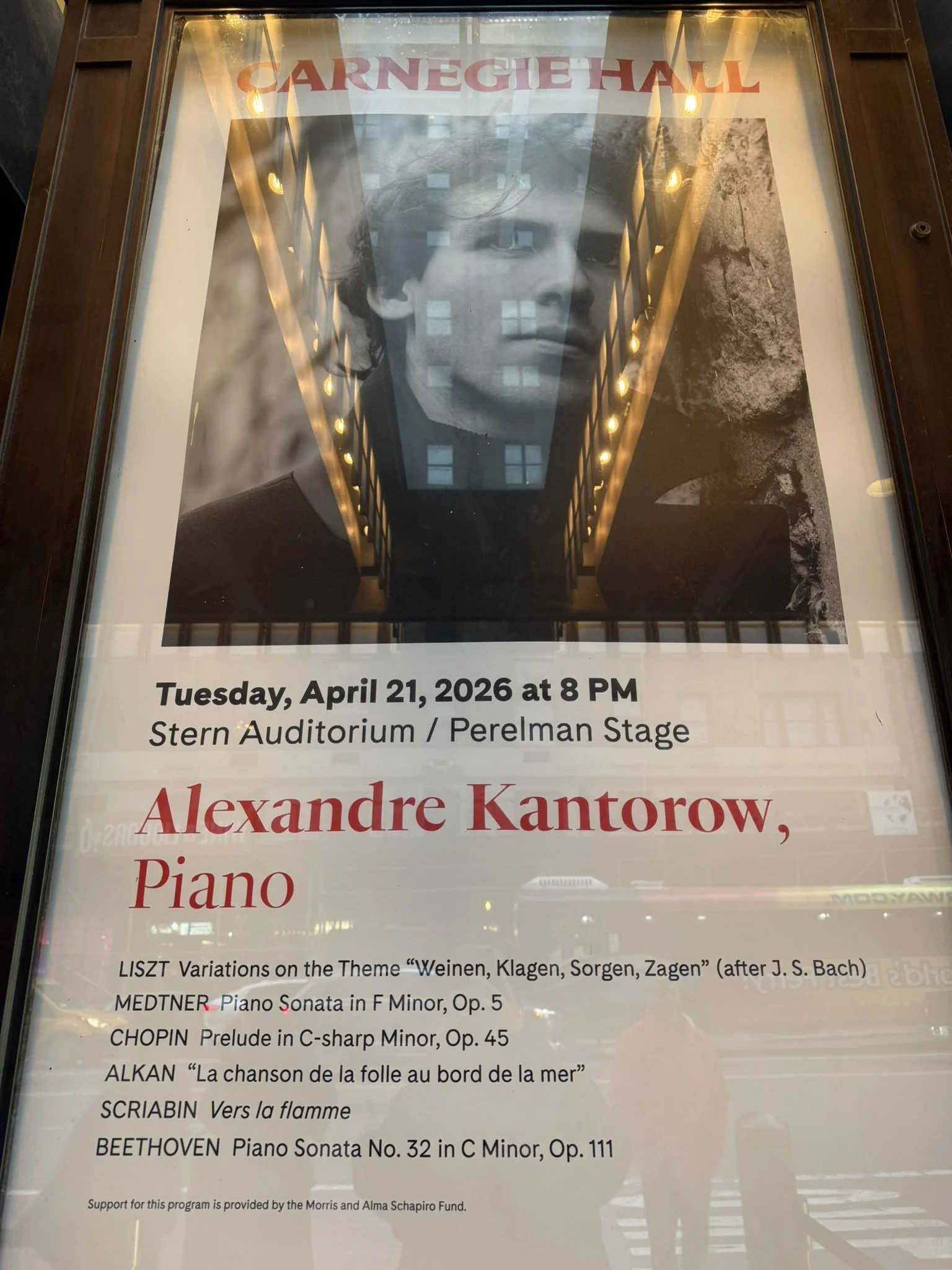
Kantorow's recital at Carnegie Hall on 4.21.2026. Liszt channeled the grief of losing his daughter, layering it upon the pain of Bach. Kantorow vividly brought to life the chromatic descent of the *lamento*—that gravitational pull of sorrow sinking ever deeper. His performance flowed with a natural freedom that never felt disjointed, and no matter how vigorously his hands struck the keys, the tone remained luminous and bright. Finally, a chorale rang out, bringing with it a sense of acceptance—a moment where one could finally embrace that pain. The woman seated next to me was a Russian from Chicago; she mentioned she had heard Kantorow perform solo six times. She told me that Kantorow is a pianist who places great reverence on the quality of his tone. As the Liszt piece concluded, she turned to me and said, "This is your first time hearing Kantorow, isn't it?" Tears welled up in my eyes. The tone had been exquisite. With profound sincerity, Kantorow had held up a mirror to the pain of the human heart.
With a handkerchief pressed against my eyes and my head still bowed, the second piece began: Nikolai Medtner’s (1880–1951) Piano Sonata in F Minor, Op. 5. I had never heard it before. Born in Moscow, Medtner studied under Taneyev and was a junior contemporary of Rachmaninoff. At a time when compositions and virtuosic displays were the prevailing trends, Medtner composed music that turned inward—exploring the depths of the human psyche through the interplay of individual tones and their harmonic layers. In the first movement, the central theme seemed to drift and intertwine—a force as inexorable as the currents of one’s own heart. It shimmered, it whispered, it cried out, it gazed inward, it reminisced—all carried along by Kantorow’s tone, his flow, and his conscious intent. He unleashed the emotional odyssey that Medtner had traversed, laying bare the inner human landscape embedded within the chords. With each repetition, the theme shed its hesitation, emerging with vivid clarity; eventually, it transcended the realm of mere notes to become pure music—as if the winding path it had traveled had been, all along, an inevitable journey.
In the second movement, intermezzo, the theme continued its ceaseless motion; the third movement proceeded with a heavy, deliberate pace. Yet, even amidst the pain, the radiance never fades. And eventually, through his own voice, that light transforms into song. Kantorov’s tone descends deep into the recesses of the soul, and once again, strength wells up from within. Light and shadow stream in, alternating. Liszt’s lament is heard; Medtner then transmutes it into a beacon of hope—a light that surges upward—only to summon the demons back once more. The final movement felt as though it were reversing the passage of time we had just traversed, accelerating backward through it.
Chopin seemed as though all the intense pain, the light, and the hope of the first half dissolved into the music. This time, ascending chords melted seamlessly into the melody. The message to transform pain and struggle into strength, one must sing. It is about listening with one’s own ears—cultivating the discernment to distinguish truly beautiful sound.
As Chopin faded, the audience applauded.
The Alkan piece felt like Spirit and Time. Heavy harmonies advanced beneath a mysterious melody that resembled an ancient incantation. In the Scriabin, the flickering of a small flame had—through Kantorov’s fierce tremolos—caused the Steinway to thunder throughout Carnegie Hall; here, too, that explosive power detonated deep within.
Beethoven’s final piano sonata (Op. 111) stood as a crystallized essence of concentrated power. Amidst its intensely dramatic unfolding, my inner vision seemed to expand endlessly. Glancing around, I saw that everyone in the audience was utterly captivated. From the chilling resonance of the low registers, the music surged upward in an instant into a spirited Allegro. The piece then shifted into the quiet resonance of the Arietta; as the variations unfolded, Kantorov’s trills seemed to venture into a realm no one had ever reached before. It no longer felt like a piano being played, but rather like pure, radiant sound itself. Chords and structural forms vanished, leaving me immersed solely in the light of Beethoven. When the final note faded, my body rose from my seat. And, Kantorow stood right in front of me.
Kantorow infuses an extraordinary amount of love into every sound and chord. While he is free to interpret the music however he chooses, it is utterly fluid; he brings out the brilliance of every single note, never indulging in anything superfluous.
The encore was Liebestod.
4.21.2026
Alexandre Kantorow, Piano
Program
LISZT Variations on the Theme "Weinen, Klagen, Sorgen, Zagen" (after J. S. Bach)
MEDTNER Piano Sonata in F Minor, Op. 5
CHOPIN Prelude in C-sharp Minor, Op. 45
ALKAN "La chanson de la folle au bord de la mer"
SCRIABIN Vers la flamme
BEETHOVEN Piano Sonata No. 32 in C Minor, Op. 111
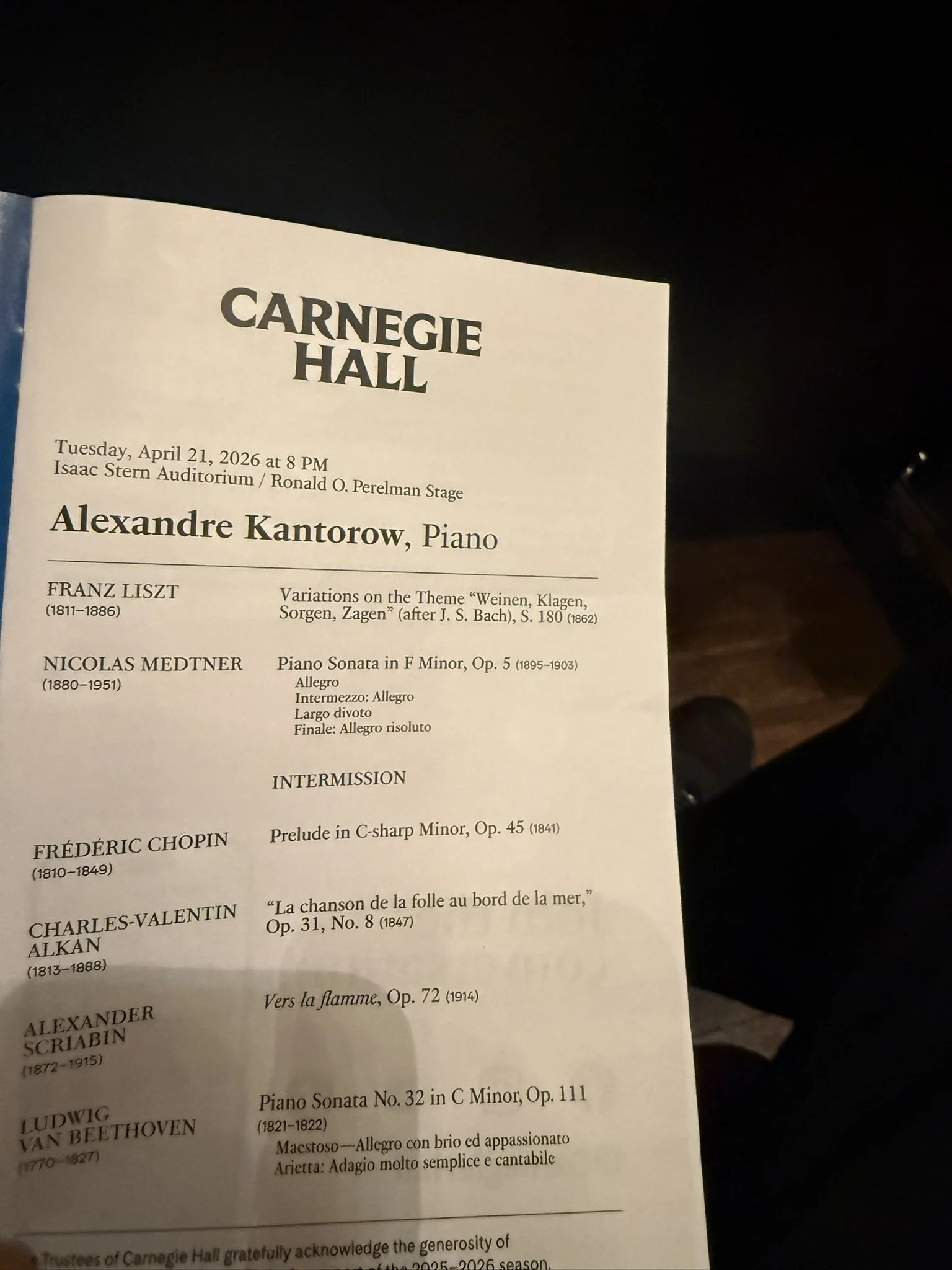
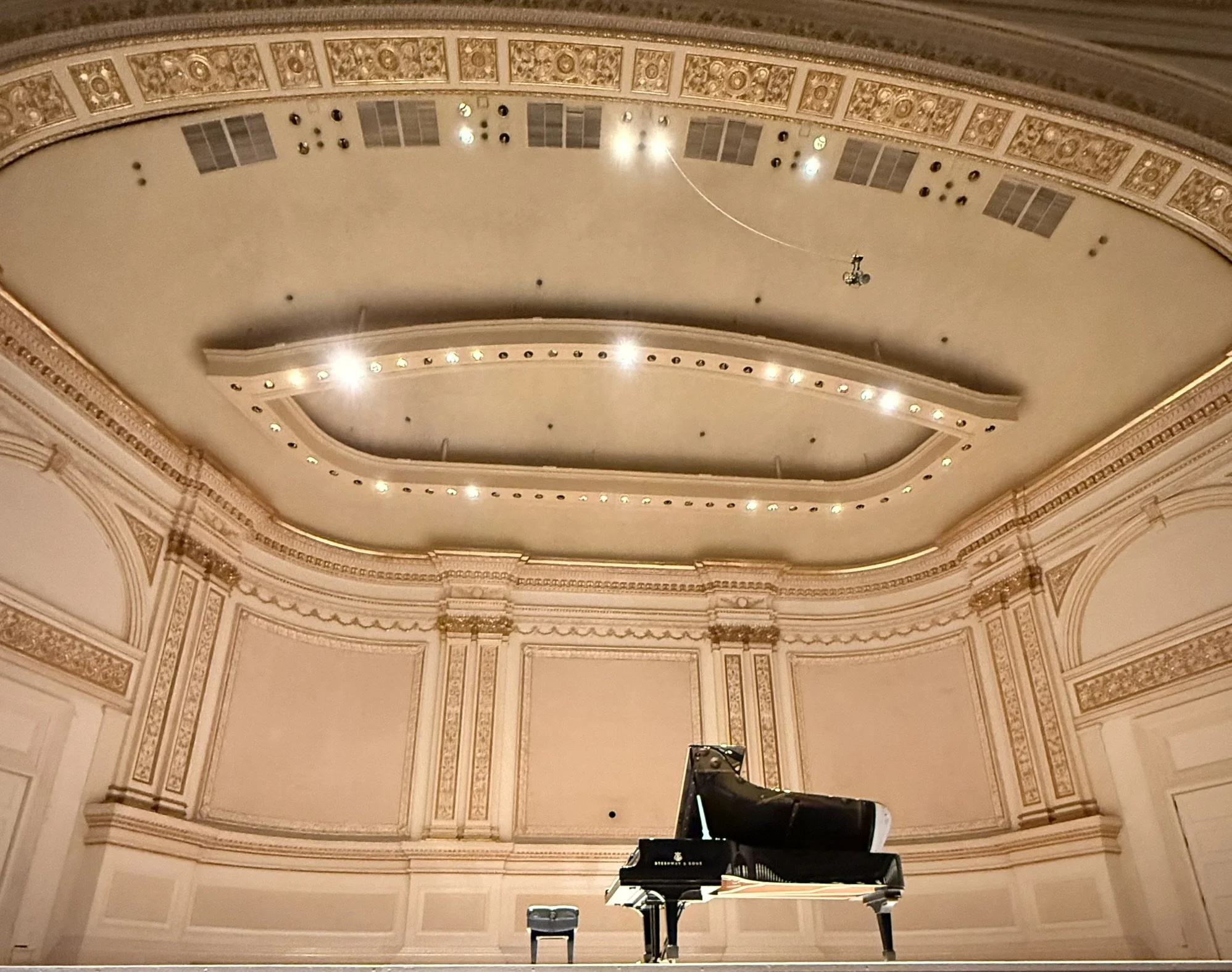
カントロフをカーネギーで聴いた。一曲目はリストが娘を亡くした喪失をバッハの痛みに重ねた曲を演奏した。カントロフはラメントの半音下降、悲しみに沈んでいく重力を鮮やかに響かせていた。演奏は流れが自由に歌っていても不安にならず、彼の手がどんなにピアノを叩いても音色は鮮やかで光っていた。最後にコラールが鳴りその痛みを受け入れることができた。隣の方はシカゴから来たロシア人の女性で、カントロフのソロを6回聴いたそうだ。彼女はカントロフを音色を大事にするピアニストだと教えてくれた。リストが終わり、彼女は「あなたにとって初めてのカントロフだね」と声をかけてくれた。涙が溢れた。音色が美しかった。心の痛みをカントロフは心を込めて映しだしていた。
目にハンカチをあてて下を向いたまま、2曲目が始まった。ニコライ・メトネル(1880-1951)のピアノ・ソナタ ヘ短調 作品5。一度も聴いたことがない。モスクワに生まれタネーエフに師事した。ラフマニノフの後輩だ。メトネルは派手な曲や演奏が流行っていた当時、音とその重なりで内面を見つめる曲を作っていった。1楽章はテーマがまるで自分の心と逆らえない力が漂いながらもつれて、流れて、それは煌めき、つぶやき、叫び、見つめる、思い出す、カントロフの音色と流れ、意識。彼はメトネルが辿った心の旅を解き放つ。コードに込められた人の内側を明らかにしていく。テーマは繰り返される度にためらいが消え、鮮やかに表れ、まるで曲がりくねった道をたどってきたことが必然だったように、やがてただの音と音楽となっていった。
2楽章のインテルメッツォでもテーマが止まらずに絶えず動く。3楽章は重くゆっくり進んでいく。でも痛みの中でも輝きを失わない。そして、やがて自分の言葉で光は歌に変わっていく。カントロフの音色が心の奥に下りていく。そして再び力が湧いてくる。光と影が交互に差し込んでくる。リストのラメントが聴こえる。メトネルはそれを駆け上がる希望の光に変えたり、また悪魔を呼び戻したりする。最後の楽章は、いままでたどってきた時間を逆さにして加速していくように感じた。
前半はこうして終わった。2階のバーで買ったフレッシュコーヒーを飲みながら友人たちと話をし一息ついた。
後半のショパンは、前半の激しい痛みや光、希望がすべて、音の中に溶けていくようだ。今度は昇っていくコードが歌の中で溶けていく。痛みや悩みを力に変えるには歌うのがいいということだ。自分の耳で聴いて、いい音を聴き分ける力を養うことだ。
ショパンが終わると拍手が起こった。
アルカンは精神と時の部屋だった。古代の祈祷のようなミステリアスなメロディに重たい和声が進む。スクリャービンでは小さな炎の揺らめきがカントロフの激しいトレモロで、スタインウェイがカーネギーに轟いたが、ここでも内側で爆発していった。
ベートーヴェンの最後のピアノ・ソナタ(作品111)は凝縮された力の結晶だった。激しいドラマの展開で視界がずっと開けていった。周りを見渡すとみなさん、引き込まれていた。低音のぞっとするような響きから、あっという間にアレグロに駆け上がる。曲はアリエッタの静かな響きに変わり、どんどん変奏していき、今まで誰も到達したことがない領域にカントロフのトリルは入り込んでいくようだった。ピアノというよりは輝く音そのものだった。コードや構成が消え、ベートーベンの光の中にいた。曲が終わると椅子からすっと立ち上がった。目の前にカントロフが立っていた。
カントロフは音や和音にこもる愛が半端ない。その中で何をやるかは彼の自由だが、聴いたら演奏によどみがなくすべての音を引き立て、余計なことを全くしない。
アンコールはトリスタンの愛の死。