To Amandine,
light and shadow, human draw
By fragments oscillate between the intangible, like a puzzle. Each piece picked up along the journey is like a pearl.
Everything fits onto a single chair.
When encountering melancholic notes, touch them sweetly and delicately.
Habits and gestures become pearls.
Affect and bizarrerie.
Look at them again and again.
Spending time together at Carnegie Hall.
I have encountered the melancholy notes that Amandine Beyer has been looking for.
Even if you gather knowledge, it becomes useless in front of,
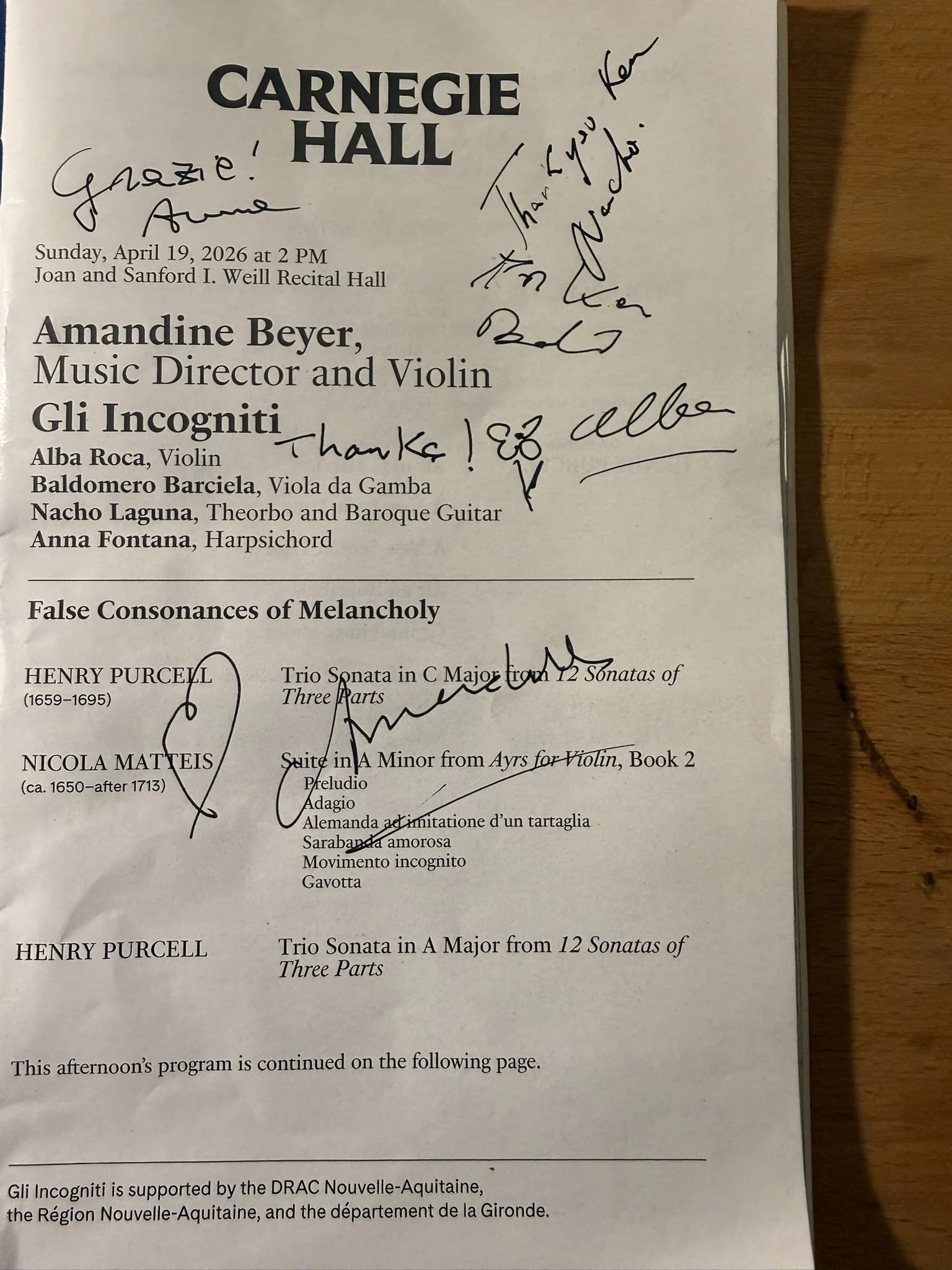
Amandine Beyer, Music Director and Violin
Gli Incogniti
- Alba Roca, Violin
- Baldomero Barciela, Viola da Gamba
- Nacho Laguna, Theorbo and Baroque Guitar
- Anna Fontana, Harpsichord.
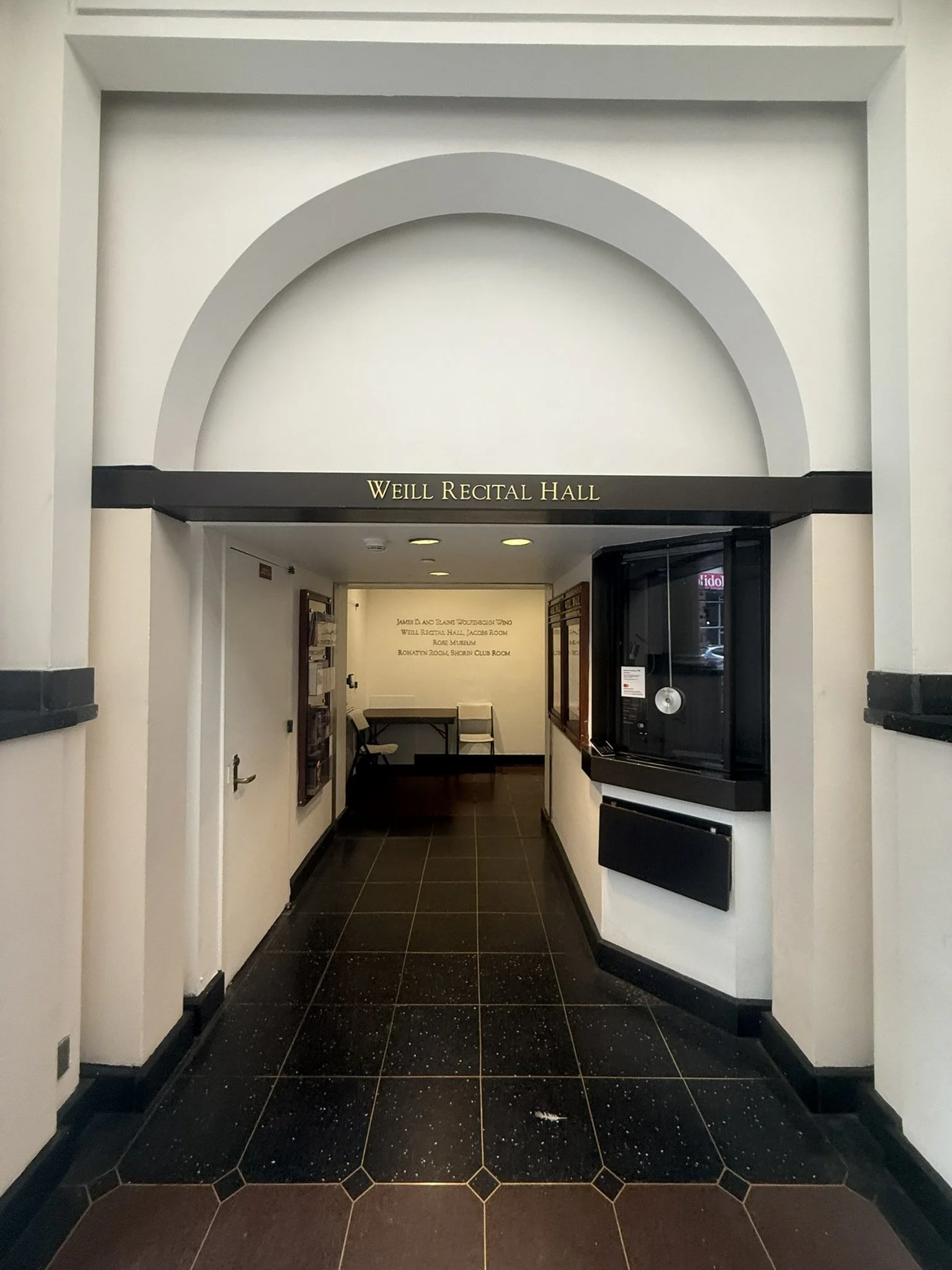
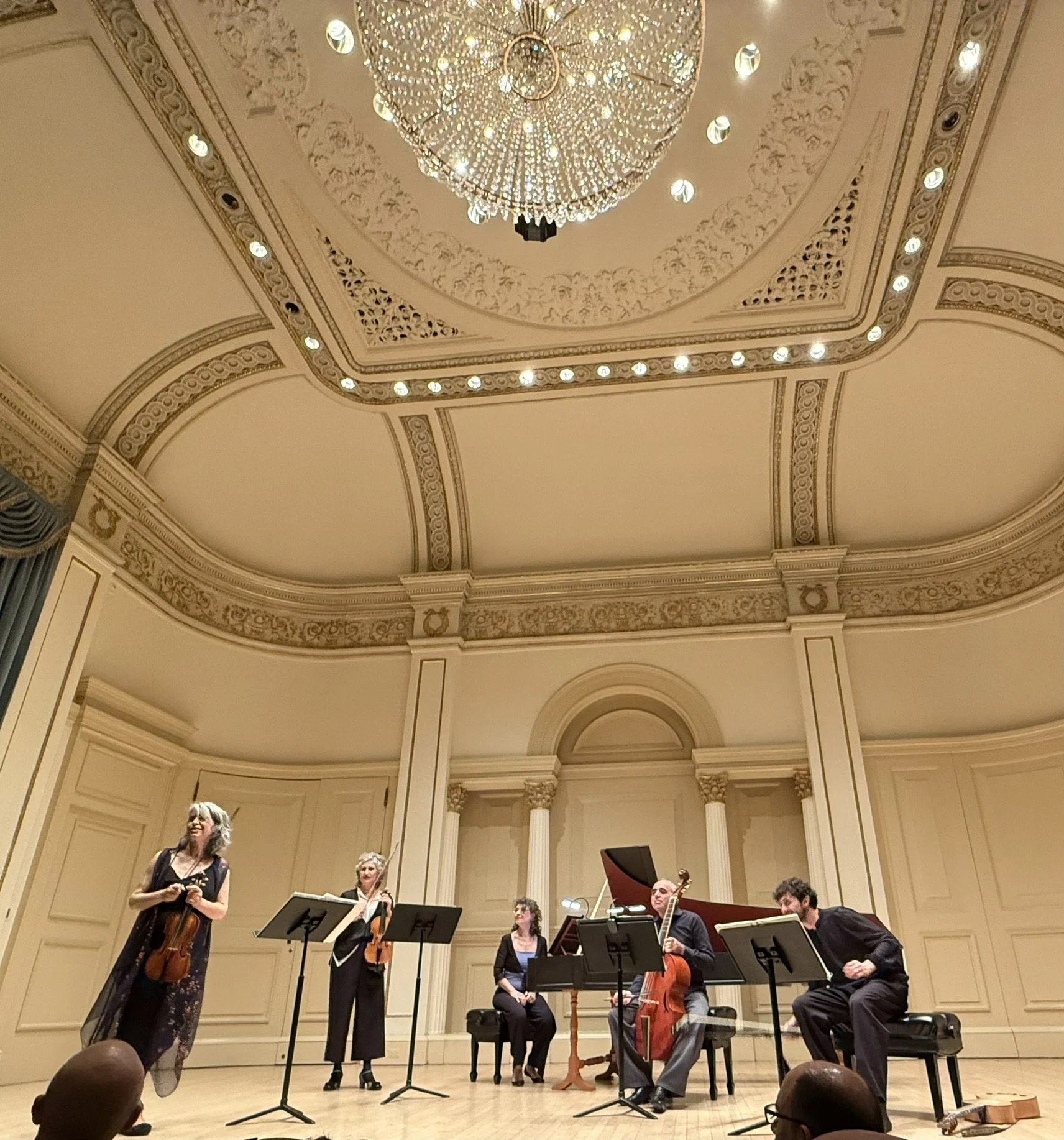
The heart melts. Flows and sounds never met before at Carnegie Hall. The music flows fresh, raw, alive. Overflowing with the play. Overflowing with love for music at Weill Recital Hall.
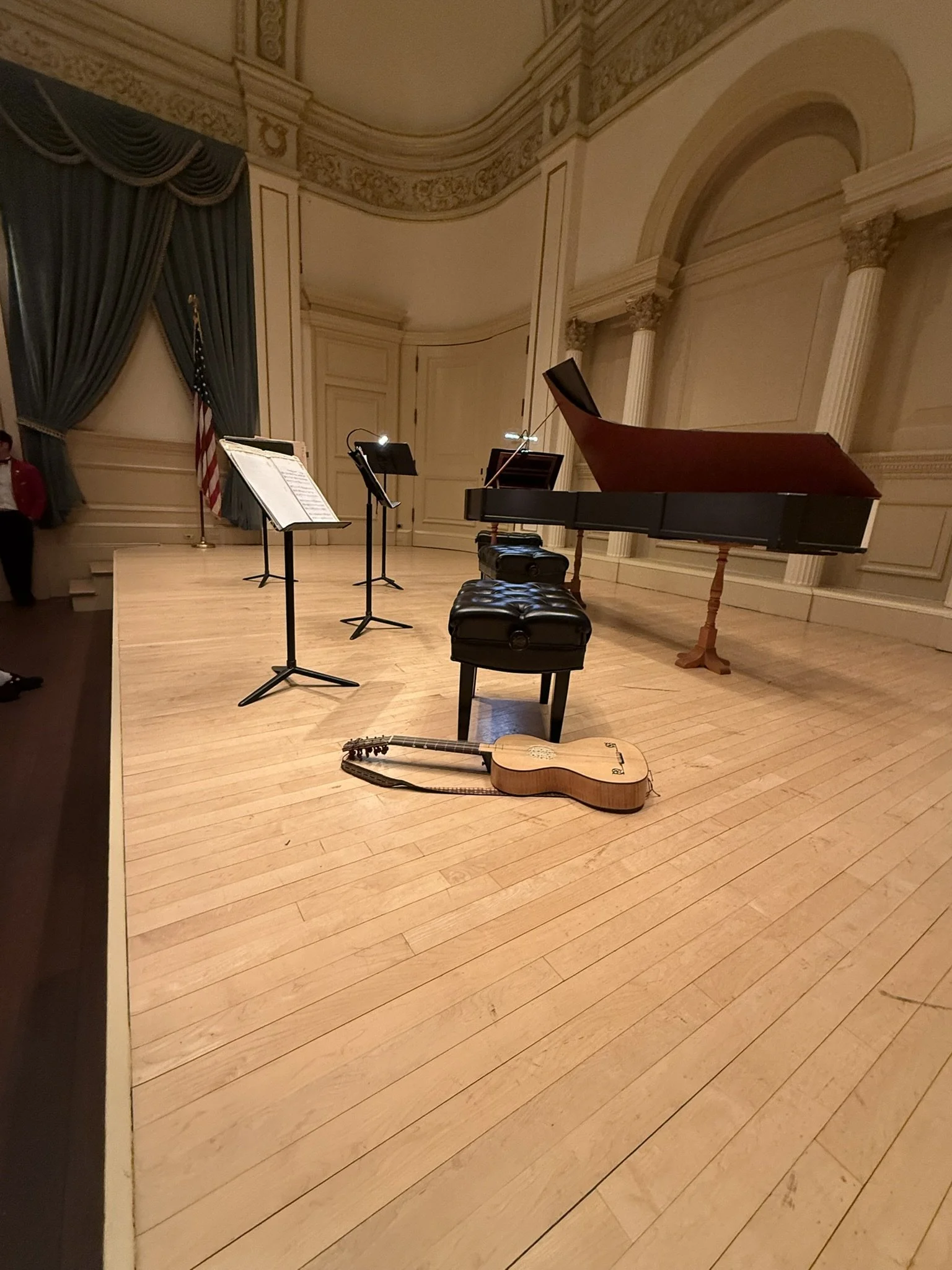
All four are protagonists—there is no center. Melody, harmony, rhythm—everything is fascinating. Even when the sound is loud, or when it is a whisper, Baldomero on viola da gamba tells Amandine, Alba, and Anna, harpsichord, one after another from the left, “sing, speak more, speak more,” while Nacho on theorbo and baroque guitar unfolds his freestyle.
There is no center at all. Before you notice, the speaker has changed. Loud voice or small voice. In the dense, layered sound of the Met Orchestra, when Silvio’s clarinet can be heard, that enormous pit becomes crystal clear. Nacho’s freestyle had that kind of fascination.
In the turbulent late 1650s, Matteis came from Italy and sparked a musical movement. This concert is an attempt to do the same again at Carnegie Hall today. In London at the time, ticketed public concerts had just begun, and after the Puritan Revolution, citizens enjoyed music at home or in taverns. Into this world came a very serious Italian musician, and the dull, French-influenced aristocratic elite—soulless, status-obsessed wealthy patrons—thought, “Who is this guy?” and began to support him, include him, and eventually change their taste because of him.
Purcell was born in London and began working in the royal musical establishment as a teenager, becoming organist at Westminster in his twenties. When these two figures are unfolded simultaneously, a two-dimensional London appears. Just as wealthy people’s trousers change—torn, widened, tightened—Purcell absorbed Matteis’s way of making music speak human emotion through instruments and began to compose with it.
It happened on 4.19.2026
Performers
Amandine Beyer, Music Director and Violin
Gli Incogniti
Alba Roca, violin
Baldomero Barciela, viola da gamba
Nacho Laguna, theorbo and baroque guitar
Anna Fontana, harpsichord
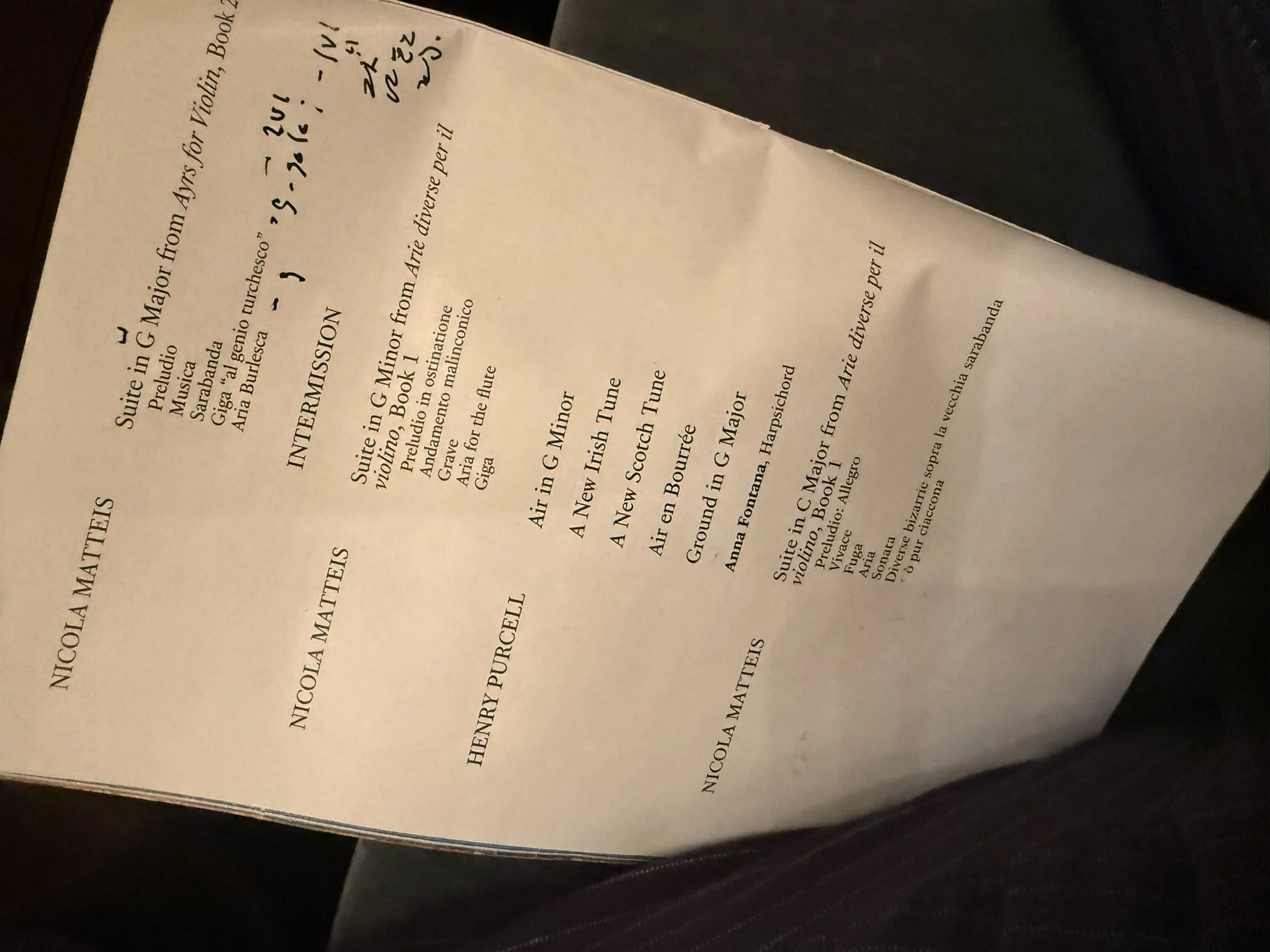
False Consonances of Melancholy
Program
Purcell: Trio Sonata in C major, Z. 795
Matteis: Suite in A minor, Book 2
Purcell: Trio Sonata in A major, Z. 799
Matteis: Suite in G major, Book 2
Intermission
Matteis: Suite in G minor, Book 1
Purcell: Selected works
Matteis: Suite in C major, Book 1
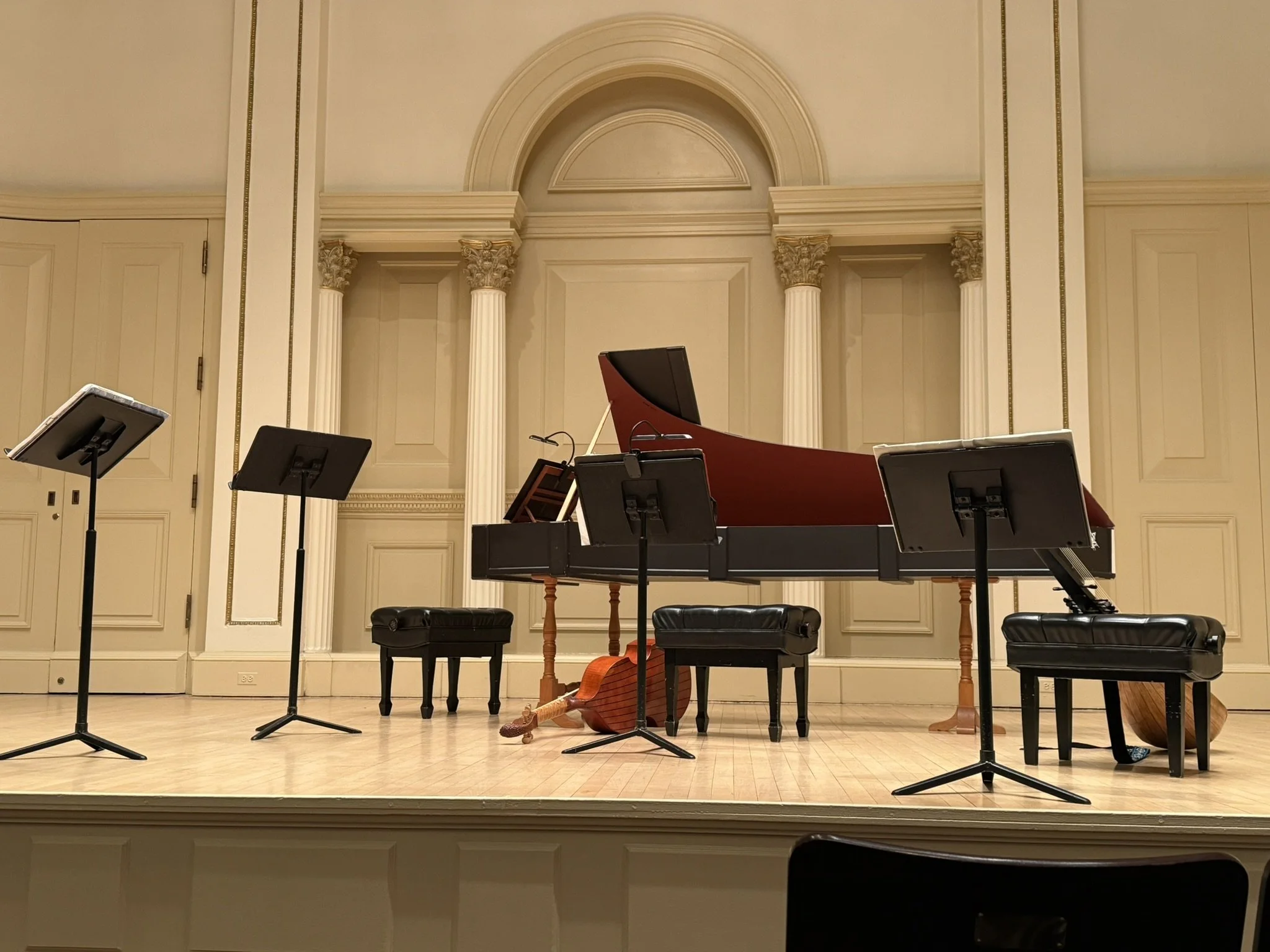
In the second half, it almost doesn’t matter which comes where. Looking at the keys, everything is simple—nothing overly complex is being done. Yet what is depicted is a world where the angle of sunlight changes and the timbre naturally transforms.
There are moments that feel like people speaking. There are also moments when something the musicians have seen passes through the space.
The first half is from Book 2 of Matteis’s Ayrs, the second half from Book 1. It felt like listening to Bach.
How Matteis learned the French suite style. How he learned the allemande. In school, allemande is taught as a German dance, but Anna on harpsichord said it was fashionable everywhere at the time. No one is telling me!
Matteis absorbed music the way one drinks alcohol or smokes in London houses and taverns.
At times, Alba, the other violinist, disappears from the stage, and the four continue as an ensemble. In certain sections, the gamba, guitar, and Amandine’s violin enter into a concert-like dialogue. Anna’s harpsichord, though supposed to support, at some point becomes the most vocal voice, even while staying in the back.
Amandine’s Matteis, when Alba is absent, feels like one person playing as if two violinists exist. Close your eyes and there are two; open them and only Amandine remains.
Matteis Book 2 in G major. They are masters of drawing patterns in the shadow of sound.
The second half begins with G from Book 1. It feels like Bach.
Matteis began publishing radical “music textbooks” in corrupt London around 1676. Bach was writing suites in his Weimar period around 1710.
Whether Matteis’s style reached Bach, or whether suites were simply everywhere, I do not know—but for Amandine, Matteis is as essential as Bach for understanding how to make music.
To create good music, it is not enough to “open your heart and get along with everyone.” One must pursue what one truly thinks. Otherwise, it decays—and performances like this cannot emerge.
This ensemble has four players, but in Boston, there are more than 100 involved in various ways. In Vienna, however, their stubbornness and tension produce crystalline performances. Constant coexistence creates culture.
Perhaps the Sex Pistols in London three hundred years after Matteis were also because of him. I don’t know.
But what we heard today—whether proto-punk, electronic, pop, or opera—feels not so distant. Whether it is electricity or tattoos, if you close your eyes, it is not that far apart. What matters is freedom.
Yet the reason such freedom produces such precision is mind and discipline.
Amandine Beyer was born in 1974 in Aix-en-Provence, studied recorder and violin from childhood, later studied modern violin at the Paris Conservatoire, and then specialized in baroque violin at the Schola Cantorum Basiliensis in Basel under Chiara Banchini. She followed the same path as my own teacher.
Originally a modern flutist in Cologne, he encountered Frans Brüggen, switched to period flute, and eventually became a musicologist because his curiosity could not be confined.
Through baroque instruments, she projects the sound pressure and dynamics of the modern violin. Holding the instrument below the chin, she releases sound that spreads like thin membranes of air through space. Sound is also heard from behind.
What matters is that each person finds what shines most for them. When that feeling fills the space, people begin to resonate. A next human. A superhuman.
In 2006, she founded Gli Incogniti. In 2009, she released recordings of Matteis. Twenty years after its founding, they arrive at Carnegie Hall—at exactly this moment.
Because what they are doing aligns with current ideas of “Innocence.” And what they show includes even the Boston situation.
Weill is small, but the audience mixes old and new. In that sense, it feels like a miniature of the Met or Boston.
No matter how skilled classical musicians become, they cannot be sold like Tiffany diamonds.
False Consonances of Melancholy
This is a music textbook that asks: “How do you feel?”
Matteis wrote it. It is about what kind of resonance moves your heart.
It is like Saariaho’s Innocence: language, acting, and other forms of expression integrated into music. Whether it tastes good or not depends entirely on individual aesthetic.
It is far removed from the habit of copying similar images on Instagram.
How will those photographing today interpret and transmit these musicians?
Amandine Beyer's Own Words
Each time I play the music of Nicola Matteis, I get a very special pleasure from it: the pleasure of crossing the frontier between our world and his, practically within a bow stroke of today, yet so assertive in its originality.
His music and his inventions always oscillate between certainty and magic, the known and the impalpable. The path leading to understanding Matteis is strewn with pitfalls because of the halo of mystery that surrounds him. But for me, it is something like an initiation quest, worthy of a fairy tale, where each piece picked up en route is a pearl whose powers of evocation have been preserved intact. In my view, the uncanny power of his music comes from the juxtaposition of very familiar elements with pieces from a puzzle. What is certain are violinistic aspects of his compositions: Melody, meter, and harmony, each play its well established role. Matteis was an excellent violinist, and one immediately senses it when listening to and playing his music. Everything falls under the fingers. The pieces are reassuring in formal terms. There is everything required to make up fine suites with typical dances, some of which seem to have stepped straight out of folklore—simple and charming.
But along with this, there is an ever-present aleatory element to amaze, confuse, and destabilize us. Of course, the tone is violinistic, but more than once, the harmonies are surprising; the melodic line seems suddenly to be seized by depression or madness; and the well-behaved rhythms grow obsessive to the point of giddiness. This must surely have something to do with Matteis’s prickly character!
Although this may seem a highly empirical observation, I am convinced that for a musician-composer, musical technique and invention are closely connected, and that if we try to get as close as possible to the way Matteis himself played, it can have a drastic influence on the performer’s musical gesture. To bring our two worlds closer together, I have tried therefore a different physical approach to the violin. What follows is a brief attempt to explain this decision, which led me to call my habits into question in a fairly dangerous way. I hope the listener will feel it was worthwhile!
When learning to play a musical instrument, one always starts from fundamentals more or less well established by tradition with the aim of mastering a given technique that then allows one to express one’s musical ideas. But things are often rather different with period instruments, since in the 17th century, the notion of a school of playing was not yet firmly established and almost every musician had his own technique. The case of Nicola Matteis gave us the chance to experiment, to look for and come up with extremely varied solutions.
Many descriptions have been preserved of this violinist’s playing style after his arrival in London, where he apparently held his instrument very low (around the level of the lower ribs), a position seen in many 17th-century paintings (especially from the Netherlands) that must surely be closely connected to folk practice. Upon trying out this low position (while of course taking into account female physiology!), one discovers that Matteis’s music is perfectly suited to the technique, which in fact poses no insolvable problems: There are few shifts, and the double stops are carefully chosen. The two most surprising consequences are: first, the modification in the violin sound, which clearly becomes more resonant with more harmonics; and second and above all, the effect on the bow, which in my opinion creates a transfer of weight that helps to concentrate the musical intention on the phrase rather than the instrument. One can play in a lighter, more relaxed way, and bring out the evocative, even melancholy, mood of many of the pieces. Reading John Evelyn’s description of Matteis’s playing in 1674—“I heard that stupendious Violin Signor Nicholao ... whom certainly never mortal man Exceeded on that instrument: he had a stroak so sweete, & made it speake like the Voice of a man; & when he pleased, like a Consort of severall Instruments ...”—one immediately grasps the notion that technique can also give us keys to interpretation.
Hence, in order to make all the changes of affect and “bizzarrie” perceptible, we have tried to follow the “Good advice to play well” that Matteis gives in The False Consonances of Musick: “You must not play allwayes alike, but somtimes Lowd and sometimes softly, according to your fancy, and if you meet with any Melancholy notes, you must touch them sweet and delicately.” And please believe us when we say that every effort has been made to find those melancholy notes and share them with you.
—Amandine Beyer

沢山知識を集めても、彼らの前では役に立たない。心が溶けていく。カーネギーで出会ったことがない音と流れ。流れる音楽が瑞々しい。生生しい。遊びに溢れている。音楽愛に満ち溢れている。4人すべてが主役で、中心が存在しない。メロディもハーモニーも刻みも全て面白い。大きな音が鳴っていても、小さなささやきも、ガンバのバルドメロは、どんどん歌え、しゃべれとアマンディーヌとアルバを、チェンバロを左から順に次々語らせ、テオルボ と バロック・ギターのナチョがフリースタイルを繰り広げたりする。中心が全く分からない。気が付くと話す人が変わっている。大きな声でも小さな声でも。メットオケの分厚い音色や複雑な音の層の中心に、シルビオのクラリネットが聴こえるときは、あのでかいピットが物凄く澄んでいるときだ。ナチョのフリースタイルはそういう面白さだった。
激動の1650年後半に、マッティスがイタリアからやってきて、音楽ムーブメントを巻き起こす。それを今カーネギーでやってみましょうという会だ。当時のロンドンでは切符を売って演奏会を開くスタイルが始まっていて、清教徒革命後の市民は家やバーで音楽を楽しんでいた。そこにイタリアからめっちゃ真面目な音楽野郎がやってきて、くそつまらないフランスかぶれの王宮趣味の魂が死んでいる貴族かぶれの富裕層が、なんだこいつはと援助し、仲間にいれ、彼らの趣味を変えていった。パーセルはロンドン生まれで、10代から宮廷音楽団で仕事をし始め、20代でウェストミンスターのオルガニストになったオルガニスト。この2人を彼らは同時に繰り広げると、当時の2次元のロンドンが見えてくる。金持ちのズボンは破けたり、太くなったり、細くなったりするのと同じで、パーセルはマッティスがやった人間の気持ちを楽器にぶつけてしゃべるやり方を取り入れて音楽を作っていった。
4.19.2026
Performers
Amandine Beyer, Music Director and Violin
Gli Incogniti
- Alba Roca, Violin
- Baldomero Barciela, Viola da Gamba
- Nacho Laguna, Theorbo and Baroque Guitar
- Anna Fontana, Harpsichord
False Consonances of Melancholy
憂鬱の偽りの協和
PURCELL Trio Sonata in C Major from 12 Sonatas of Three Parts, Z. 795
MATTEIS Suite in A Minor from Ayrs for Violin, Book 2
PURCELL Trio Sonata in A Major from 12 Sonatas of Three Parts, Z. 799
MATTEIS Suite in G Major from Ayrs for Violin, Book 2
Intermission
MATTEIS Suite in G Minor from Arie diverse per il violino, Book 1
PURCELL Selected Works
MATTEIS Suite in C Major from Arie diverse per il violino, Book 1
後半はどっちでもよくなった。これを見るとキーが全部単純。複雑なことをしていないが、描かれていた世界は、太陽の光が角度を変えて音色が自然に変わる。人が話すような場面もあったし、彼らが見て来た何かがそこを取りすぎるような感覚もした。前半はマッティスのエアーの2巻、後半は1巻。バッハを聴いているようだった。マッティスがどうやってフランス組曲のスタイルを覚えたか。アレマンドをどうやって覚えたか。学校でアレマンドはドイツ舞曲だと教えるが、チェンバロのアンナは当時はどこでも流行ってたと言っていた。マッティスはロンドンの家やパブで酒やたばこを飲むように音楽を吸収していったんだろうな。時々、もう一人のバイオリンのアルバがステージからいなくなって4人で合奏した。部分によってはガンバやギターとアマンディーヌのバイオリンが協奏した。アンナのチェンバロはそれをサポートしているはずなのにいつの間にか後ろなのに一番よく歌っていたりする。アマンディーヌのマッティスは、アルバがいないときは、1人で2人のバイオリニストが演奏しているようだった。目をつぶると2人いて、開くとアマンディーヌしかいない。マッティスのG 2巻。彼らも音の影に模様を描く天才だ。後半はマッティスの1巻のgで始まる。バッハだった。マッティスが腐ったロンドンで過激な音楽教科書を発売し始めたのは1676年。バッハが組曲を書いていたのはワイマール時代の1710年ごろ。マッティスがロンドンに持ち込んだスタイルがバッハに伝わったか、そこら中組曲だらけだったかはしらないが、アマンディーヌにとってマッティスはバッハのように音楽をするためにとても大切な人だ。いい音楽を描くためには、心を開いてみんなと仲良くではだめで、自分はどう思っているか追及しないと腐敗していく、そしてこのグループのような演奏にはならない。この方たちは4人だが、ボストンはいろいろ含めたら100人超える。それで超もめている。しかし、ウィーンでは、彼らの頑固さとタフなぶつかり合いがクリスタルのような名演が生まれる。絶え間ない共存が美しい文化を育むということだ。もしかしたら、マッティスの300年後にロンドンでセックスピストルズが出てきたのはマッティスのせいかもしれない。わからない。
しかし、今日聴いた彼らはパンクでもエレクトロでも歌謡曲でもオペラでも、それが電気かタトゥーがかっこいいか、目をつぶるとそんなに遠くない。要は自由なのだ。
しかしなぜ彼らがここまで自由なのに、精密な演奏を繰り広げるかは、それはマインドと鍛錬である。
アマンディーヌベイヤーは、1974年にフランスのエクス=アン=プロヴァンスで生まれ、幼い頃からリコーダーとヴァイオリンを学び、後にパリ音楽院でモダン・ヴァイオリンを学んだあと、スイス・バーゼルのSchola Cantorum Basiliensisで、Chiara Banchiniに師事し、バロック・ヴァイオリンを専門にする。私の先生と同じコースだ。元々、モダンフルートでケルンで、ブリュッヘンに出会い、トラベルソに転向するが、結局興味を限定できなくて音楽学者になった。アマンディーヌはモダンバイオリンの音の張りやダイナミクスを、古楽器を使って、顎より下で楽器を構え、時にワイルの空間に彼れらの解き放った音色は細かな音の膜の様にいっぱいに広がっていった。後ろからも音が聴こえてきた。要は何が一番輝いているかはその人それぞれだということだ。そういう気持ちが空間を満たしたときに、人は共鳴をし始める。ネクストヒューマン。超人。
アマンディーヌは2006年にGli Incognitiを結成する。2009年にマッティスの録音も出している。結成から20年でカーネギーにやってきたのか。しかもこのタイミングで。なぜなら、今話題のイノセンスと彼らは同じことをやっていたからだ。そして、ボストン事件も彼らが見せてくれたことは包括している。ワイルは小さなリサイタルホールだが、集まる連中は新旧一緒だ。だからメットやボストンの縮図がもっと間近に感じる。クラシック音楽家はどんなに腕を磨いても、ティファニーのダイヤのようには売れない。
False Consonances of Melancholy
憂鬱の偽りの協和
これは、おまえはどう感じるんだを語る音楽の教科書。マッティスが書いた。自分がどういう響きに心を打たれるのか、サリアホのイノセンスだ。サリアホは言葉、演技、そのほかの表現が音楽と統合されたり共存している。その味がうまいかどうかはその人本人の審美眼にかかっている。それはインスタに上がっている似たような写真を次々コピーする人の嗜好とはかけ離れている。今日写真を撮っている方は、この方たちをどう捉えて伝えるんだろう。
以下、アマンディーヌの言葉、
In the Artist’s Own Words
Each time I play the music of Nicola Matteis, I get a very special pleasure from it: the pleasure of crossing the frontier between our world and his, practically within a bow stroke of today, yet so assertive in its originality.
His music and his inventions always oscillate between certainty and magic, the known and the impalpable. The path leading to understanding Matteis is strewn with pitfalls because of the halo of mystery that surrounds him. But for me, it is something like an initiation quest, worthy of a fairy tale, where each piece picked up en route is a pearl whose powers of evocation have been preserved intact. In my view, the uncanny power of his music comes from the juxtaposition of very familiar elements with pieces from a puzzle. What is certain are violinistic aspects of his compositions: Melody, meter, and harmony, each play its well established role. Matteis was an excellent violinist, and one immediately senses it when listening to and playing his music. Everything falls under the fingers. The pieces are reassuring in formal terms. There is everything required to make up fine suites with typical dances, some of which seem to have stepped straight out of folklore—simple and charming.
But along with this, there is an ever-present aleatory element to amaze, confuse, and destabilize us. Of course, the tone is violinistic, but more than once, the harmonies are surprising; the melodic line seems suddenly to be seized by depression or madness; and the well-behaved rhythms grow obsessive to the point of giddiness. This must surely have something to do with Matteis’s prickly character!
Although this may seem a highly empirical observation, I am convinced that for a musician-composer, musical technique and invention are closely connected, and that if we try to get as close as possible to the way Matteis himself played, it can have a drastic influence on the performer’s musical gesture. To bring our two worlds closer together, I have tried therefore a different physical approach to the violin. What follows is a brief attempt to explain this decision, which led me to call my habits into question in a fairly dangerous way. I hope the listener will feel it was worthwhile!
When learning to play a musical instrument, one always starts from fundamentals more or less well established by tradition with the aim of mastering a given technique that then allows one to express one’s musical ideas. But things are often rather different with period instruments, since in the 17th century, the notion of a school of playing was not yet firmly established and almost every musician had his own technique. The case of Nicola Matteis gave us the chance to experiment, to look for and come up with extremely varied solutions.
Many descriptions have been preserved of this violinist’s playing style after his arrival in London, where he apparently held his instrument very low (around the level of the lower ribs), a position seen in many 17th-century paintings (especially from the Netherlands) that must surely be closely connected to folk practice. Upon trying out this low position (while of course taking into account female physiology!), one discovers that Matteis’s music is perfectly suited to the technique, which in fact poses no insolvable problems: There are few shifts, and the double stops are carefully chosen. The two most surprising consequences are: first, the modification in the violin sound, which clearly becomes more resonant with more harmonics; and second and above all, the effect on the bow, which in my opinion creates a transfer of weight that helps to concentrate the musical intention on the phrase rather than the instrument. One can play in a lighter, more relaxed way, and bring out the evocative, even melancholy, mood of many of the pieces. Reading John Evelyn’s description of Matteis’s playing in 1674—“I heard that stupendious Violin Signor Nicholao ... whom certainly never mortal man Exceeded on that instrument: he had a stroak so sweete, & made it speake like the Voice of a man; & when he pleased, like a Consort of severall Instruments ...”—one immediately grasps the notion that technique can also give us keys to interpretation.
Hence, in order to make all the changes of affect and “bizzarrie” perceptible, we have tried to follow the “Good advice to play well” that Matteis gives in The False Consonances of Musick: “You must not play allwayes alike, but somtimes Lowd and sometimes softly, according to your fancy, and if you meet with any Melancholy notes, you must touch them sweet and delicately.” And please believe us when we say that every effort has been made to find those melancholy notes and share them with you.
—Amandine Beyer
ニコラ・マッティスの音楽を弾くたびに、私は特別な喜びを感じます。それは、私たちの世界と彼の世界の境界を越える喜びです。ほとんど一つの弓の動きの中に現代へとつながる距離にありながら、その音楽は強い独創性を持っています。
彼の音楽と発想は、常に「確かさ」と「魔法」、「理解できるもの」と「捉えどころのないもの」のあいだを揺れ動いています。マッティスを理解する道は、彼を取り巻く神秘的なオーラのために、多くの落とし穴に満ちています。しかし私にとってそれは、まるで童話のような“通過儀礼(イニシエーション)”のようなもので、その旅の途中で拾う一つひとつの作品は、いまなおその喚起力を失っていない真珠のようです。
私の考えでは、彼の音楽の不思議な力は、非常に親しみのある要素と、パズルのような断片的要素が並置されていることにあります。確かなのは、彼の作品のヴァイオリン的な側面です。旋律、拍子、和声はそれぞれ確立された役割を果たしています。マッティスは優れたヴァイオリニストであり、彼の音楽を聴き、弾けばすぐにそれが感じ取れます。すべてが指の下に自然に収まります。作品は形式的にも安心感があります。典型的な舞曲による優れた組曲を作るための要素はすべて揃っており、その中にはまるで民俗音楽からそのまま抜け出してきたような、素朴で魅力的なものもあります。
しかしその一方で、驚きや混乱、そして私たちを不安定にさせる偶然性の要素が常に存在します。もちろん音色はヴァイオリン的ですが、しばしば和声は驚くべきものであり、旋律は突然、憂鬱や狂気にとらわれたかのように見えます。そして整ったリズムは、陶酔に近いほど執拗になります。これはおそらく、マッティスの気難しい性格と関係があるのでしょう。
これは非常に経験的な観察に思えるかもしれませんが、私は、作曲家でもある音楽家にとって、音楽技術と創造性は密接に結びついていると確信しています。そして、マッティス自身の弾き方にできるだけ近づこうとすることは、演奏者の音楽的身振りに大きな影響を与え得るのです。私たちと彼の世界を近づけるために、私はヴァイオリンに対してこれまでとは異なる身体的アプローチを試みました。以下はその決断の簡単な説明であり、それは私の習慣をかなり危険な形で問い直すことになりました。聴き手がそれを価値あるものと感じてくださることを願っています。
楽器を学ぶとき、人は常に伝統によってある程度確立された基礎から始め、それによって技術を身につけ、それが音楽表現を可能にします。しかし古楽器の場合は事情が異なることが多く、17世紀にはまだ「演奏の学校」という概念が確立されておらず、ほとんどの音楽家がそれぞれ独自の技法を持っていました。ニコラ・マッティスの場合、それは実験の機会であり、非常に多様な解決方法を探し出すことを可能にしました。
ロンドンに到着したこのヴァイオリニストの演奏については多くの記述が残っており、彼は楽器をかなり低い位置(下肋骨のあたり)で構えていたとされています。この姿勢は17世紀の多くの絵画にも見られ(特にオランダ絵画)、民俗的な実践と密接に関係していたと考えられます。この低い構えを試してみると(もちろん女性の身体的条件を考慮しつつ)、マッティスの音楽はこの技法に非常に適しており、実際ほとんど無理のないことが分かります。ポジション移動は少なく、重音も慎重に選ばれています。
最も驚くべき結果は二つあります。第一に、ヴァイオリンの音が変化し、明らかにより響きが豊かになり倍音が増えること。第二に、そして何より重要なのは、弓への影響です。そこでは重さのかかり方が変化し、音楽的意図が楽器そのものではなくフレーズに集中されるようになります。その結果、より軽く、よりリラックスした演奏が可能になり、多くの作品に含まれる喚起的で、ときに憂鬱な雰囲気を引き出すことができます。
1674年のジョン・エヴリンによるマッティスの演奏の記述——「私はあの驚異的なヴァイオリン奏者ニコラオ氏を聴いた。彼に勝る者は誰もいないだろう。彼の弾き方は非常に甘美で、まるで人間の声のように語り、望めば複数の楽器の合奏のようにも聴こえた」——を読むと、技術が解釈の鍵にもなり得ることがすぐに理解できます。
したがって、あらゆるアフェクト(情念)の変化や「ビザール(奇想)」を明確にするために、私たちはマッティスが『音楽の偽りの不協和音(The False Consonances of Musick)』で述べた「良い演奏のための助言」に従うことを試みました。
「いつも同じように弾いてはいけない。ときには強く、ときには弱く、自分の感覚に従って弾くべきである。そして憂鬱な音に出会ったときは、それを甘く繊細に触れなさい。」
そして、その憂鬱な音を見つけ出し、皆さんと共有するために、あらゆる努力を尽くしたと信じていただきたいと思います。
—アマンディーヌ・ベイヤーへ
人間が描く光と影は
捉えどころのないものの間で揺れ動く
パズルの様な断片に魅了され
旅の途中で拾うひとつひとつが真珠の様だ。
全ては一つの椅子の上に全て修まる。
憂鬱な音に出会ったときは、甘く繊細に
習慣や身振り手振りが真珠となる。
アフェクトとビザール
それを何度も見直すこと
カーネギーで時を共に過ごす
アマンディーヌが探し続けた melancholy notes と私は出会った。