
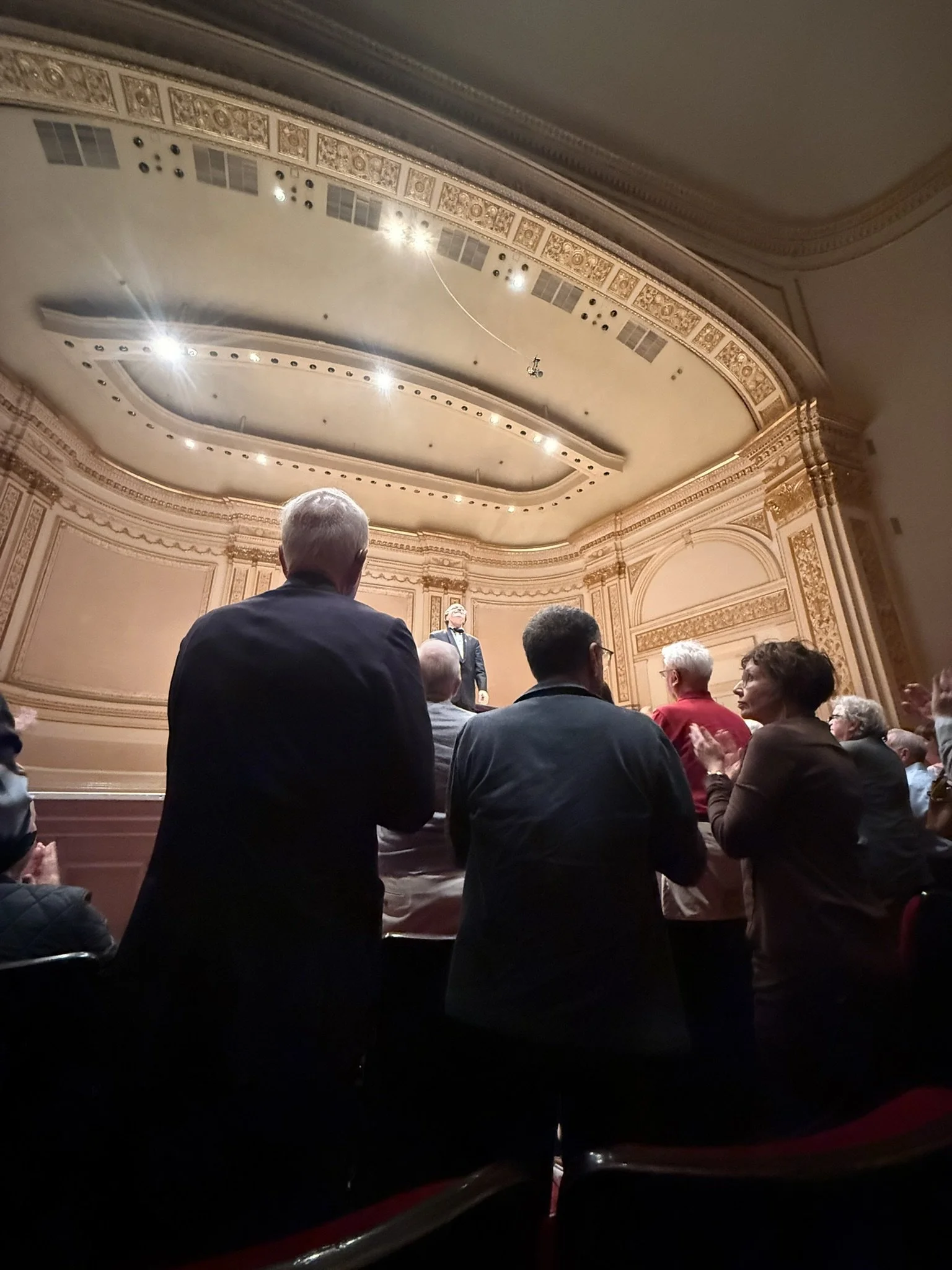
5.13.2026 Kissin at Carnegie
He was like Schumann before marriage, searching for his own music. Evgeny Kissin appeared on stage with a restlessness like Schumann's. Ludwig van Beethoven’s Piano Sonata No. 7, for its time, is a groundbreaking work that disrupts metric stability.
The opening theme did not project outward in tone, nor did it display technical brilliance. It felt less like a finished interpretation and more like something being re-selected in real time. It was as if a tense, anxious Schumann were playing Beethoven, directly converting an unstable consciousness into sound. The same thematic material is repeatedly reinterpreted through different states of mind.
In the second movement, the handling of the mesto phrase sounded like a sound being pulled out with effort, as if repeatedly shaking the head while forcing the notes into existence. His touch reflected a naked inner self through tone. The sound remained within the piano, like a journey in search of the resonance it was trying to become.
As in the case of the recent “Violetta” by Rosa, Kissin was someone for whom sound itself was will, and therefore music. The moment his fingers touched the keys, music was already happening. The audience was overwhelmed—by sound pressure, articulation, overtones, and momentum—and responded with reverence.
That virtuosity, refined over the years, had also begun to meet resistance within the body itself. Kissin missed several notes. The flow stopped, and he seemed to search again, asking where the sound had gone, trying to reconnect.
In Chopin’s mazurkas, he selected five works spanning from Chopin’s years of emotional harmony to his final period. There was a sense of wandering within the sound itself. It was the same period in which Schumann wrote Kreisleriana. Kissin’s mazurkas, driven by the pursuit of artistic authority, were absorbed and dissolved into the audience’s greedy energy.
The latter Kreisleriana unfolded as a sequence of hesitation and tension. Even Liszt’s Hungarian Rhapsody felt less like brilliance and more like a dull, distorted kind of light.
Such a complex performance cannot be immediately appreciated even by adults. Near me sat a parent and child. The child was not really listening, yet when the performance ended, they stood up and applauded, even handing over a bouquet of flowers. The mother, meanwhile, remained indifferent to the child’s irritation during the performance, and was constantly noisy.
The sound of page turning and small movements occasionally entered the musical flow. At Carnegie Hall, silence is not an absolute given. Different modes of attention share the same space.
In music that demands intense concentration, even the smallest movements in the surroundings can be perceived with the sharpness of insects moving through perception. As a result, a strong rupture can emerge between the musical flow and external behavior.
The consciousness that attempts immersion in the performance and another rhythm existing simultaneously within the same space can disrupt the continuity of listening. At times, the invisible connection between audience and performance feels as if it has been cut.
Even the applause after the performance felt hollow.
5.13.2026
Performers
Evgeny Kissin, Piano
Program
BEETHOVEN Piano Sonata No. 7 in D Major, Op. 10, No. 3
CHOPIN Mazurka in E Minor, Op. 41, No. 2
CHOPIN Mazurka in A-flat Major, Op. 41, No. 4
CHOPIN Mazurka in C Minor, Op. 56, No. 3
CHOPIN Mazurka in B Major, Op. 63, No. 1
CHOPIN Mazurka in F Minor, Op. 68, No. 4
R. SCHUMANN Kreisleriana
LISZT Hungarian Rhapsody No. 12 in C-sharp Minor
5.13.2026 Kissin at Carnegie
自分の音楽を探している結婚前のシューマンだった。ステージに現れたキーシンの落ち着かない心。シューマンのようだ。ベートーベンのピアノソナタ7番は、拍節を壊す当時としては画期的だ。冒頭のテーマは音色が外に広がったり、彼の技術が光ったりしなかった。完成した表現というより、その瞬間に選び直されているように聴こえた。その様子はまるで焦燥に煽られたシューマンがベートーベンを弾いている。不安定な意識をそのまま音にしている。同じテーマを何度も別な意識を入れる再解釈の連続。2楽章のmestのフレーズの扱いが、何度も首ふりながら音をひねり出す。彼の打鍵は裸の心を音色が映し出す。音色はピアノの内側に留まり、求める響きを探る旅のようだった。先日のロサのビオレッタのように、キッシンは音が意思であり音楽だった。鍵盤に触れた瞬間、音楽が鳴っていた。聴衆は音圧、打鍵、倍音、推進力に圧倒され崇拝した。その卓越は年を重ね鋭さを増し、そして、その心身に抵抗が生じる。キッシンは数回音をはずした。流れが止まり、もう一度接続しようと音色はどこにあるのか探ってく。ショパンのマズルカは彼が彼女とうまくいっているときから死ぬ前までの作品を5曲取り上げた。音の中で迷っている。シューマンがクライスレリアーナを書いた時期を同じ時期だ。キーシンの奏でるマズルカは名声を求めやってきた聴衆のエネルギーに吸われて消えていった。後半のクライスレリアーナも迷いと焦燥の連続だった。リストのハンガリアン狂詩曲でさえ、冴えた輝きというよりは鈍く歪んで光る音色に感じた。
こんな複雑な演奏は大人でもすぐには楽しめないのに、近くの親子は、子供がさっぱり聴いていないのに演奏が終わると立って拍手を送り、花束まで渡していた。その母親は演奏中、イライラしている子供に対して無関心だった。そしてずっとうるさかった。ページをめくる音や小さな動きが、音楽の流れの中に入ってくる瞬間もあった。カーネギーでは静寂などない。違う意識が同じ場を共有している。集中を要求する音楽では、周囲のわずかな動きも、まるで蚊やハエのように鋭く知覚される。その結果、音楽の流れと外部の振る舞いの間に、強い断絶が生まれる。演奏に没入しようとする意識と、別のリズムが同時に存在するため、聴衆と演奏のあいだにあるはずの見えないつながりが、途切れて感じられることがある。演奏が終わった後の拍手もとても空虚に感じた。