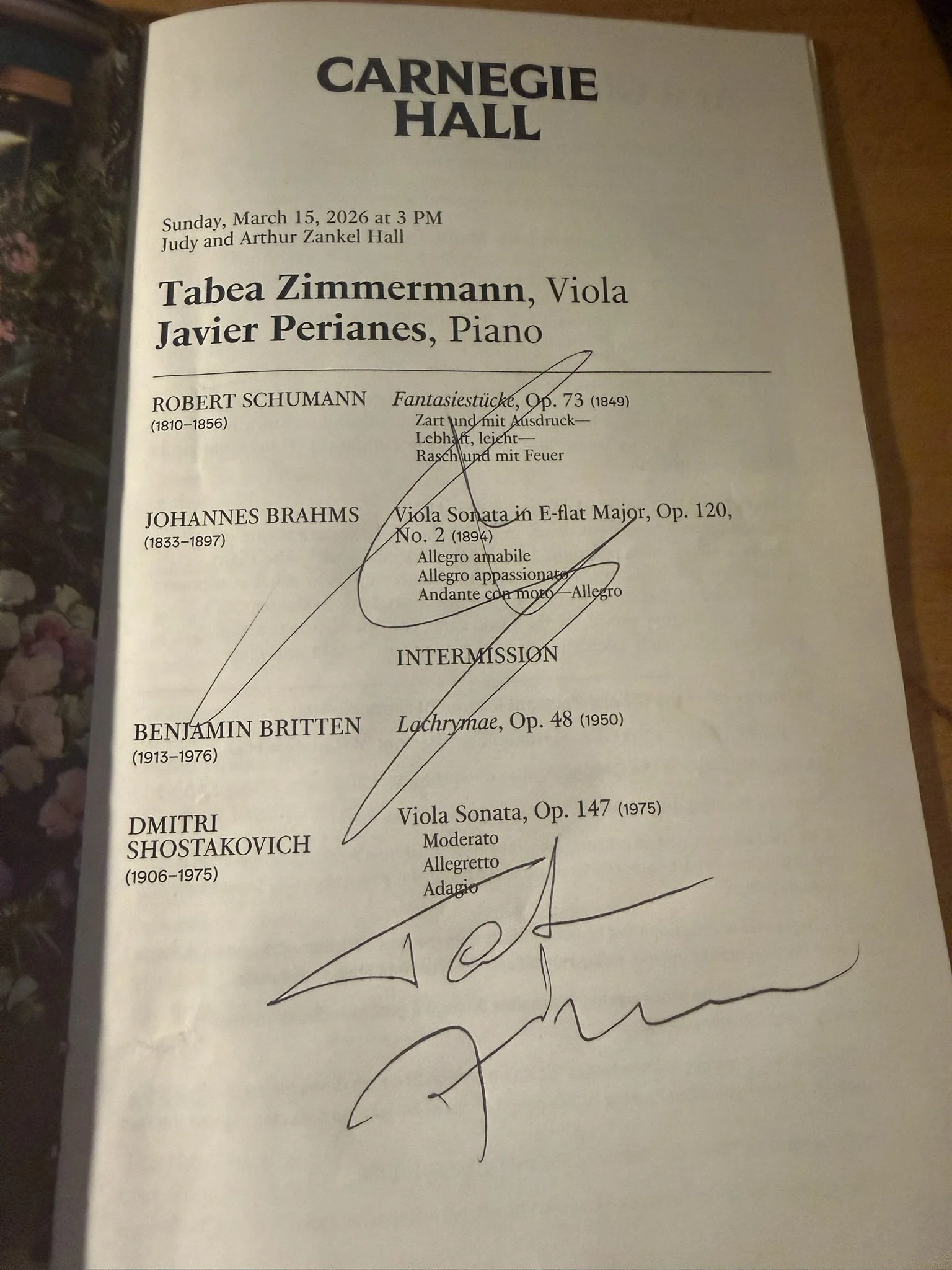
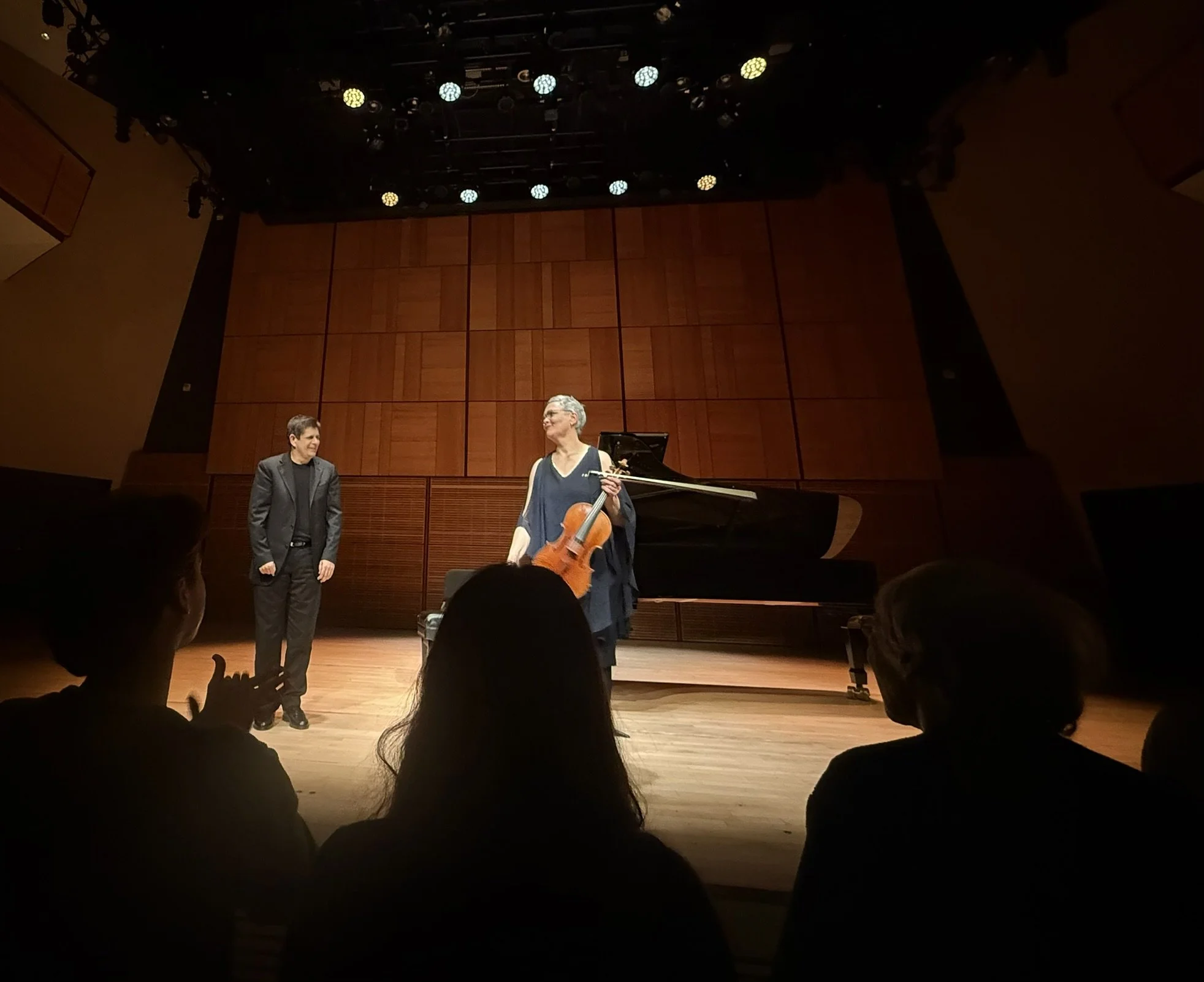
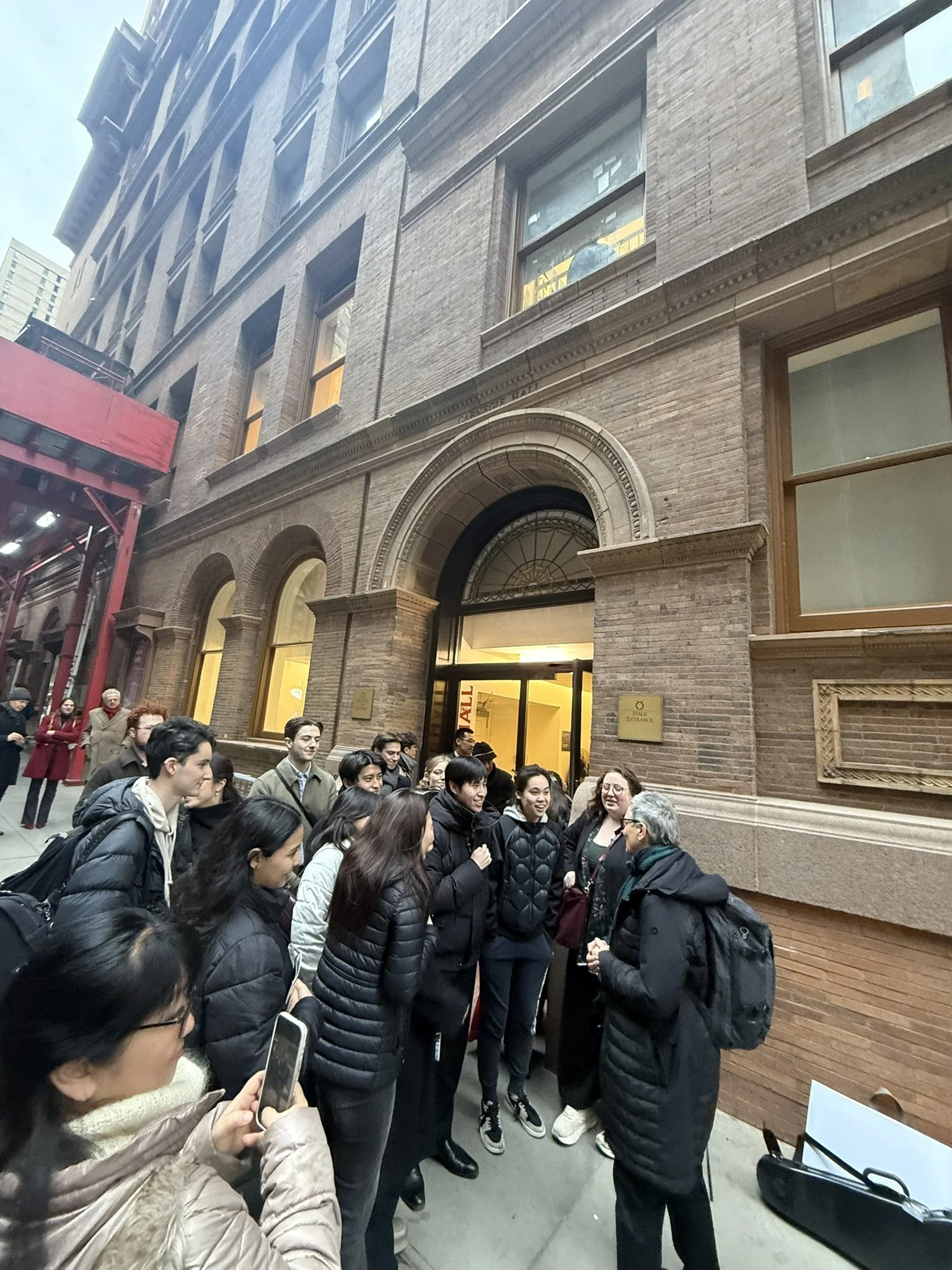
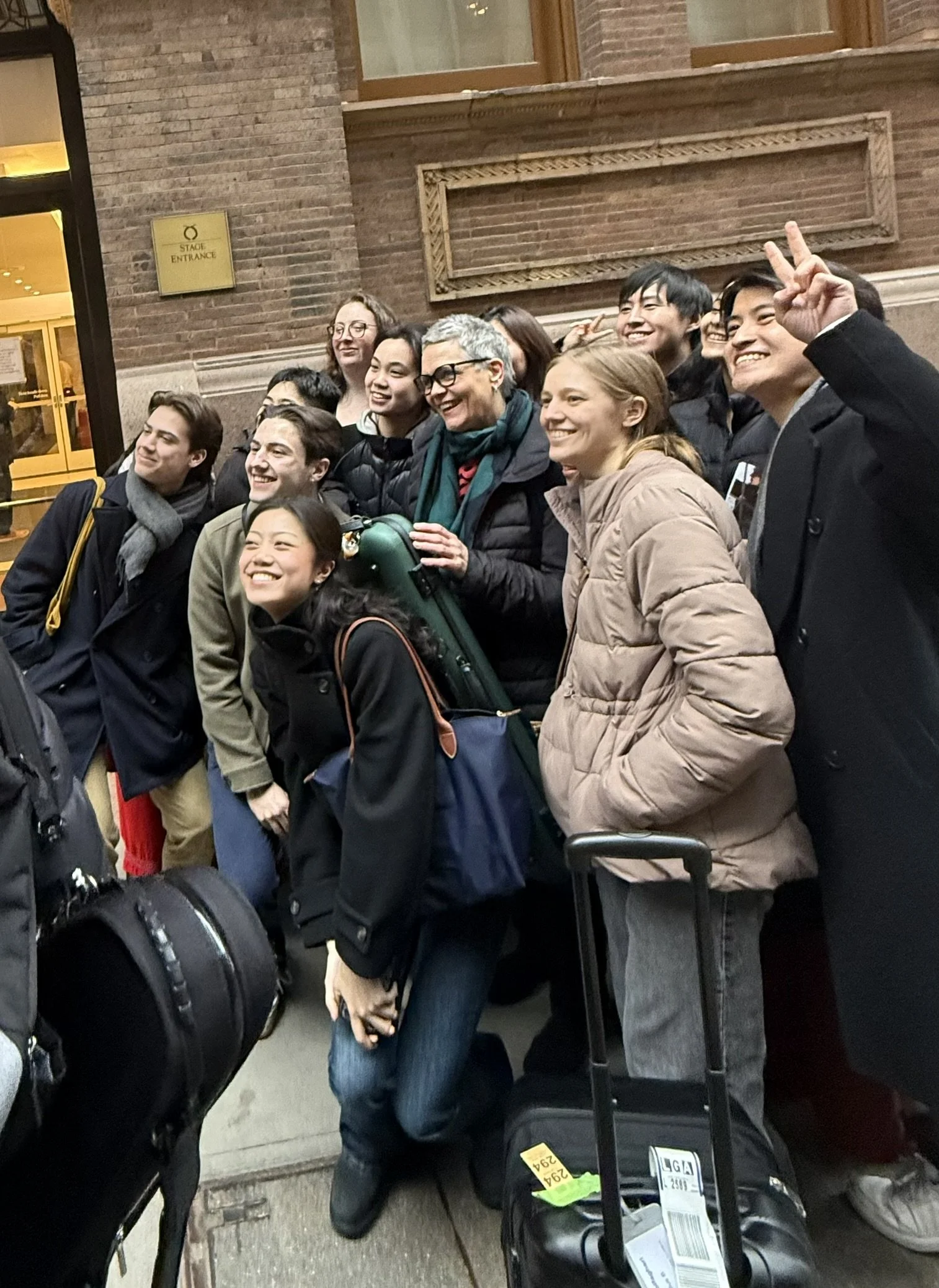
Tabea Zimmermann and Javier Perianes gave a recital at Zankel Hall, Carnegie Hall on 3.15.2026
The program began with Schumann's heart at 38 in 1849, and Tabea and Javier let the music resonate slowly and fully throughout the hall.
The first piece, Zart und mit Ausdruck, was played gently and with expressive nuance. The theme was passed between the viola and piano as if they were breathing together, creating a rich, slightly wistful adult sound.
The second piece, Lebhaft, leicht, was lively and light. Within Javier's delicate notes, Tabea's viola sang vividly.
The third piece, Rasch und mit Feuer, was fast and fiery, yet never rushed; every sound was carefully connected and layered so that each note could be heard clearly. With each repetition of the theme, the tone deepened, giving the impression of listening to an orchestral arco. Both performers were very passionate, yet calm, as if capturing every nuance in the room to share with the audience.
Next one, Johannes Brahms’s Viola Sonata was played with careful, generous phrasing, exuding a transparent, rich Amabile and weaving the music beautifully. Composed in 1894, at the age of 61, the music carries the memories of Brahms’s life, full of love and disappointment. The two performers conveyed it as if they were close friends who could not run out of things to talk about—sharing good memories and bitter ones, honestly and sincerely, with a mix of emotions intertwined. Brahms’s motto, Frei aber froh (“Free but happy”), felt perfectly suited to them.
In the second movement, the viola and piano quietly built energy with subtle bowing and resonance, repeatedly creating gentle explosions of sound.
In the third movement, the theme that begins Andante feels as if it is taking each step forward in the present moment. Brahms’s simple yet multifaceted harmonic shapes are layered one upon another. Tabea’s bowing is so intimate that it is difficult to tell whether the viola is touching the strings or directly conversing. The performance was both rich and elegant, yet approachable, at times giving the impact of an orchestra, and it ended as if the audience could see the performers’ smiles.
Benjamin Britten’s Lachrymae, subtitled “Reflections on a Song of Dowland,” is a set of variations on John Dowland’s Renaissance song If my complaints could passions move. From the beginning, various colors and motifs intertwine with the original harmonies, and finally, the viola sings the theme. Dowland’s melodic fragments appear in different forms—sometimes buried deep in the fabric of the music, sometimes emerging brightly on the surface. The song that inspired Britten’s title appears in the sixth variation.
Lento
Allegretto, andante molto
Animato
Tranquillo
Allegro con moto
Largamente
Appassionato
Alla valse moderato
Allegro marcia
Lento
L'istesso tempo
A tempo semplice
It felt as if we were reflecting on a lifetime. The viola’s turbulent, cloudy tones sometimes overlapped with the shadows left by the piano’s chords. Yet Dowland’s music could always be heard somewhere. By the final viola lines, all the turbulence seemed to dissolve.
The last, Shostakovich’s Viola Sonata, was composed in 1975, when he was on the verge of death, and even holding a pen was nearly impossible. The opening beats like a heartbeat. Lights fell on an empty stage, and I felt as if I were inside his heart. The viola’s rasping, dissonant arpeggios are accompanied by the piano, descending like the world surrounding him. Shostakovich lived in a time of unrest, loneliness, and loss. From such chaos, his creative energy emerges.
The second movement, Allegretto, progresses with a biting irony. After moments of quiet breathing, we sense Shostakovich forced to continue within the system. The viola and piano oscillate between tension and faint hope, reflecting the realities of life.
The third movement, Adagio sostenuto, sustains notes reminiscent of Beethoven’s Moonlight Sonata. Long, sorrowful breaths repeat. The viola repeats Beethoven’s theme, drifting as Shostakovich’s musical soul that could not reach a conclusion. Doo-doo-doo. The theme does not change into Shostakovich. In his mind, Beethoven sounded the same in 1975. Tabea’s viola was the flame of a life fading, a soul dissolving into the space. A human will and experience vanish, yet Beethoven’s spirit continues to inhabit him.
For the encore, they played Clara Schumann’s Three Romances, Op. 22, Andante molto.
3.15.2026
Performers
Tabea Zimmermann, Viola
Javier Perianes, Piano
R. SCHUMANN Fantasiestücke, Op. 73
BRAHMS Viola Sonata in E-flat Major, Op. 120, No. 2
BRITTEN Lachrymae
SHOSTAKOVICH Viola Sonata
Encore:
C. SCHUMANN Andante molto from Three Romances, Op. 22
3月15日、カーネギーホールの地下にあるザンケルホールで、タベア・ジンマーマンとハビエル・ペリアネスがリサイタルを行った。
プログラムは1849年に38歳のシューマンが書いた心の風景から始まり、タベアとハビエルはじっくり、たっぷり、空間に響かせる。1曲、Zart und mit Ausdruck、優しく、表情豊かに。主題をアルトとピアノがお互いに呼吸を交わすように様々な音色でつないでいく、豊かで少し切ない大人の歌と響き。2曲 Lebhaft, leicht、活発に、軽やかに。ハビエルの細かな音の粒の中にタベアのアルトが活き活き歌う。3曲 Rasch und mit Feuer、速く、火のように、でもずっと急がずじっくり、全ての音がよく聴こえるように、丁寧に音を繋いで重ねていた。テーマが繰り返される度に音色がずっと深くなっていって、オーケストラのアルコを聴いているようだった。2人ともとても情熱的だったがここにある全ての気配をかぎ取ってみんなに披露しているように、落ち着いてとても充実したシューマンだった。
2曲目のJohannes Brahmsのヴィオラ・ソナタでも、丁寧に、たっぷりとした呼吸で、透明で豊かなアマービレを湛え、愛らしく音楽を紡いでいく。1894年、61歳のブラームスの愛と失望に満ちた人生の記憶が刻まれた音楽を、二人は慈しむように、次から次へと話題が尽きない仲の良い親友のように語っていく。良い思い出も、苦い思い出も、まっすぐで素直な心のままに、さまざまな感情が交錯しながら語られていった。ブラームスのモットーは「Frei aber froh(自由に、しかし幸福に)」──この二人にふさわしい言葉だ。2楽章でも、熱を秘めた丁寧な運弓とピアノの響きがじっくりとエネルギーを蓄え、静かな爆発を何度も繰り返していく。3楽章では、アンダンテから始める主題は、まるで今ここから歩んでいくように、一歩一歩確実な和声とコードの進行で、ブラームスの単純で多彩な音の形を幾重にも折り重ねていく。タベアの弓が弦に触れる音なのか、それとも直接おしゃべりしているのか、判別がつかないほど親密である。豊かで気品がありながら親しみやすく、オーケストラのような迫力も同時に感じさせ、最後は2人の笑顔が見えるような演奏だった。
Benjamin BrittenのLachrymae、涙はルネサンスのJohn DowlandのIf my complaints could passions moveの主題を変奏したもので、開始からさまざまな音色や音型がもともとのコードに絡まって、最後にビオラがテーマを歌う。ダウランドの旋律の断片は、ある時は音楽の織り目の中に深く埋もれ、またある時は明るく表面へと浮上するなど、様々な姿形を変えて現れる。ブリテンの表題の由来となった歌は6番目の変奏に現れる。
Lento
Allegretto, andante molto
Animato
Tranquillo
Allegro con moto
Largamente
Appassionato
Alla valse moderato
Allegro marcia
Lento
L'istesso tempo
A tempo semplice
自分たちの一生を振り返っているような気分だった。ビオラの混沌としたもやもやした音色が、ピアノが置いていくコードの影と重なったりした。でもいつもどこかでダウランドが聴こえてきた。最後のビオラの歌の中に今までのもやもやが溶けていく。
最後のショスタコーヴィチのヴィオラ・ソナタは、1975年、死の間際にペンを手にすることさえままならない時期に書かれた。はじまりは心臓の鼓動のよう。何もない舞台に明かりが下り、私は彼の心の中にいた。ビオラの掠れる、外した分散和音に、ピアノが彼を取り巻く世間のように下りてくる。ショスタコが生きた時代は不穏、孤独、喪失。そういった混沌にショスタコのクリエイティブなエネルギーが宿る。2楽章はアレグレットで皮肉が付き進む。途中、静かな呼吸の後、再び体制の中で進まざるをえないショスタコーヴィチの姿を感じた。ヴィオラとピアノは、緊張と微かな希望の間を行き来しながら、この世の現実を映し出している。3楽章のAdagio sostenuto、ノートがサステインして、ベートーベンのピアノソナタ、月光に似た音楽。長くて悲しい呼吸を繰り返す。ビオラが繰り返すベートーベンのテーマは、終止符を打つことができずにいたショスタコの音楽の魂のように漂う。ドードドー。このテーマがショスタコに変わらない。ショスタコの頭の中で1975年に鳴り続けていたベートーベンがショスタコに変わらない。タベアのビオラは消えていく命の炎。魂が空間に溶けていく。一人の人間の意思や経験が無くなっていく。彼の魂に宿り続けたベートーベン。
アンコールはクララ・シューマンのOp. 22、3つのロマンスからAndante molto。