
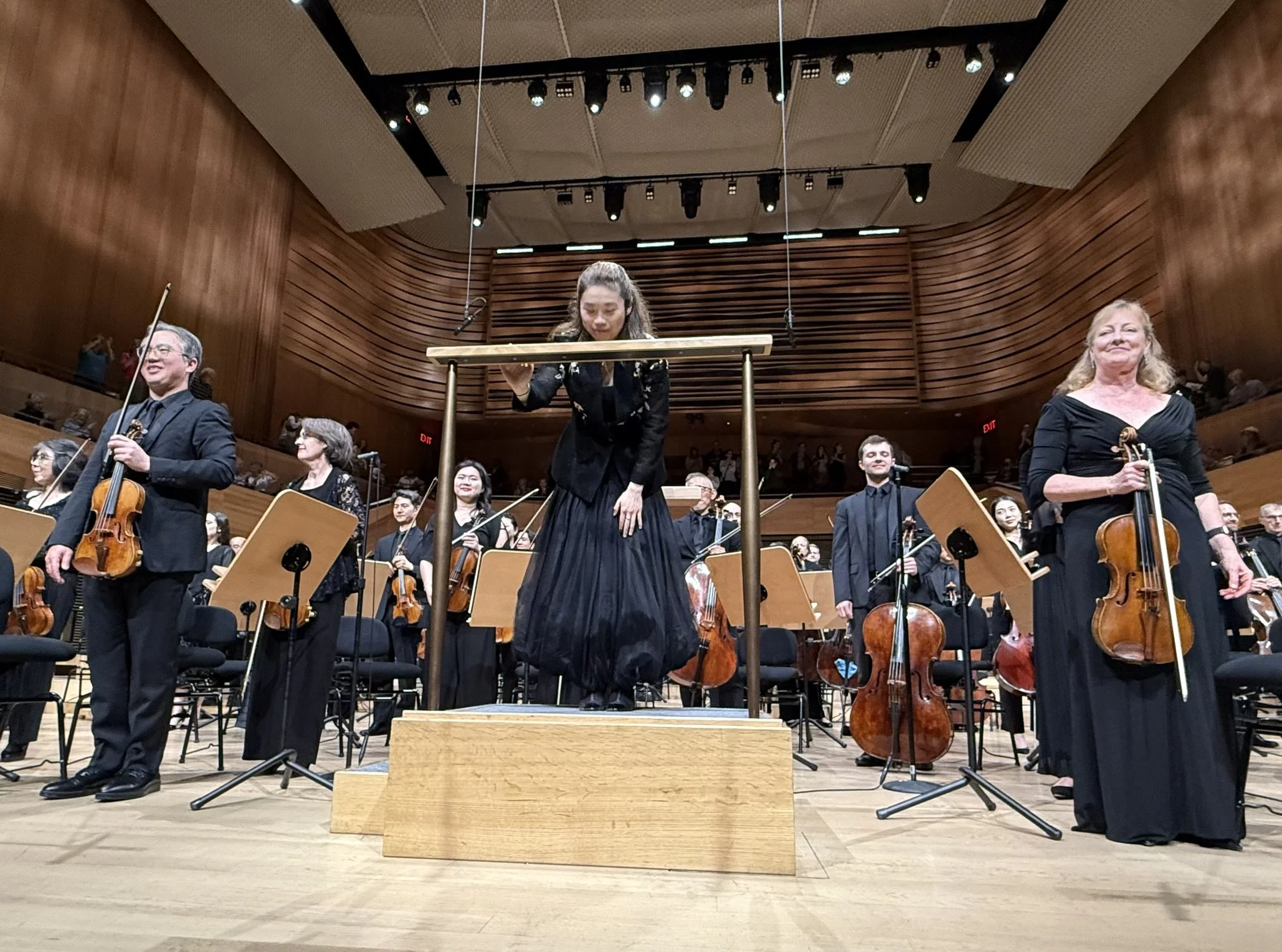
5.27.2026 David Geffen Hall
I experienced the Hong Kong–born conductor Elim Chan live for the first time.
Swaddling Silk and Gossamer Rain (premiered in 2022) felt, in the context of living in New York, where destruction, violence, and noise are physically present and constantly felt on the skin, slightly at odds with Noriko Koide’s meticulous musical construction.
The New York Philharmonic created rain sounds by silently shaping their lips, then layering another kind of rain by tapping pencils against strings. Harp tones and shimmering metallic percussion resonated throughout. Everything felt careful—precise, hard-edged, as if the sound itself were being observed so gently that it must not be damaged.
At David Geffen Hall, one can perceive with striking clarity how sound expands, pauses, and disappears in real time. After the lingering resonance of harp and metallic timbres drifted through the space, the hall would return to silence in an instant. It reaffirmed the precision of this acoustic environment.
Carter Brey, principal cellist of the New York Philharmonic, is finally retiring. Since joining in 1996, he has delivered countless memorable performances. In Philharmonic concerts, he was always simply there.
The second work under Elim Chan was Saint-Saëns’ Cello Concerto No. 1 in A minor, Op. 33. Although its three movements were performed without breaks, it felt like watching a single flowing river—an unbroken current of intent.
The orchestra was smaller than in Koide’s piece. I could sense individual presence within the ensemble. Clara Neubauer was in the second violins; everyone seemed to be listening intently to Carter.
The cello played by Carter felt like the Milky Way on a summer night—one continuous flow. Countless sparks of light converged into his broad sonic stream. Among them, Alison Fierst’s flute tone was especially beautiful.
Saint-Saëns’ Romance, following Koide, sounded warm, intense, passionate, fragile—yet constantly directed toward a single, unwavering gaze. Complex, but pure in tone. The cellist Oliver, whom I heard last week, came to mind.
At the end of the performance, I applauded instinctively, completely absorbed. Carter returned for the curtain call and played a piece in memory of someone who had passed away six years earlier.
In Prokofiev’s ballet Cinderella, traces of Marek Janowski’s textures from the previous week still lingered in my perception. Soft, refined basses and brass, with middle-register accents standing out, created a free and vividly alive reading of the score—a deeply expressive Prokofiev.
I kept watching Elim Chan from the Saint-Saëns onward. I could not remember the last time I had observed a conductor so closely.
Her breathing, motion, tempo, and dynamics were like a highly trained tennis player’s serve—personal, flexible, yet controlled. With her whole body, she gave the orchestra a stable sonic space where rhythm, texture, and phrasing could exist with clarity.
That “space” is an acoustic illusion woven from rhythm and harmony. Within it, the New York Philharmonic unfolded performance after performance.
Robert Langevin, the flutist, could be seen through gaps in Elim’s gestures. The cantabile of the first violins was especially beautiful, and the brass sounded refined and elegant.
Cinderella is more sparingly ornamented and feels far more refined than Romeo and Juliet. In every episode, Elim’s approach was graceful yet deeply sincere in how she drew out human emotion.
When midnight arrives, and the magic breaks, an abrupt explosion of sound follows. It is no longer a fairy tale, but reality itself. Cinderella merges with the real world.
Cynthia Phelps’ viola playing was extraordinary. Her energy made Cinderella feel not like a fairy tale, but like the present world itself—where brief happiness is followed by the harsh, heavy, visceral force of reality. Her sense of beat was remarkable.
From the final waltz into “amoroso,” everything gradually unraveled from its heightened world. When the performance ended, Elim relaxed her tension, and even as she turned toward the audience, I remained unable to move for a moment. When she smiled warmly at Cynthia Phelps, I finally felt my body return.
Prokofiev was a master of ballet music—capable not only of danceability, but of depicting human rawness through sound. Elim Chan and the Philharmonic made that unmistakably present.
It is because suffering, love, and happiness are transformed into pitch and dynamics, recorded in musical form, and then projected through the performer’s interpretation. Therefore, understanding both the work and the performer allows one to experience the performance more fully and to expand one’s own perception. As the body responds to this experience, it connects to other senses and ideas, which can eventually lead to products, services, or other forms of art. This chain of perception, in turn, helps cultivate and shape society.
Elim Chan, Conductor
Carter Brey, Cello
The Fan Fox and Leslie R. Samuels Chair
Noriko KOIDE Swaddling Silk and Gossamer Rain
(b. 1982) (2022; New York Premiere)
SAINT-SAËNS Cello Concerto No. 1 in A minor, Op. 33
(1835–1921) (1872)
Allegro non troppo
Allegretto con moto
Tempo primo
(played without pause)
CARTER BREY
Intermission
PROKOFIEV Selections from Zolushka (Cinderella),
(1891–1953) Opp. 87 and 107 (1940–44)
Introduction
Veil Dance
The Sisters Dress for the Ball
Quarrel
Cinderella’s Dream of the Ball
The Beggar Fairy
Cinderella’s Arrival at the Ball
Grand Waltz
Fruits and Refreshing Drinks
Cinderella’s Waltz
Midnight
The Morning After the Ball
Slow Waltz
Amoroso
5.27.2026 David Geffen Hall

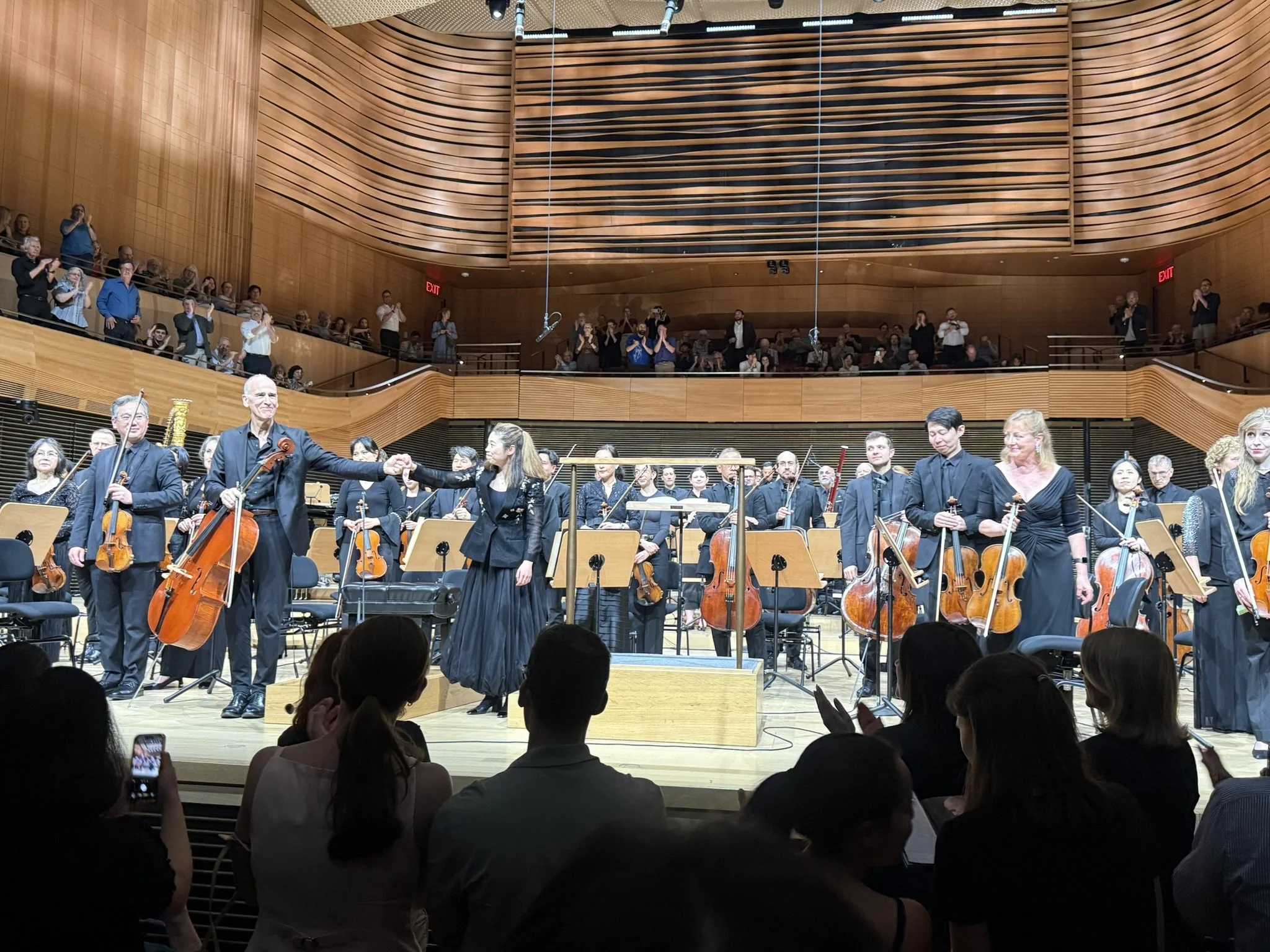
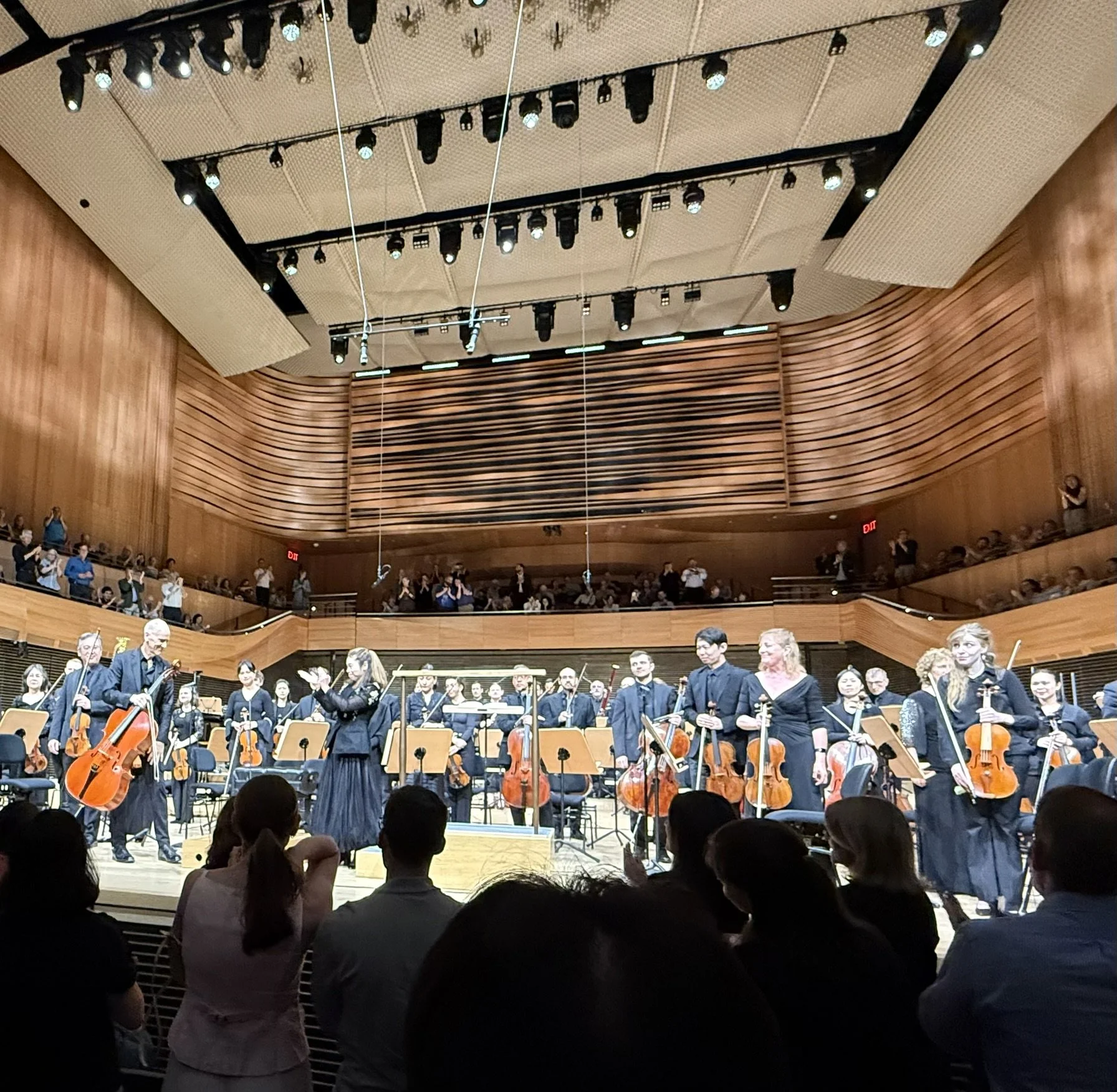
香港生まれの指揮者、Elim Chan、エリム・チャンを初めてライブで体験した。
2022年初演の Swaddling Silk and Gossamer Rain は、ニューヨークの破壊や暴力、ノイズを肌で感じ暮らしていると、Noriko Koide の丁寧な音楽作りに違和感を感じた。
New York Philharmonic は唇をパクパクと動かして雨音を作り、さらに鉛筆で弦を叩きながら別の角度の雨を重ねていく。ハープや揺れる金属打楽器の響き。それは丁寧で、硬質で、音を傷つけないよう静かに観察しているようだ。
David Geffen Hall では、音がオンタイムで広がり、止まり、消えていく様子が手に取るようにわかる。ハープや金属音の余韻が空間を漂ったあと、一瞬で静寂へ戻る感覚に、このホールの精密さを改めて感じた。
ニューヨーク・フィルの首席チェロ、Carter Brey が遂に引退する。1996年の入団から、数々の名演を繰り広げて来た。ニューヨーク・フィルの公演では行くと必ず彼がいた。
Elim Chan との2曲目はCello Concerto No. 1 in A minor, Op. 33。3つの楽章は切れ目なく演奏されたが、一つの川の流れを見ているようだった。途切れなく続く一つの意思を感じた。
Koideよりもオーケストラのサイズが小さかった。オーケストラにも一人ひとりの意思を感じた。セカンドバイオリンに Clara Neubauer がいた。みんなカーターを聴いていた。
カーターの奏でるチェロが、夏の夜の天の川みたいに一つの流れだった。静かな輝きがカーターのチェロの大きな流れに集まって、無数の輝きが瞬いていた。その中でも、Alison Fierstのフルートの音色が特に美しかった。
サンサーンスのロマンスは、Koideの後では熱く、激しく、情熱的で、壊れやすくて、でもずっと同じものを見つめ続けているような、複雑だけど純粋な音色だった。Concertstück
演奏が終わった瞬間に夢中で手を叩いていた。カーターはカーテンコールに応えてステージに戻り、6年前に亡くなった誰かのために一曲演奏してくれた。先日聴いたオリバーが心に浮かんだ。
3曲目の Cinderella (Prokofiev ballet) では、先週聴いた Marek Janowski のテクスチャが残っていて、柔らかく上品なベースやブラスに中声のアクセントが際立ち、自由で活き活きしたソリストの名演だった。じっくり聴かせるプロコフィエフだった。
Elim Chan の指揮を《サン=サーンス》の時からずっと見ていた。指揮者をこんなによく眺めたのはいつだろう。
呼吸と動きとテンポとダイナミクスが、まるで鍛え上げられたテニスプレーヤーのサービスのようだった。性格的で柔軟。呼吸やリズムや音のテクスチャを全身全霊でオーケストラに安定した空間を与える。
空間とは、リズムとハーモニーが織りなす音の錯覚の空間のことだ。そこに New York Philharmonic の数々の名演が繰り広げられていく。
今回はフルートの Robert Langevin がエリムの体の隙間から見えた。ファーストバイオリンのカンタービレが特に美しかった。ブラスが上品で優雅だった。
Cinderellaは飾りが少なく、《ロメオとジュリエット》よりずっと洗練された作品だと感じた。どのエピソードでもエリムは優雅でありながら、人間の心の引き出し方が誠実で豊かだった。
やがて真夜中が訪れ、魔法が切れると、目が覚めるような爆音が鳴りだす。おとぎ話ではなく現実だ。シンデレラが現実の世界と重なる。
Cynthia Phelps のビオラがすごかった。彼女の躍動はシンデレラをおとぎ話ではなく、今の現実の世界のように見せる。束の間の幸せのあと、魔法が切れるとやってくる現実の激しさや重さ、生々しさ。ビートの感じ方がすごかった。
最後のワルツから amoroso で段々、彼らの極まった世界からほどけていくようだった。演奏が終わってエリムが緊張をほどき、こちらを振り返ってもしばらく体が動かなかった。エリムがシンシアのビオラに素直に喜んで笑顔を見せて、こちらも嬉しくなってやっと体が動いた。
プロコフィエフはバレエ音楽の達人だった。踊りやすさに加え、人の生々しさを音楽で描き、エリムとフィルはそれを見せてくれた。