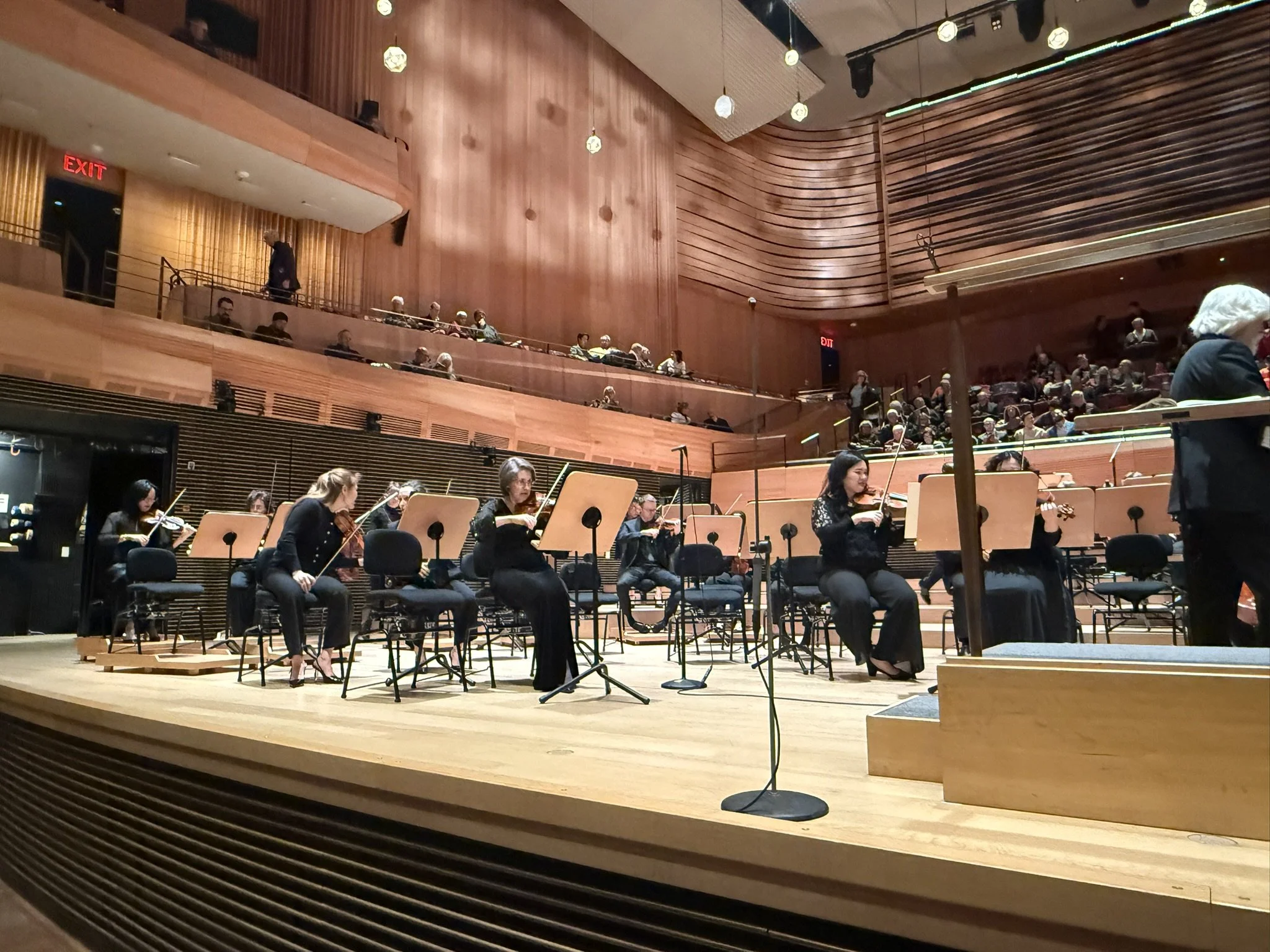

New York Philharmonic conducted by Mirga Gražinytė-Tyla on3.5.2026, opened with Elgar's Violin Concerto, featuring soloist Vilde Frang.
At the outset, the orchestra began in a swelling, symphonic wave. The sound seemed to express deeply held emotions, much like Schumann. Elgar, in his 50s and at the peak of his life, wrote this work for Fritz Kreisler.
Soon, the solo violin took up the theme. With a distinctly British elegance and dignity, episodes filled with ornamentation and leaps unfolded one after another.
Vilde Frang's rich tone blended seamlessly with the orchestra, the melody passing among various instruments before returning to her violin, like a conversation in which everyone listens attentively to one another. Mirga was visibly catching her breath—a very focused and delicate interaction.
The second movement quietly retraced the events of the first. It felt like gazing upon a deep river flowing inside the heart—quiet, rich, and deeply satisfying.
In the third movement, the violin displayed sparkling, fast passages. Vilde Frang projected her tone across the hall, drawing back the melody and unfolding it again. Eventually, a dramatic, cadenza-like clash arose, which the orchestra then took up, moving into the next episode. At David Geffen Hall, it felt as if the violin had momentarily left Vilde and was resonating as an instrument in its own right. She seemed to release the instrument into the space, allowing the music to unfold freely.
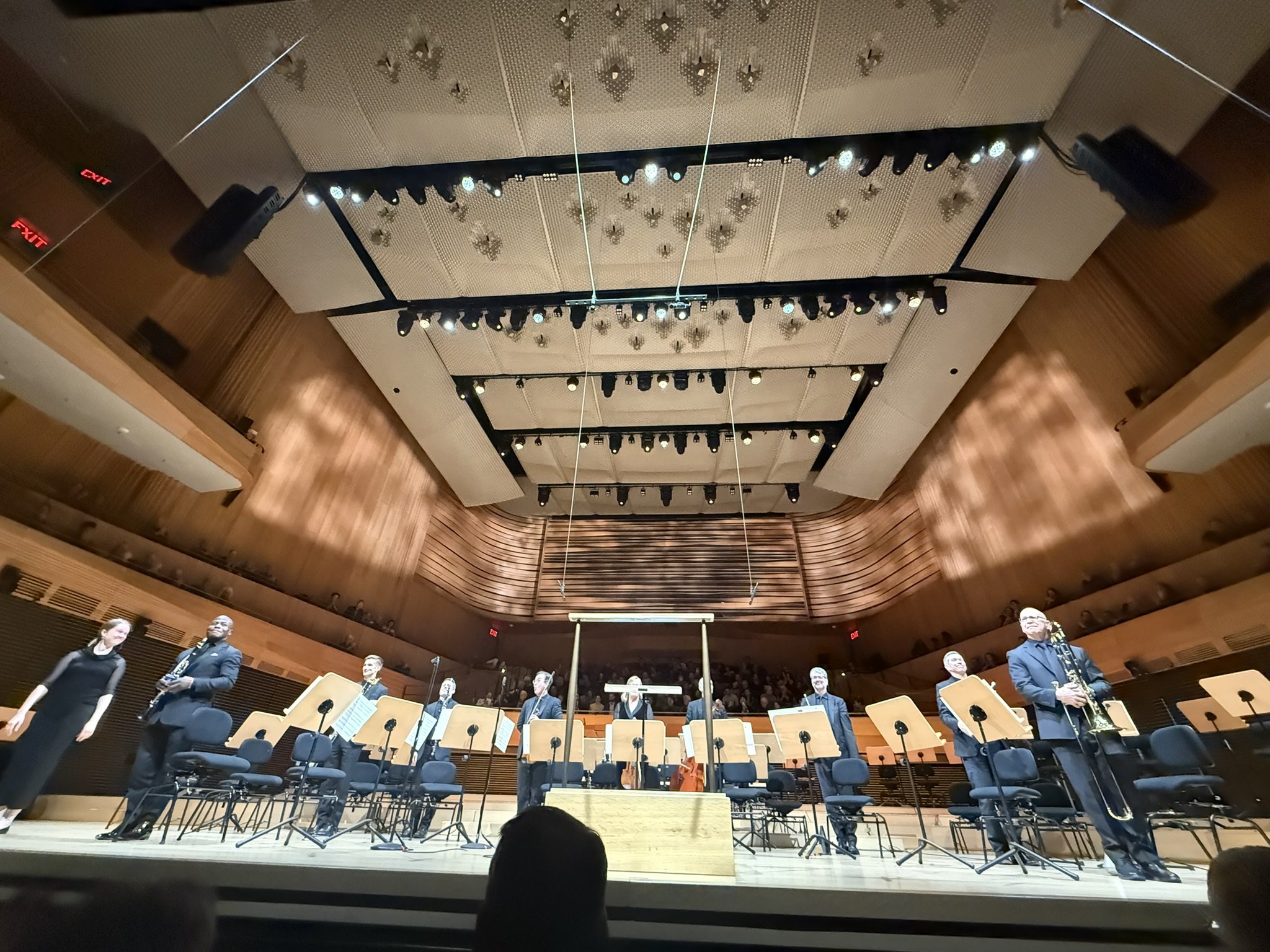
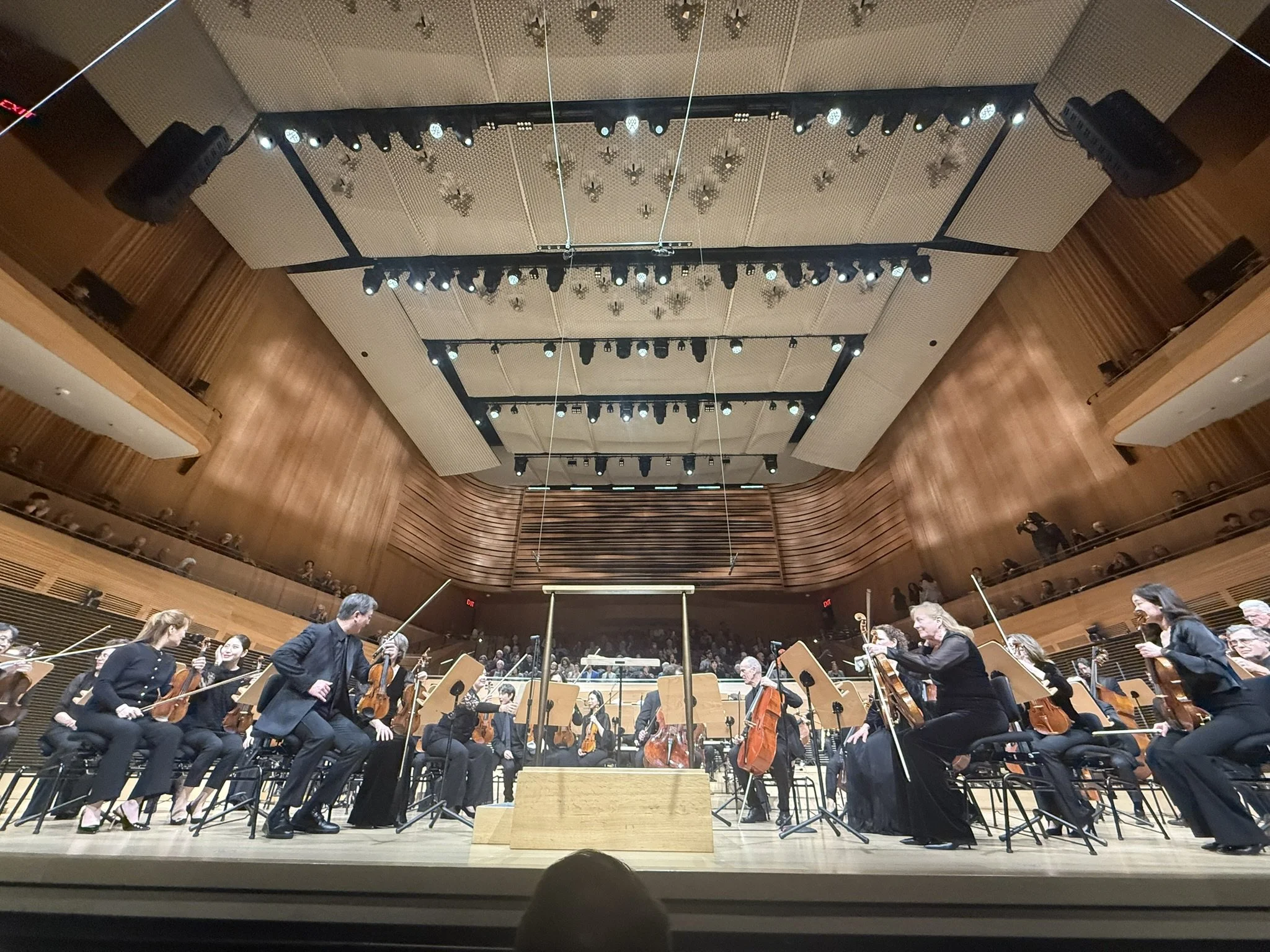
Next came Kurtág's Brefs messages, Op. 47, dedicated to Boulez. The stage was filled with New York Philharmonic soloists, and the piece consisted of four movements. One could hear medieval and Renaissance vocal techniques recreated through ensembles of various instruments. Kurtág had compiled and restructured his previous works into this composition. It began with a trombone fanfare and ended in a chamber-music-like texture. Rather than music alone, it felt as though the performers were conversing with each other.
The program quoted Kurtág's words:
“The power of art emerges naturally when a work is performed with sensitivity to its particular demands and an open heart. Musicians who possess this sense become devoted performers.”
Finally, I heard Schumann's Symphony No. 1, Spring. It felt like a heartfelt confession composed before he married Clara, when he was in love. The first movement began slowly and relaxed, with the trumpet gently projecting the breath of spring.
The original score apparently included Schumann's own words:
“O wende, wende deinen Lauf, — Im Talle blüht der Frühling auf!”
(“O turn, turn your course, — In the valley spring blooms!”)
The orchestra joined the theme, the flute played birdsong, and the confession of a lover began. When the cello and double bass bows touched the strings, the sound crackled like sparks. The dynamics were restrained, yet the texture was so dense that it felt as if intensely passionate emotions, which could not be spoken aloud, were resonating inside me. It seemed as if the excitement of being in love had become music.
The second movement was a slow, romantic dialogue in a natural setting. The performance, combined with the soloists from the Kurtág piece earlier, brought his words to mind.
The third movement, a scherzo, was lively and energetic. Mirga used her whole body to make the orchestra sing. The middle section slowed, reminiscent of Kurtág's deconstruction and restructuring of Schumann.
In the fourth movement, one could hear a simple dance. Indeed, it was light, innocent, and dance-like.
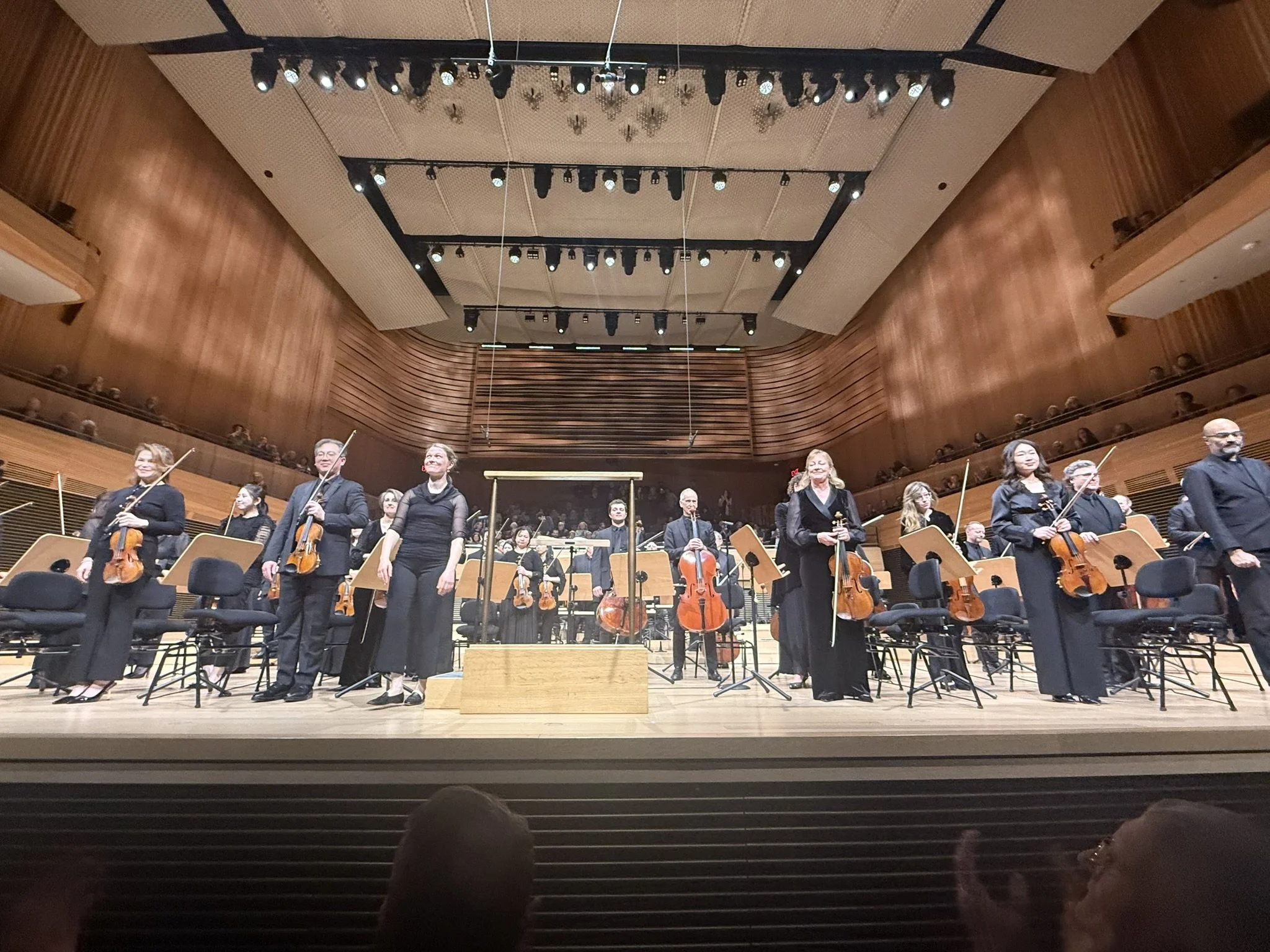
Although the audience cannot enter the stage, Mirga takes us there. Even the spatial distance between the double bass and the first violin seemed bridged, as if I were on stage with them. She invites the soloists from the New York Philharmonic to participate in passages that convey messages directly. At David Geffen Hall, there was no sense of distance between the performance and the composer. There was no exaggeration, no sense of history—only the present moment.
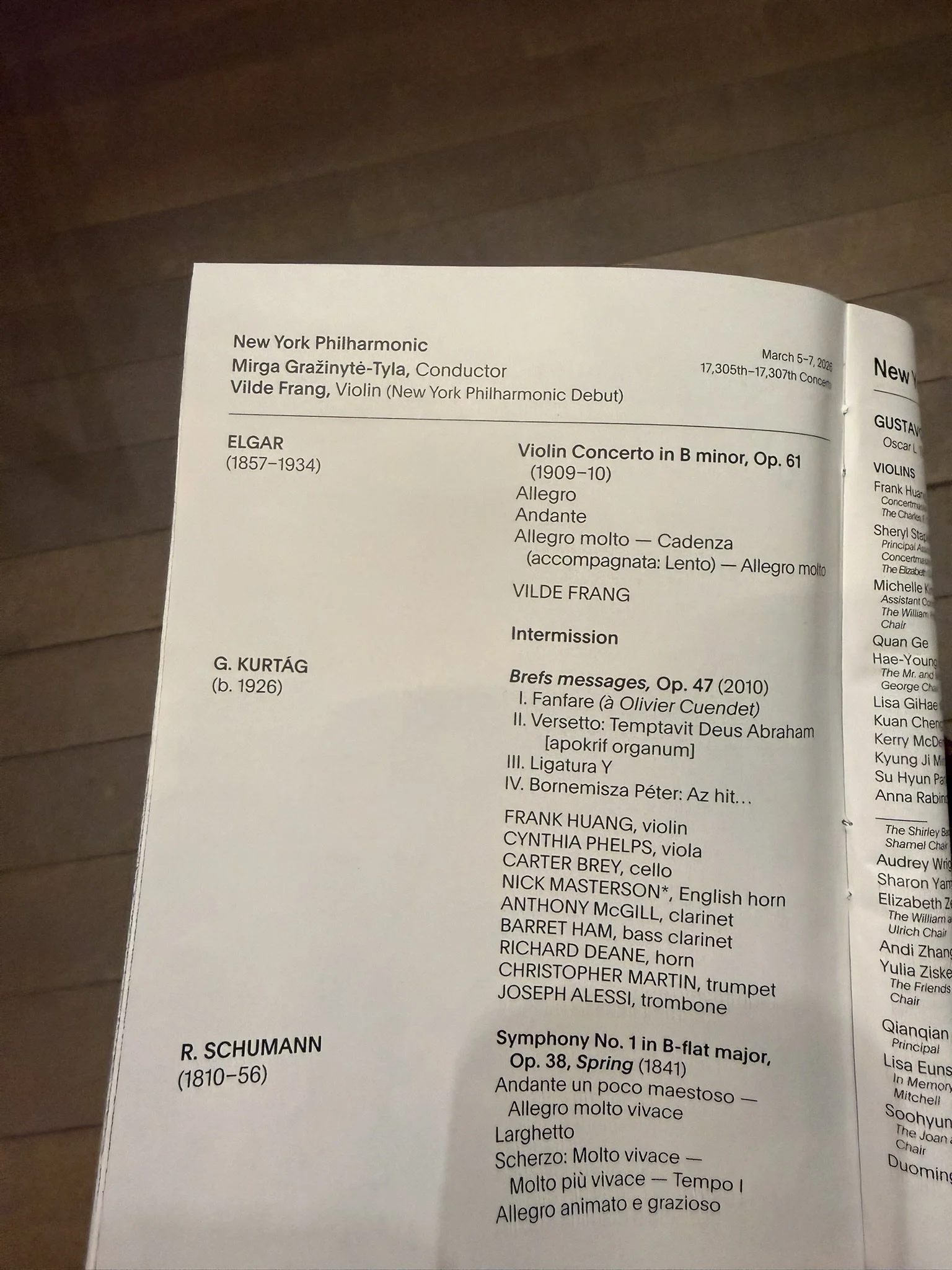
Performer
New York Philharmonic
Mirga Gražinytė-Tyla, Conductor
Vilde Frang, Violin (New York Philharmonic Debut)
Program
ELGAR Violin Concerto in B minor, Op. 61
G. KURTÁG Brefs messages, Op. 47 (2010)
R. SCHUMANN Symphony No. 1 in B-flat major, Op. 38, Spring (1841)
ミルガ・グラジニーテ=ティーラが指揮するニューヨーク・フィルの演奏を聴いた。プログラムはエルガーのヴァイオリン協奏曲から始まる。ソリストはヴィルデ・フラング。
冒頭、うねるように交響するオーケストラが始まる。その響きはシューマンのように、腹に抱えた思いを訴えるようだった。50代、人生が最も充実していた時期のエルガーが、フリッツ・クライスラーのために書いた作品だ。
やがてソロのヴァイオリンがテーマを引き継ぐ。イギリス独特の風格と気品をまとい、装飾や跳躍を含んだエピソードが次々と紡がれていく。
ヴィルデ・フラングの豊かな音色はオーケストラに溶け込み、旋律はオーケストラのさまざまな楽器へと受け渡され、再び彼女のヴァイオリンへ戻ってくる様子は、互いに耳を澄ませながら交わす対話のようだった。1楽章が終わると、指揮のミルガは肩で息をしていた。とても集中した繊細なやりとりだった。
2楽章では、1楽章で起こった出来事を静かに辿る。心の中に流れている深い川の流れを見つめるような演奏。静かで豊かで満たされた安らぎを感じた。
3楽章では、ヴァイオリンが瑞々しい輝きで早いパッセージを繰り広げる。ヴィルデ・フラングは音色を遠くまで響かせ、旋律を引き戻しながら再び展開する。やがて独特なカデンツァのような激しい衝突が訪れ、オーケストラが受け継いで次のエピソードへと進む。デビッド・ゲフィン・ホールで聴くと、バイオリンがヴィルデから離れ、楽器そのものが鳴っているようにも感じられた。彼女は楽器を会場の空間に解き放ち、音楽を繰り広げているように見えた。
次にクルタークの Brefs messages, Op. 47 を聴いた。この曲はブーレーズに捧げられた。ステージにはニューヨーク・フィルのソリストたちが並び、曲は4つの楽章で構成されていた。中世からルネサンスの声楽技法を、さまざまな楽器のアンサンブルで聴くことができた。クルタークは以前に作った曲をまとめ、この作品として再構成している。曲はトロンボーンのファンファーレで始まり、最後は室内楽のようだった。音楽というより、むしろ演奏者たちが互いに会話しているように感じられた。
プログラムには、クルタークの言葉が引用されていた。
芸術の力は、作品が特有の要求に敏感かつ開かれた心で演奏されるときに自ずと現れる。その感覚を持つ音楽家は、献身的な演奏者となる。
そして次に彼らが演奏するシューマンの交響曲1番《春》を聴いた。シューマンがクララと恋をしていた、結婚前に書かれた心の告白のような演奏だった。1楽章の出だしはゆったりリラックスし、トランペットがふわっと春の息吹を繰り広げる。
当時のスコアの冒頭にはシューマンの言葉が書かれていたそうだ。
「O wende, wende deinen Lauf, — Im Talle blüht der Frühling auf!」
(「ああ、進路を変え、谷間には春が花開く!」)
オーケストラがテーマに加わり、フルートが鳥のさえずりを奏で、恋する人間の告白が始まる。チェロやコントラバスの弓が弦を擦ると、バチバチ火花が散るような音がした。ダイナミクスは控えめで、音の密度は非常に高く、まるで誰にも言えない熱い気持ちが自分の中で鳴っているようだった。恋をしているドキドキする気持ちが音楽になっているように感じられた。
2楽章はロマン派らしい、自然の中で対話するようなゆったりとした豊かな曲だ。先ほどクルタークで聴いたソリストたちの作品と一体になった演奏に、彼の言葉を思い出す。
3楽章はスケルツォで動きが激しい。ミルガは体を使ってオーケストラを鳴らしていた。中間部のテンポがゆっくりで、シューマンを分解して再構成しているクルタークのようにも感じられた。
4楽章では素朴な踊りが聴こえてきた。その通り、素朴で軽やかな踊りだった。
聴衆はステージの中には入れないが、ミルガはそこに連れて行ってくれる。距離が離れたコントラバスと1stバイオリンのセッションさえ、ステージのその間に自分がいるように聴こえる。彼女はパッセージをインバイトし、ニューヨーク・フィルのトゥッティの中から見事なソリストたちを招き、メッセージを届けてくれる。演奏と作曲者の間に距離を感じないデビッド・ゲフィン・ホール。誇張や歴史を意識させず、あるのはただ「今」だけだった。