
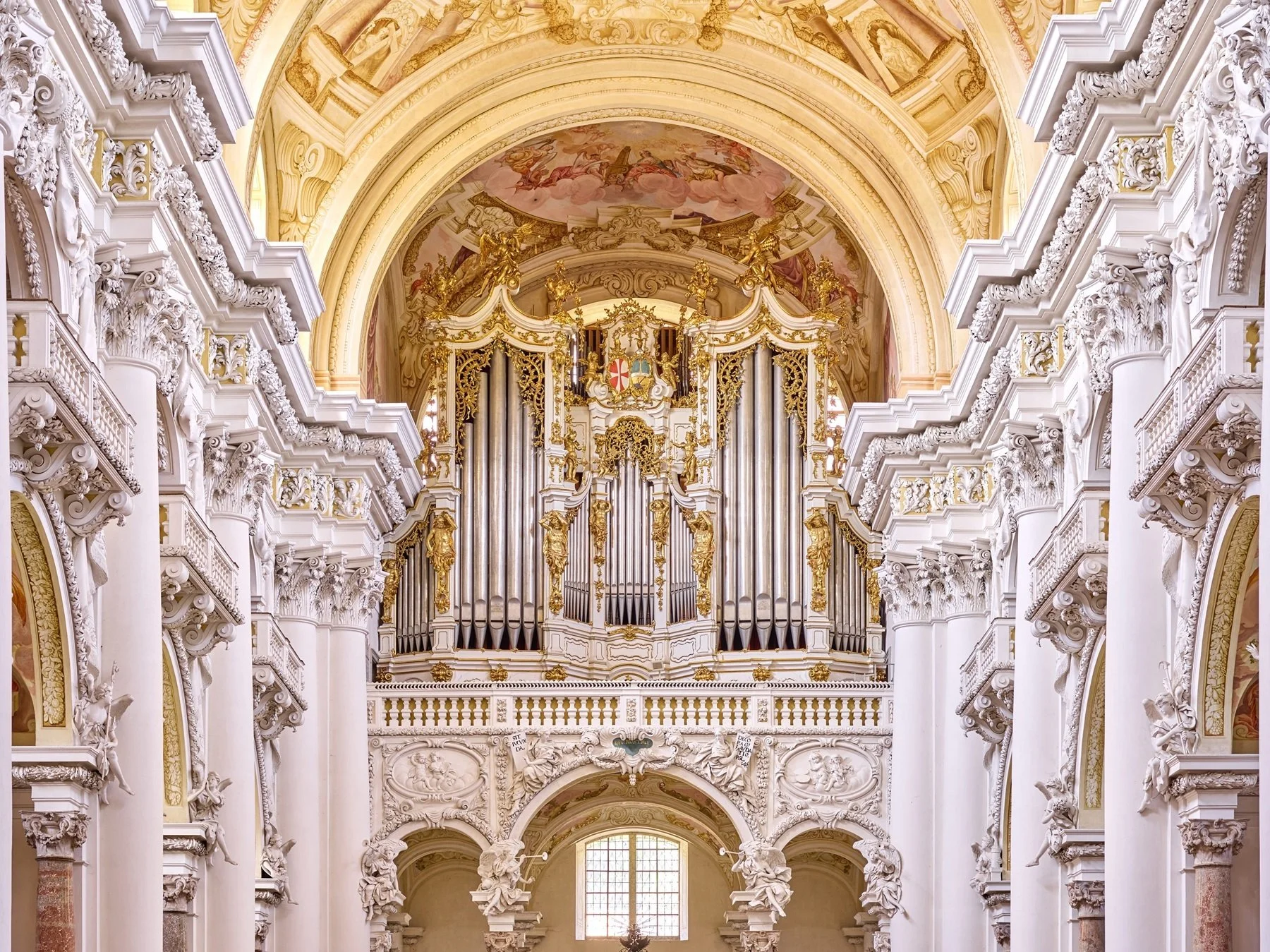
Bruckner’s Symphony No. 8 by the New York Philharmonic and Semion Bychkov at David Geffen Hall on 6.4/5.2026
Anton Bruckner was born in 1824 in the Austrian countryside. He was a simple man, easily intimidated by authority, someone who believed praise too readily and fell into deep despair when criticized. At the same time, to survive in Vienna, he aligned himself with Wagner, then the dominant figure, and brought his works to the world through relationships with students and supporters. He was usually timid and easily influenced by others, yet firmly believed he was writing music for God and acted strategically in order to present his works. In this Eighth Symphony, I experienced this oscillation between the sacred and the worldly.
Reading the program notes, I learned that this work is based on the acoustics of St. Florian Abbey, where Bruckner had strong ties since childhood, and that he built his own cathedral-like structure through the orchestra. Sound lingers in space, and the sense of time disappears. It is a place where musicians pursue the symphonic ideal, and the audience shares and transcends pain and sorrow with the performers. Sound rises in space, overlaps, and echoes repeatedly. Massive sonic masses return again and again in large arcs.
The Eighth Symphony was not published when Bruckner first completed it. It was rejected by supporters, revised under pressure from his disciples, and finally completed in 1890. In 1930, within Bruckner scholarship, attempts were made to synthesize the original version with the 1890 version, and later, a 1955 edition based on the 1890 version was published. The New York Philharmonic performed the Nowak edition based on the 1955 version.
Bychkov’s Bruckner has a thick yet transparent sonority. Within its large-scale flow, I could sense Bruckner’s compositional gestures, as well as echoes of Wagner and Mahler, who influenced him. Even when intonation and ensemble were not perfectly aligned, nothing became muddy; everything remained clear and forward-moving. There was a deep sense of breathing, and the rests were always charged with invisible energy. Each musician carefully followed, connected, and breathed through the sound. I spent about 90 minutes experiencing the many layers of tone the New York Philharmonic had refined over the season.
The opening of the first movement—the dotted rhythms and triplets in the violas and cellos—sounded like human darkness itself. It felt like hammering stakes into the ground, searching for the cathedral Bruckner had envisioned at St. Florian.
Bychkov, like a walrus shifting its weight from side to side, gently built the orchestral structure that unfolds into a cathedral of sound, carefully consolidating its foundation. On the first night I focused on the individual sonic impressions and Bruckner’s gestures; on the second night I paid more attention to the finer details of the music.
The theme and tremolo vibrations continue throughout, until the sense of time disappears. Waves of crescendo form large circular arcs, brass blends into them, and timpani tremolos mark the climaxes. These waves return again and again. At the end, a violent string tremolo remains with a trumpet sound like a declaration of fate, echoing and fading away. On the second night, I could hear more clearly the second violins, flutes, oboes, and horns—details Bruckner had embedded in the score. Nathan’s oboe solo was especially beautiful.
In the scherzo of the second movement, the ostinato in the double basses and cellos felt like a single massive line. I felt this was the essence of Bychkov’s approach. Over it, fine tremolos in the strings—like the fluttering of insect wings—merged, dissolving rhythm itself. What emerged was a dense layering and undulation of sound.
Even though the tempo was not fast, the sound was compressed, the space was compressed, and a wild symphony of sound seemed to appear before me. In the trio, a suddenly calm, dreamlike time arrived, and finally, the harp played. Then, suddenly again, the Germanic wild man Michel appeared.
The third movement begins with a sorrowful melody, but with Bychkov and the New York Philharmonic, it becomes something broader: human and social darkness, emotional clouding, and then the sound gradually clears—only to fall back into darkness again in the next moment. Nature seems to speak, or the theme from the first movement returns. Bruckner’s characteristic oscillation between innocence and uncertainty continues. Within the transparent texture, a fragile violin solo emerges, and the full orchestra gradually plays the theme together. I listened to this section extensively. The score shows everyone from violins to tuba singing together. After that, a Wagner tuba solo unfolds, followed by grand horn statements and various episodes. With each wave, the brass becomes more refined; unnecessary ambiguity disappears, leaving only pure sound, color, and texture
The fourth movement begins with both refined brass and equally refined strings. The brass rises from the low register with great weight, and the trumpet climbs like a fanfare. The sound ascends upward. The strings support it with rapid figuration, each stroke adding another layer upward. It felt like the upper part of a cathedral being constructed.
The tempo then changes, turning inward into a slower, more contemplative state. My inner world, Bruckner’s inner world, and the outer world he observed begin to resonate together. Sitting at an organ in a church where life and death echo, I wondered what he saw and felt that led to such sound. It connects to universal human psychology. Have I ever experienced another work on such a massive scale that allows me to reflect on my own inner world? Bychkov’s vast yet transparent musical vision connects with the New York Philharmonic, resonating through the hyper-real acoustic space of David Geffen Hall and the gathered audience.
In the end, the bass disappears, leaving fragments of beautiful sound scattered in space. Suddenly, we are thrown back into vast, dark turbulence, alternating between heaven and hell, until the symphony concludes in overwhelming grandeur.
On the first night, when the performance ended, Bychkov had the orchestra stand and did not turn back for a while. On the second night, he turned to acknowledge and thank the orchestra. The amount of sound Bruckner demands is overwhelming. Everything is carefully calculated—where explosions occur, how light and dark in human emotion alternate—and for sensitive listeners, it can be deeply moving.
What I felt most strongly was the descending triplet motion, the sound of lament. This is a theme I strongly felt in performances by Amandine Beyer and Alexandre Kantorow. Beyer taught me that such pain must be treated with care. Kantorow handled it with both delicacy and intensity. In Bruckner, dotted rhythms and triplets—whether duplets or triple subdivisions—transform human descent and suffering into upward-moving energy, ultimately leading to the most beautiful place he envisioned.
This is perhaps the most extreme realization of the symphonic form as an orchestral apparatus even today. The New York Philharmonic, with each musician overcoming their own difficulty and pain, supported by Bychkov’s vast and transparent structure, and within the hyper-real space of the venue, delivered something that felt completely real.
It was a rare experience—two performances that I feel fortunate to have witnessed. Meeting Nathan and Matthew after the concerts was also an invaluable moment for me. In the end, it is not about tempo, narrative, or structure; it is an experience in which the value of sound itself transcends time and human perception. That is Bychkov.
The section in the fourth movement where the first violins divide and expand was especially thrilling. At the end of this vast sonic journey, Bruckner’s characteristic playfulness emerges, revealed vividly by the principals of the New York Philharmonic.
Let’s meet in the park next week.
Thank you, New York Philharmonic 2026. Farewell, Carter Brey.
6.4/5.2026
Semyon Bychkov, Conductor
BRUCKNER Symphony No. 8 in C minor (1887,
(1824–96) rev. 1889–90; ed. Nowak, 1955)
Allegro moderato
Scherzo: Allegro moderato —
Trio. Langsam (Slow). Scherzo da capo
Adagio. Feierlich langsam, doch nicht
schleppend (Solemnly slow, but not
dragging)
Finale: Feierlich, nicht schnell (Solemn,not fast)
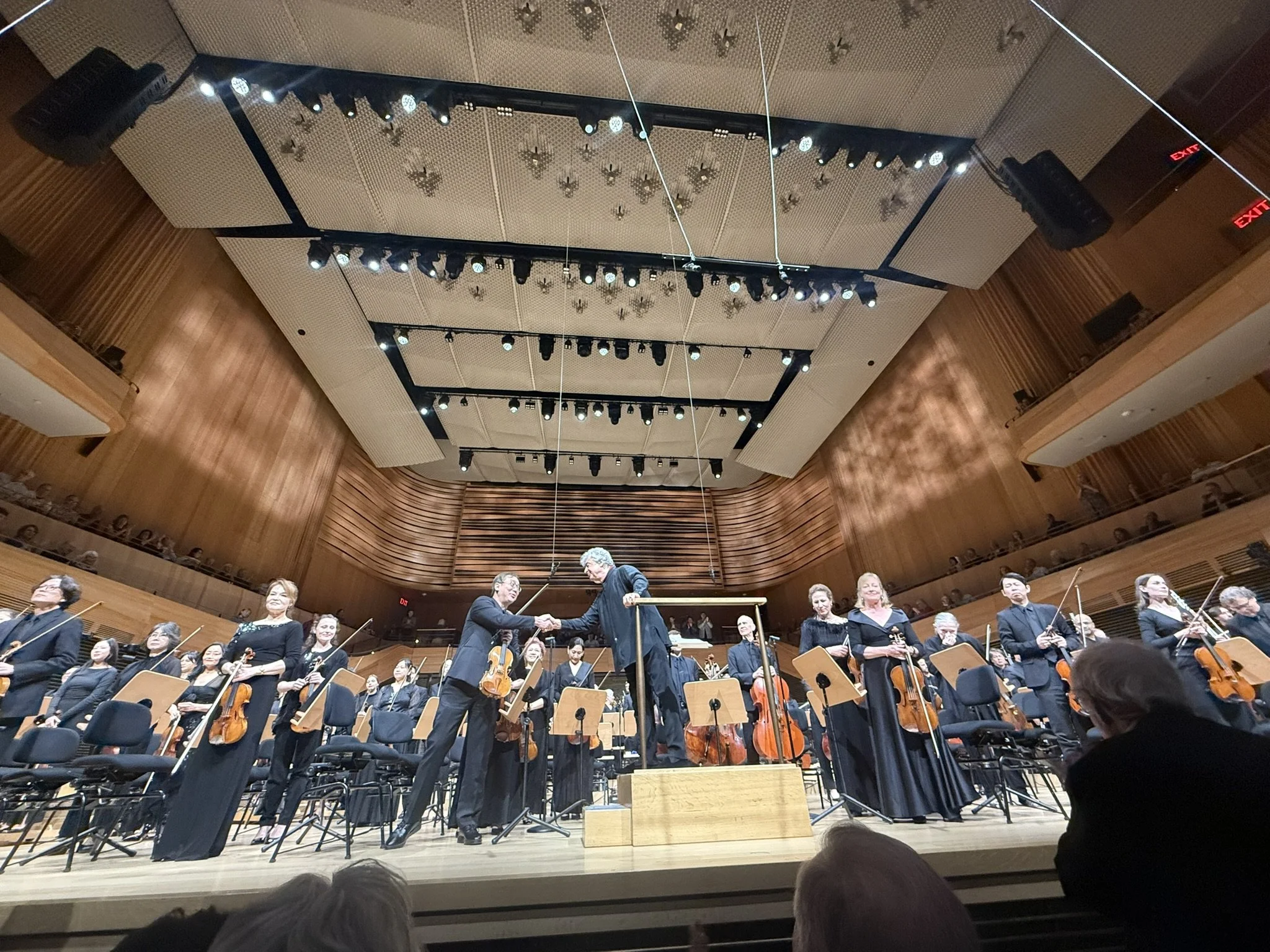
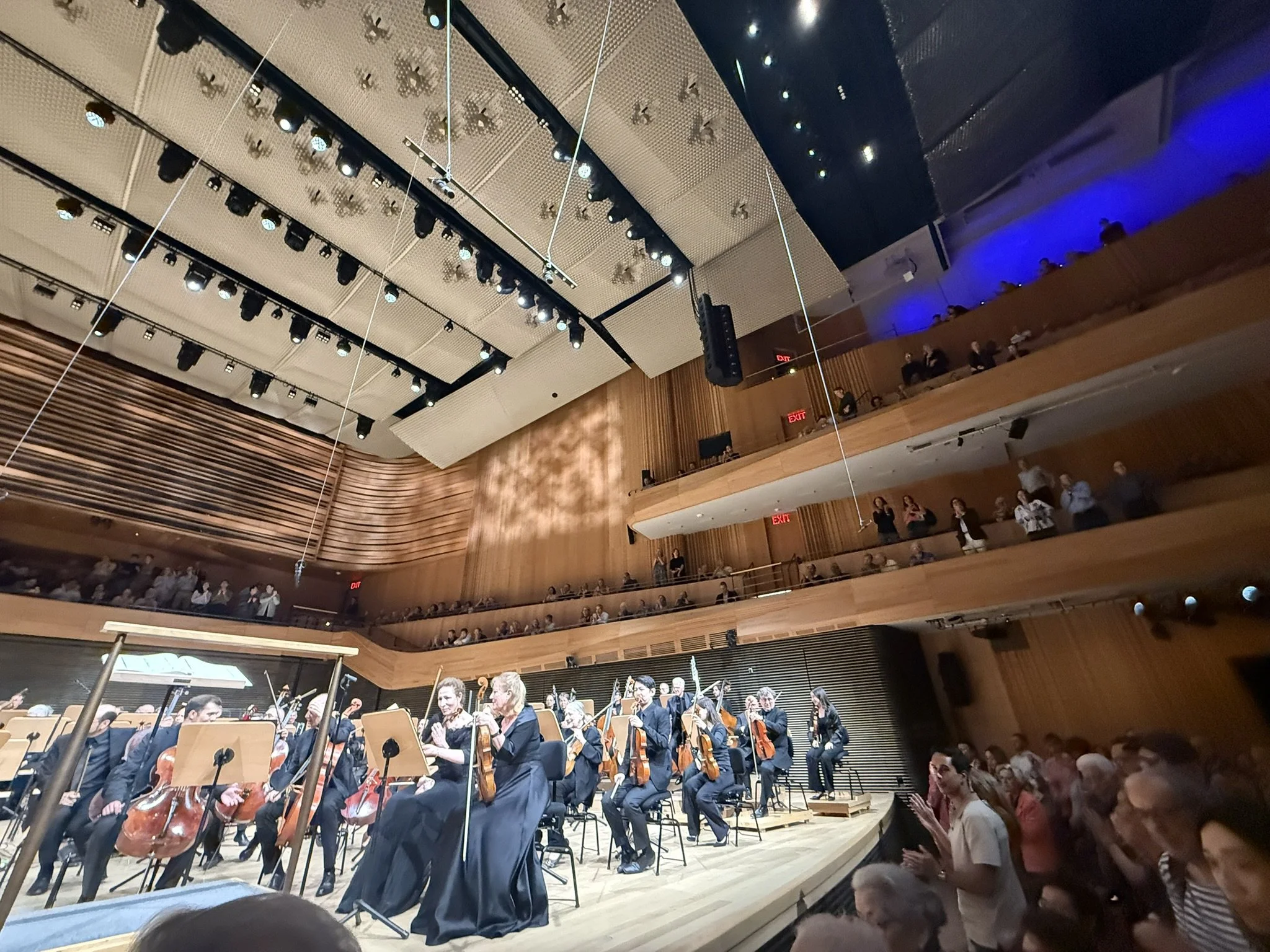
Rebecca Young, viola’s right hand, still grabs the code after Bruckner 8th
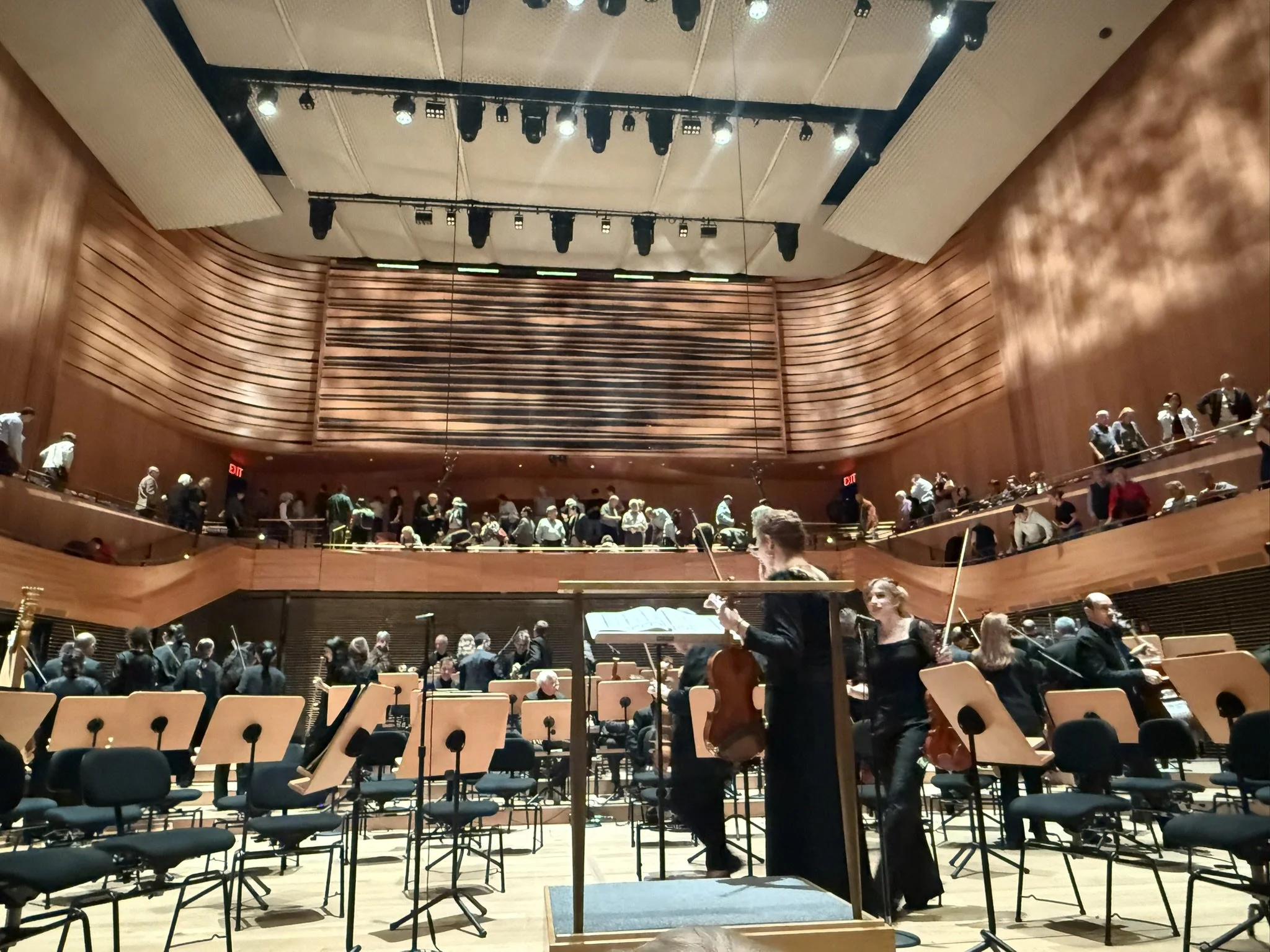
And make sure what it is
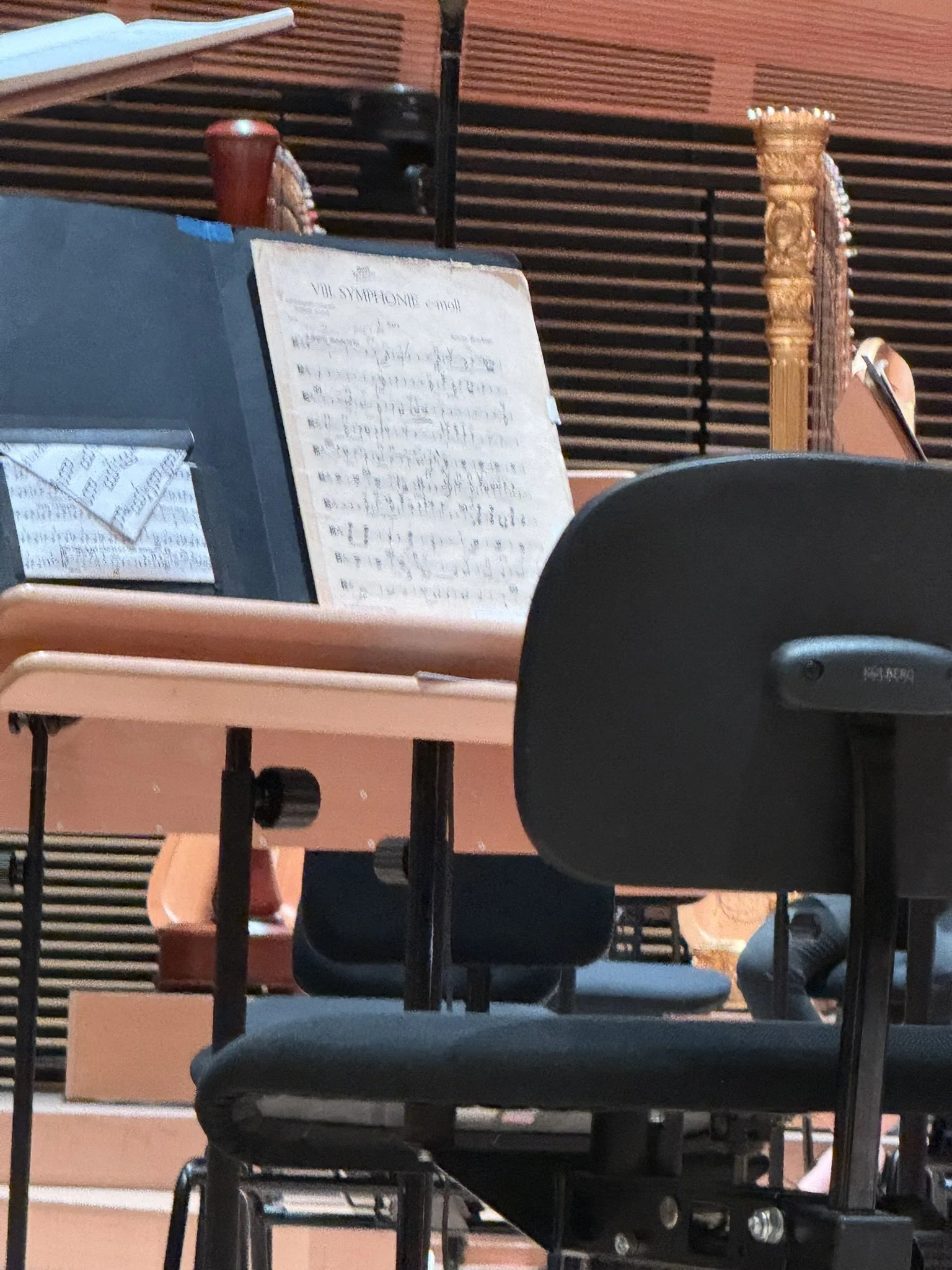
Carter Brey’s stand
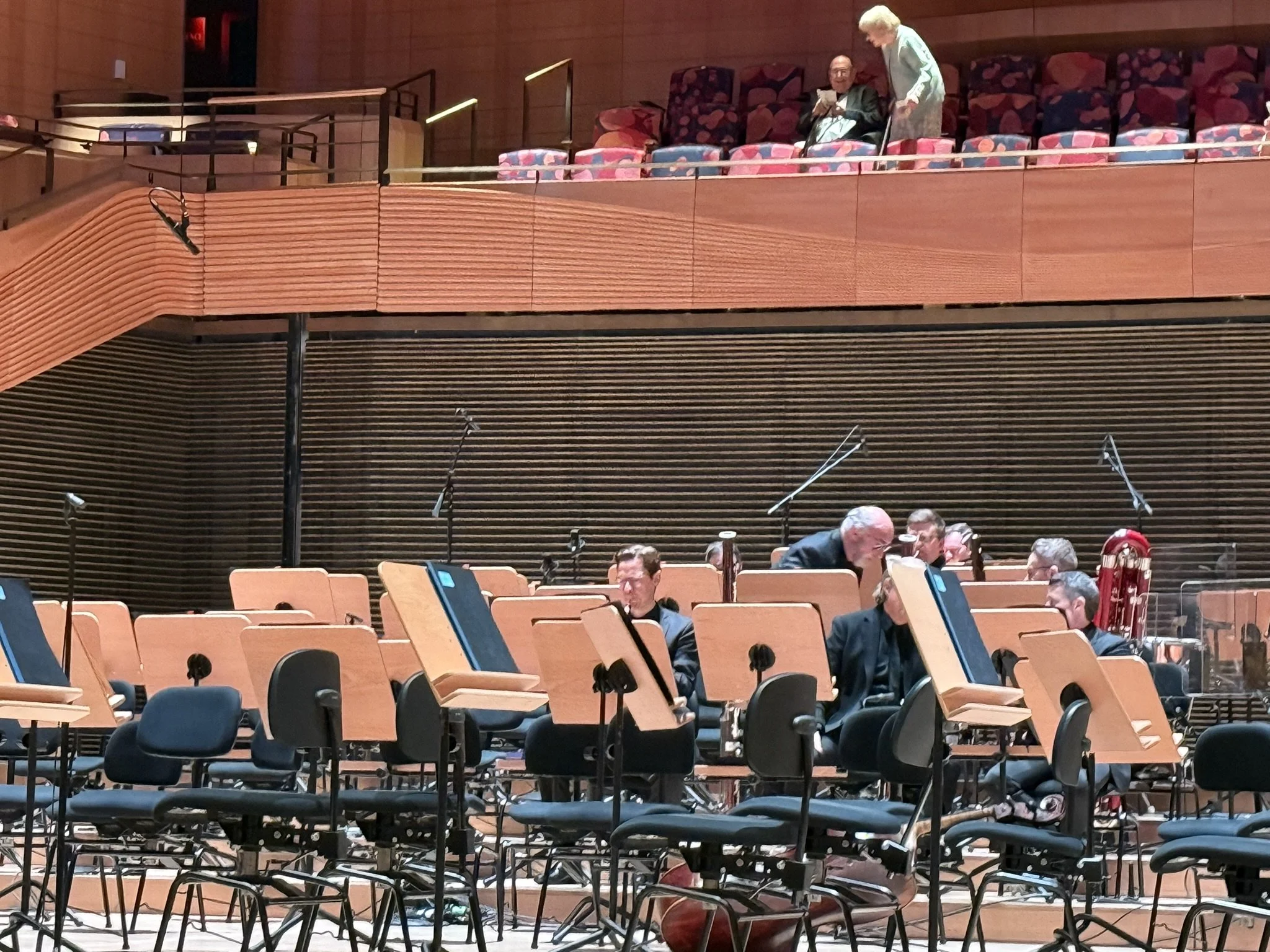
Nathan, ob
ブルックナーの伽藍
ザンクト・フローリアンの響き
ニューヨーク・フィルとビシュコフのブルックナー8番を、デイヴィッド・ゲフィン・ホールで6月4日と5日の2回聴いた。Anton Brucknerは1824年にオーストリアの田舎に生まれ、素朴で、権威に弱く、褒められると信じてしまい、酷評されると深く落ち込む性格だった。一方で、ウィーンで生きていくため、当時主流だったワーグナーに寄り、弟子や支援者との関係を通じて自分の作品を世に出す。普段はおどおどして他人の意見に影響されつつも、自分は神のための音楽を書いているという確信を持ち、曲を世に送り出すために計算高くふるまう。そうした聖と俗の往復を、この8番で体験した。
プログラムノートを読むと、この曲はブルックナーが幼少期からゆかりのあったSt. Florian Abbeyの響きを基盤としており、自分の伽藍をオーケストラで積み上げていったことがわかる。音は空間に残り、時間の感覚が失われていく。そこは音楽家たちがシンフォニーを極め、聴衆が痛みや悲しみを演奏家たちとともに受け止め、乗り越える体験の場だった。空間で響きが湧き上がり、重なり、それがいくつにもこだまする。巨大な響きの塊が何度も大きな弧を描いてやってくる。
第8番は、ブルックナーが最初に完成させたときは出版もされなかった。支持者に反対され、弟子に編集を迫られ、1890年に完成へ至る。1930年にブルックナー研究の流れの中で、初稿と1890年版を合成する試みが行われ、その後さらに1890年稿を基にした1955年版が出版された。ニューヨーク・フィルで演奏されたのはノヴァークによる1955年版である。
ビシュコフのブルックナーは、響きが厚いのに透明で、大きな流れの中にブルックナーの指の動きや、発想の源になったワーグナーやマーラーの響きを感じさせるものだった。音程やアンサンブルが完全であってもわずかに揺れていても濁らず、常に見通しがよく、前へ進む力が途切れない。大きな呼吸があり、休符には常に見えない力が宿っていた。一人ひとりが音を見つめ、つなぎ、呼吸している。ニューヨーク・フィルがシーズンをかけて磨いてきた音色の数々を、約90分かけて味わった。
第1楽章冒頭の、ヴィオラとチェロの付点と三連の一つ一つのストロークは、人間が抱える闇のように響く。ブルックナーがサンクト・フローリアンで見ていた伽藍を求める楔を打っていくような体験だった。
ビシュコフは、オットセイのように左右へ重心を移しながら、両手で両サイドに展開する伽藍の響きを構築していくオーケストラを、丁寧にその基礎からじっくりと固めていくようだった。1日目は一人ひとりの響きの感触を、また、ブルックナーの指の動きを、2日目はより音楽の細部の面白さを味わった。
このテーマとトレモロの震えは最後まで持続し、そのうち時間の感覚が消えていく。大きな円を描くようなクレッシェンドの波に金管がブレンドされ、ティンパニのトレモロで頂点を迎え、その波が何度も訪れる。最後は弦楽器の強烈なトレモロにトランペットの運命を告げるような響きがこだまし、やがて消えていった。2回目はセカンドヴァイオリンやフルート、オーボエ、ホルンなど、ブルックナーが仕込んだ細部が浮かび上がって聴こえ、より楽しめた。特にオーボエのネイサンのソロが美しかった。
2楽章のスケルツォでは、特にコントラバスとチェロの刻みが、ズーンと一つの大きな線のように感じられた。これがビシュコフなのだと痛感した。そこに、虫の羽ばたきのような細かな微分音が弦楽器のトレモロで重り、リズムは消えていった。見えてきたのは、たくさんの音の層とうねりだった。
テンポは速くないのに、音が圧縮され、空間が圧縮され、音でできた野生のシンフォニーが空間に現れ眺めていた。トリオになると、急にまったりとした夢のような時間が訪れ、最後にはハープが奏でられる。すると突然また、ドイツの野人ミヒェルが現れる。
3楽章は、悲しみの歌のような旋律で始まるが、ビシュコフとニューヨークフィルは、もっと人や社会が抱える闇、心の曇り、それが響きを重ね晴れていく、と思うと次の瞬間、また一人、暗闇の中にいる。すると自然が語りかけてきたり、1楽章の主題が蘇ってきたたり、ブルックナーらしい、無垢と迷いが繰り返される。透明な響きの中に、か弱いソロバイオリンの響き、そうするうち、テーマを力強くみんなで奏でる。ここを沢山聴いた。スコアを見るとバイオリンからチューバまでみんなで歌っている。このあとワーグナーチューバのまったりしたソロや、ホルンの壮大なテーマやさまざまなエピソードが展開され楽しかった。うねりがやってくるたびにホルンや金管の響きが洗練されていく。余計な迷いが消えて音がシンプルに、色やその感触だけを残していく。
4楽章は、その研ぎ澄まされたブラスと、同じく研ぎ澄まされた弦楽器の組み合わせで始まる。ブラスは低い音から厚く立ち上がり、トランペットがファンファーレのように駆け上がっていく。ブラスの響きは上へと登っていく。それを弦楽器の速い刻みが支え、刻まれるたびに鋭い響きが上へと積み上がってく。まるでカテドラルの上部が形成されていくようだった。今度はテンポが変わって、ゆったりと内側をじっくり眺めていく。自分とブルックナーの内側と、ブルックナーが眺めていた外側の世界が重なりこだまする。人の生死がこだまする教会のオルガンに座って、何を見て感じて、こんな響きにたどり着いたのか、それは万人の心理につながる。他の誰かが作った音楽で自分の内面を見つめるきっかけをこんなに大きなスケールで見つめたことがあったか。ビシュコフの大きなスケールで透明な精神がニューヨークフィルと繋がって、デビットデフィンの精緻な響きの中で集まった聴衆にこだまする。最後はバスがカットされ、美しい響き、音の欠片、その混ざりが空間で展開され、突然、また巨大な闇のうねりに放り出され、天国と地獄を繰り返し、壮大なシンフォニーの響きで曲が閉じた。
1日目は曲が終わるとビシュコフはオーケストラを立たせしばらく振り返らなかった。2日目はオーケストラをしばらくねぎらって振り返えった。ブルックナーは聴いていて受け止める音の量が半端ない。とてもよく計算されて、どこで爆発が起こるか、人の気持ちの明と暗が交互にやってくるので、感じやすい人は心が揺さぶられる。私が感じたのは、3連の下降だ。ラメントの響き。Amandine Beyerとカントロフの公演で強く感じたテーマだ。そういった痛みに触れたときは丁寧に扱うとアマンディーヌが教えてくれた。カントロフはとても丁寧に刺激的に扱っていた。そして、ブルックナーは付点と3連も2拍3連も下降する人の痛みを上昇するエネルギーに変え、最後は彼が見た最高に美しい場所に連れて行ってくれる。それを多分、今でもオーケストラという装置をシンフォニーというスタイルで一番極端に描いる。ニューヨークフィルは一人ひとりがその難しさや痛みを乗り越えて、ビシュコフの巨大で透明な支えによって、そして、べニューの超リアルな空間の中で、最も現実のものとして私たちに与えてくれた。そういう2回の公演だった。1回目と1回目を見れて本当に幸運で、公演後にネイサンとマシューに会えたことも、私にとってこれ以上ない貴重な体験となった。要はテンポの速さとか展開の面白さとか、ストーリーとかそういうことではない。音の価値そのものが時間や人の意識を超えてしまう体験だった。さすがビシュコフだ。4楽章中の、ファーストバイオリンが分かれて展開される部分が一番ぞくぞくした。この長大な音響体験の最後に、ブルックナーらしい遊びが溢れ、それをニューヨークフィルのプリンシパルがとても刺激的に味わい深く見せてくれた。それでは来週公園で会いましょう。
ありがとうニューヨークフィル2026。さようならカーターブレイ。