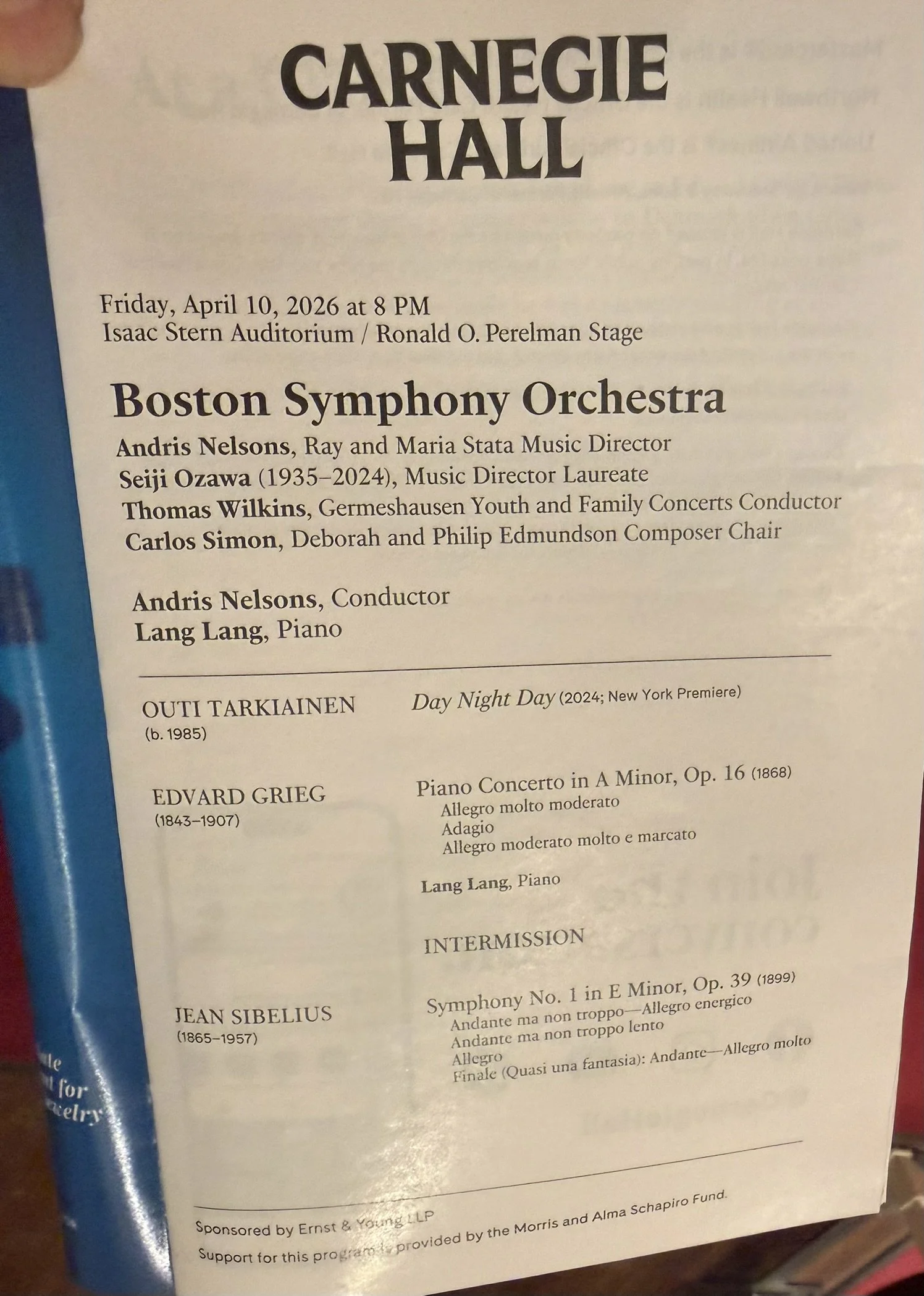
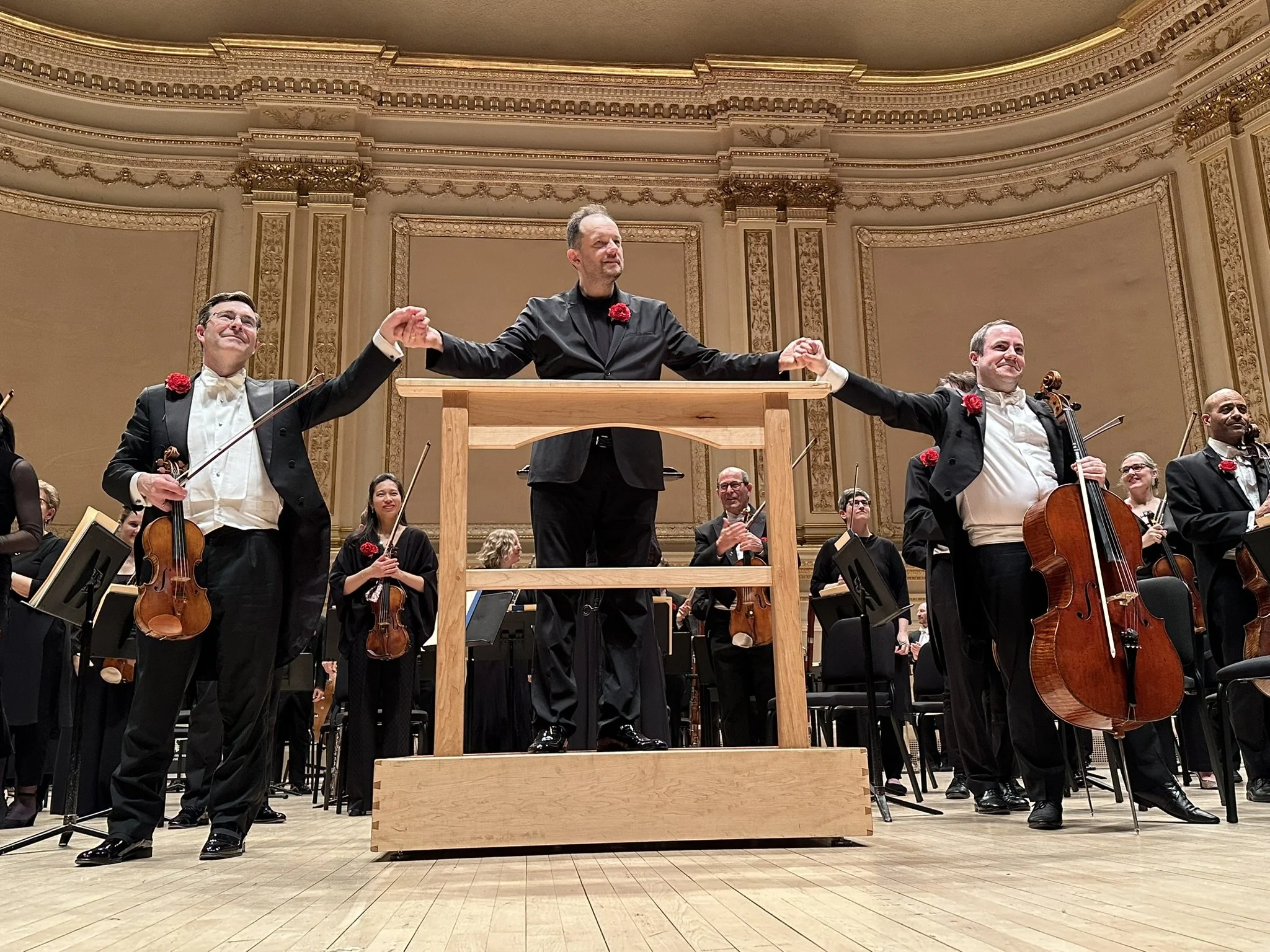
On April 10, the Boston Symphony Orchestra and Andris Nelsons presented their second concert at Carnegie Hall.
The program opened with the symphonic poem *Day Night Day*, a work derived from the composer’s recent opera, *Day of Night*. Drawing upon Sami *joiks* and lullabies, the piece sonically renders the light and ice of the Arctic Circle—capturing the natural reflections, spectral qualities, and landscapes of the North.
Outi Tarkiainen is a Finnish composer who grew up in Rovaniemi, near the Arctic Circle; after studying in Helsinki and abroad, she returned to her hometown to establish her career. Deeply influenced by Sami culture and the North's natural environment, she focuses primarily on contemporary classical music, creating works for orchestra and the stage that are widely performed by major orchestras across Europe and North America. Her opera *Day of Night* is a collaborative work with Aleksi Barrière; based on Niillas Holmberg’s novel *Halla Hella*, it employs multiple languages—primarily English, alongside Sami. The opera was commissioned jointly by the Aalto Music Theatre and the Finnish National Opera and Ballet.
Tarkiainen employs a unique sonic approach rooted in nature, bodily sensation, and the quality of time. This approach is inextricably linked to the extreme environment of Lapland—the High North—and is grounded in phenomena such as the dramatic shifts between the Midnight Sun and the Polar Night, a sense of time that expands and contracts like breath, and the subtle changes that lie latent within stillness. Consequently, sustained tones, slowly shifting harmonies, and transitions in orchestral density coalesce to generate a spectral soundscape. Through the interplay of sonic particles, the faint traces of melodic phrases, and the resonance spreading throughout the performance space, the music slowly transforms within a breathing, living perception.
Her music captures the essence of humanity and its lyricism; themes such as pregnancy, childbirth, corporeality, memory, and emotion lie at the very heart of her compositions, with the underlying sonic structures supporting and framing these experiences. In *Day Night Day*, the soundscape emerges like mist; the shifting light of the High North manifests as a sonic transformation—a vivid recreation of natural phenomena. It is a poetic orchestral language—rooted in nature, the body, and the perception of time—that gives rise to a truly distinctive and singular sound world. The performance by the Boston Symphony Orchestra and Andris Nelsons seemed to breathe naturally as it expanded within the space; the sound diffused throughout the entire hall, permeating it like a spreading stain and giving rise to delicate sonic gradations. One could sense the humidity, texture, atmosphere, and even the scent of the air—as if the space itself were vibrating, channeling the experiences and sensibilities of composer Lotta Wennäkoski as a natural phenomenon.
The second piece was the Piano Concerto by Edvard Grieg, born in Norway in 1843. After studying in Leipzig, Germany, Grieg pursued studies in Copenhagen, focused on music with a distinctly Norwegian character. In 1868, while in the Danish countryside, his creative drive surged, leading him to compose this Piano Concerto. Inspired by Schumann’s concerto, the work fuses the brilliance of Liszt with a unique sensibility rooted in Norwegian folk melodies; the solo piano and orchestra intertwine and interplay, allowing rich melodies to resonate in harmony. The lyrical melody of the second movement is colored by harmonies that foreshadow his later arrangements of folk songs, while the final movement evokes the rhythms of traditional dances such as the halle and springdans.
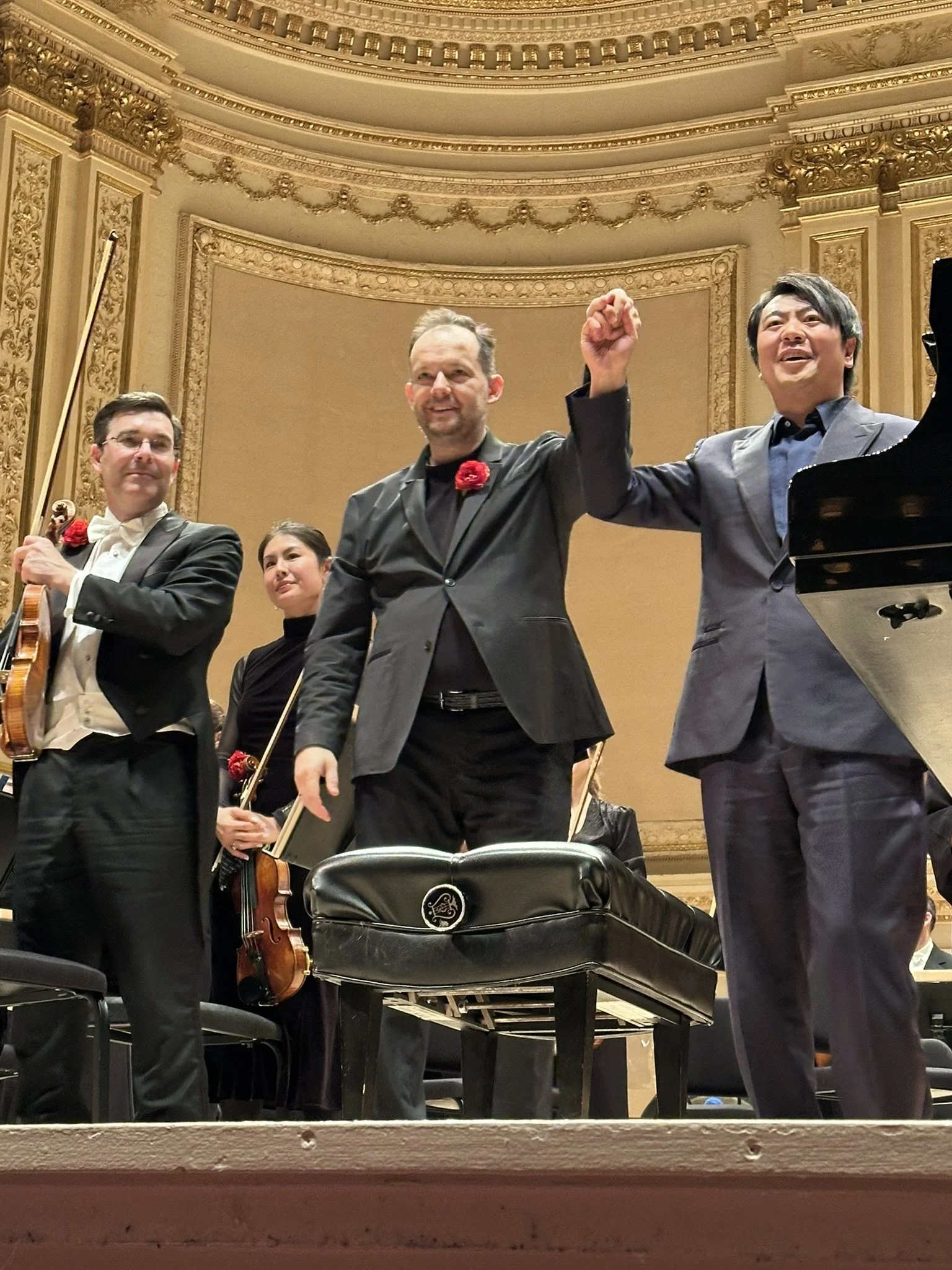
Lang Lang shifting seamlessly between the distinct styles of composers such as Chopin, Liszt, Rachmaninoff, Schumann, Beethoven, and Tchaikovsky—creating an effect akin to fragments of music history unfolding like scenes in an amusement park. The orchestra, for its part, embraced and supported his free-flowing tempos and dynamic shifts, expertly unifying the overall narrative in a magnificent performance distinguished by its striking sense of improvisation.
In 1865, Sibelius’s Symphony No. 1 was born. Sibelius studied in Helsinki and Berlin, where he also came under the influence of Richard Strauss. Upon returning to Finland, he began releasing orchestral works imbued with a strong sense of national identity, thereby establishing a musical idiom distinctly Finnish in character. Composed in 1899, his Symphony No. 1 is grounded in the techniques of the Late Romantic era while simultaneously forging deep connections with the nature and mythology of Finland. Furthermore, set against the backdrop of Tchaikovsky’s *Pathétique* Symphony, the work is believed to have been composed amid political tension and anxiety. As symbolized by the opening clarinet solo; it begins with an atmosphere of solitude and unease; through shifting tonalities and contrasting thematic material, it gradually evolves into a powerful, vigorous development. Taken as a whole, the piece weaves together dark lyricism, dramatic tension, and folkloric elements, ultimately concluding as a unified dramatic narrative with the return of the opening thematic material in the final movement.
This performance of Sibelius stood in stark contrast to the open, expansive renditions of Adams and Dvořák heard just the day before—performances rich in playful spirit and technical virtuosity that elicited spontaneous smiles of delight. It was also utterly distinct from the shifting timbres and luminous qualities of the first half of the program, as well as from the ever-changing dramatic and musical landscapes of the Grieg piece. Instead, Nelsons and the Boston Symphony Orchestra crafted a Sibelius performance of seamless perfection—a definitive realization of the Boston Symphony’s current approach to this composer. Shortly after the opening bars, all conscious thoughts regarding personal taste or emotion vanished from my mind. The very presence of Nelsons and the orchestra underwent a complete transformation from the first half of the concert; they began to weave the very particles of Sibelius’s sound into the fabric of the surrounding space. The gravitational pull of the room seemed to shift; everything else faded away, leaving only the orchestra playing Sibelius. The gentleman sitting next to me—with whom I had been sharing moments of laughter and tears just moments before—and I could do nothing but sit motionless in our seats, surrendering ourselves completely to the sheer weight of the sound, its tactile presence, and the stream of music flowing through our consciousness. When the performance finally ended, I rose after a brief pause and began to applaud in a daze; my eyes met those of a friend sitting in the row ahead, and we exchanged expressions of profound satisfaction. We had truly savored a performance of total commitment and intensity from the Boston Symphony Orchestra and Andris Nelsons.
The sonic signature of the Boston Symphony Orchestra is characterized by spatial layering in which the string and wind sections—while each retaining its distinct identity—interweave to create a soundscape in which refined overtones rise and dissipate naturally. Nelson’s conducting style—which allows the music to breathe—sustains the energy of each phrase while achieving a perfect balance between an open, lucid structural clarity and a liberating freedom of sound.
This approach ensures that, even during moments of heightened intensity, the orchestral texture never becomes saturated or dense, thereby accentuating the dramatic contrast between tension and lyricism. In John Adams’s work, the interplay of harmonic change and continuity drives the passage of time; rhythmic pulses—punctuated by saxophones and synthesizers—forge a sonic landscape at once modern and contemporary. This creates a sensation of time being compressed, drawing the listener into a swirling vortex. Yet, even amidst this high-density sonic texture, each orchestral layer remains remarkably transparent; because moments of compression and release occur simultaneously, the music seems to rise forth from light and space, creating a three-dimensional soundscape that transcends the boundaries of time and space.
In the Dvořák performance as well—where the surging waves of folk-inspired melodies and rhythms seemed to breathe with great expansiveness—both the lyrical content and the structural architecture emerged with striking clarity. Beyond merely conveying the inherent character of the work, the performance allowed the audience to savor those unique moments of *ma* (spatial interval) and those exquisitely sculpted musical contours that are the unmistakable hallmarks of the Boston Symphony Orchestra under Andris Nelsons. This achievement is the fruit of countless shared sessions over many years, through which the conductor and the orchestra have cultivated a profound mutual understanding—a shared sense of breath, intuition, and sonic perception.
In the Tarkiainen piece featured in this program, the music unfurled like a mist—expanding outward without ever losing its distinct contours—slowly weaving together layers of sound bathed in the ethereal light of the Arctic Circle. The Boston Symphony’s transparent ensemble playing brought this lucid, three-dimensional sonic architecture vividly to life. In the Grieg performance, the torrent of emotion flowed without ever becoming muddied, and the Romantic fervor was rendered with vivid brilliance. Even as the music reached a fever pitch, it never lost its structural integrity; it never succumbed to sentimental excess, but rather maintained a crystalline clarity throughout. Finally, in the Sibelius performance, the music was honed to an absolute razor’s edge; telt compressed to its utmost limit, yet every individual voice within the orchestra remained clearly visible—transparent to the ear. The music seemed to inhabit a purely physical realm, where the sheer gravity and propulsive force of the sound itself held the listener’s consciousness completely captive.
Performers
Boston Symphony Orchestra
Andris Nelsons, Music Director and Conductor
Lang Lang, Piano
OUTI TARKIAINEN Day Night Day (NY Premiere)
GRIEG Piano Concerto
SIBELIUS Symphony No. 1
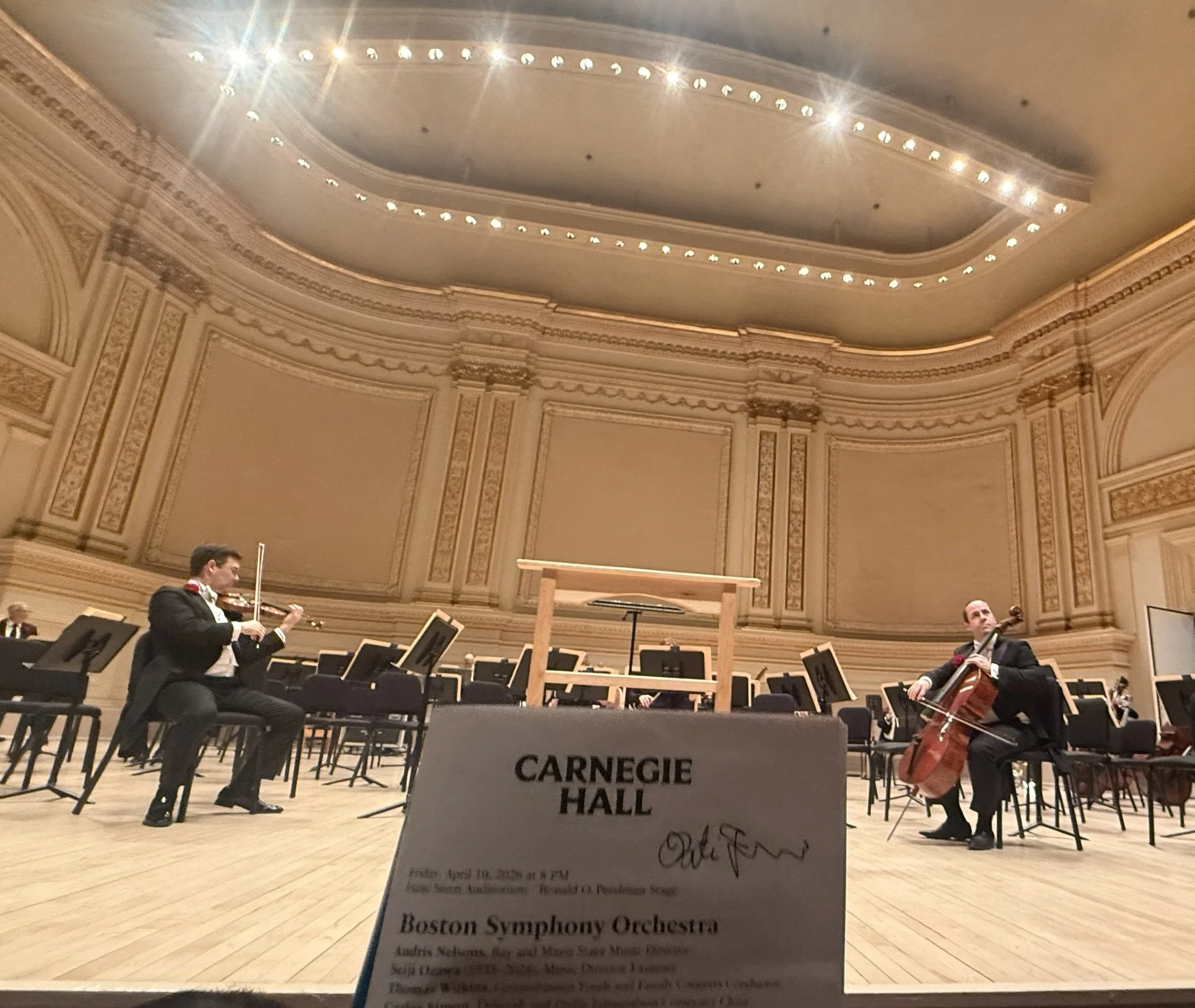
ボストンとネルソンスは4月10日にカーネギーで2回目の演奏会をおこなった。
一曲目、交響詩『Day Night Day』は、最新オペラDay of Nightから派生した。北極圏の光と氷を、サーミのヨイクや子守歌を引用しながら、自然の反射やスペクトル的な北方の光と風景を音響化している。
Outi Tarkiainenは、北極圏に近いロヴァニエミで育ち、ヘルシンキや海外で学んだ後に故郷へ戻って活動するフィンランドの作曲家である。サーミ文化や北方の自然から強い影響を受け、現代クラシックを中心にオーケストラや舞台作品を手がけており、作品は欧米の主要オーケストラで広く演奏されている。オペラDay of Nightは、Outi TarkiainenとAleksi Barrièreの協働作品で、英語を中心にサーミ語など複数言語を用い、Niillas Holmbergの小説Halla Hellaに基づく。アールト音楽劇場とフィンランド国立歌劇場・バレエ団の委嘱作品。
彼女は自然・身体感覚・時間の質に根ざした独自の音響アプローチをとる。それはラップランドという極北の環境と結びつき、白夜や極夜といった極端な光の変化、呼吸のように伸縮する時間感覚、そして静止の中に潜む微細な変化が基盤となっている。そのため、持続音や緩やかに変化する和音、オーケストラの密度の推移がスペクトルを生む。音の粒子やフレーズの気配、空間への響きの広がり、音楽は呼吸する知覚の中でゆっくりと変容していく。
彼女の音楽は人間とその叙情を捉えており、妊娠や出産、身体性、記憶、感情といったテーマが作品の中心に据えられ、音響構造はそれらの経験を支えている。Day Night Dayでは、音響は霧のように、極北の光の変化が音の変化として、自然現象の再現として立ち上がる。自然・身体・時間感覚に根ざした詩的なオーケストラの響きが独特の響きを生む。
ボストン交響楽団とアンドリス・ネルソンスの演奏は空間の中で自然に呼吸しながら広がり、音はホール全体に滲むように拡散し、繊細な音のグラデーションが生まれた。空気の湿度や質感や気配、においを感じた。タルキアイネンの経験と感覚を自然現象として空間が振動しているようだった。
2曲目は、1843年、ノルウェーに生まれのグリーグのピアノ協奏曲。ドイツのライプツィヒで学んだ後、コペンハーゲンでノルウェーらしい音楽研究。1868年、デンマークの田舎で意欲が高まり、ピアノ協奏曲を書いた。Schumannの協奏曲に着想を得て、リストの華やかさや、ノルウェー民謡に由来する独自の感覚が融合しソロピアノとオケが相互に交錯し、豊な旋律が響き合う。2楽章の抒情旋律は後年の民謡編曲を思わせる和声で彩られる。終楽章はハリングやスプリングダンスといった舞曲のリズムを想起させる。
Lang Langは、ショパンやリスト、ラフマニノフ、シューマン、ベートーヴェン、チャイコフスキーなどのスタイルを次々と切り替えるように弾き分け、まるで音楽史の断片が遊園地のように展開していく。そして、オーケストラは、その自由なテンポや変化を受け止め、支え、全体の流れをまとめ、即興性が際立つ見事な演奏だった。
3曲目、シベリウスの交響曲1番。シベリウスは1865年生まれ。ヘルシンキとベルリンで学び、シュトラウスの影響も受けた。その後フィンランドにもどり、民族性の高い管弦楽作品を発表し、フィンランド的音楽語法を確立していく。そして1899年に書いた交響曲第1番は、後期ロマン派の技法を基礎とし、フィンランドの自然や神話と結びついている。
またチャイコフスキーの悲愴の影響を背景に、政治的な緊張や不安の中で書かれたと考えられている。冒頭のクラリネット独奏に象徴されるように、孤独で不安な雰囲気から始まり、調性の揺らぎと対比主題がやがて力強い展開へと発展していく。全体として、暗い抒情性と劇的な緊張、そして民俗的要素が交錯し、終楽章で冒頭の素材が回帰することで、統一されたドラマとして閉じられる。
一日前のアダムズやドヴォルザークでの開いた演奏。遊びが豊富で思わず笑ってしまうような、うまさを味わう演奏。または前半の音色や光、または、グリーグでの次々に変わるドラマや音楽とはまったく違う、隙が無いネルソンスとボストンが作り上げるシベリウス。今のボストンのシベリウスが展開された。出だしから少し経つと意識から嗜好や感情が消えた。ネルソンスたちの気配が前半と一変し、シベリウスの音の粒子を空間に繋いでいく。重力が変わり、何もかも消え、オーケストラがシベリウスを奏でる。隣のおじちゃんと私もそれまで、楽しく笑ったり泣いたりしていたのに、ただただじっと椅子に座り、その音の重さ、感触、意識を通り過ぎる音の流れに身を任せるしかなかった。演奏がおわり、しばらくして立ち上がり、呆然と拍手をしていると、前の列の友人と目が合い、お互い満足した表情を交わした。ボストンとネルソンスの渾身の演奏を味わった。
ボストン交響楽団の響きは、空間で弦も管もそれぞれを保ちながら重なっていき、洗練された倍音が自然に抜けていく。ネルソンスの音を呼吸させる指揮は、フレーズのエネルギーを保ち、開放された明晰な構造と響きの自由さを両立させている。
これは、高揚した場面でも響きが飽和せず、緊張と抒情の対比を際立たせる。ジョン・アダムズでは、コードの変化と連続が時間を駆動し、サックスやシンセを交えた刻みが近現代的な音響空間を形成することで、時間が圧縮され、聴き手を渦の中へ巻き込んでいく感覚を生んだ。このオーケストラは高密度の音響でも各層が見通しよく保たれ、圧縮と開放が同時におこるため、音楽は光と空間によって立ち上がり、時間や空間を超えた立体音響を作っていた。
ドヴォルザークでも、民族的な旋律とリズムのうねりが大きく呼吸しながら、抒情と構造がより明晰に浮かび上がるため、作品の性格を越えてボストンとネルソンスならではの間やシェイプされた音型を堪能した。これらは彼らお互いの呼吸や嗅覚、そして音を知覚するセンスが、長年のセッションで育まれてきたためだ。
このプログラムでは、タルキアイネンの音は霧のように広がりながらも輪郭が失われず、北極圏の光の中でゆっくりと音の層を織りなす。ボストンの透明なアンサンブルは、その明晰な立体を音で魅せてくれた。グリーグでは、感情の奔流が濁らず、ロマン派の高揚が鮮やかだった。音楽は熱狂しなら、常に形を保ち続け、感情に溺れず、音楽が明晰だった。シベリウスでは、極限まで研ぎ澄まされ、音は圧縮されながら各声部が透けて見え、音楽は物理の世界のようで音そのものの重力と推進力が意識を支配した。