
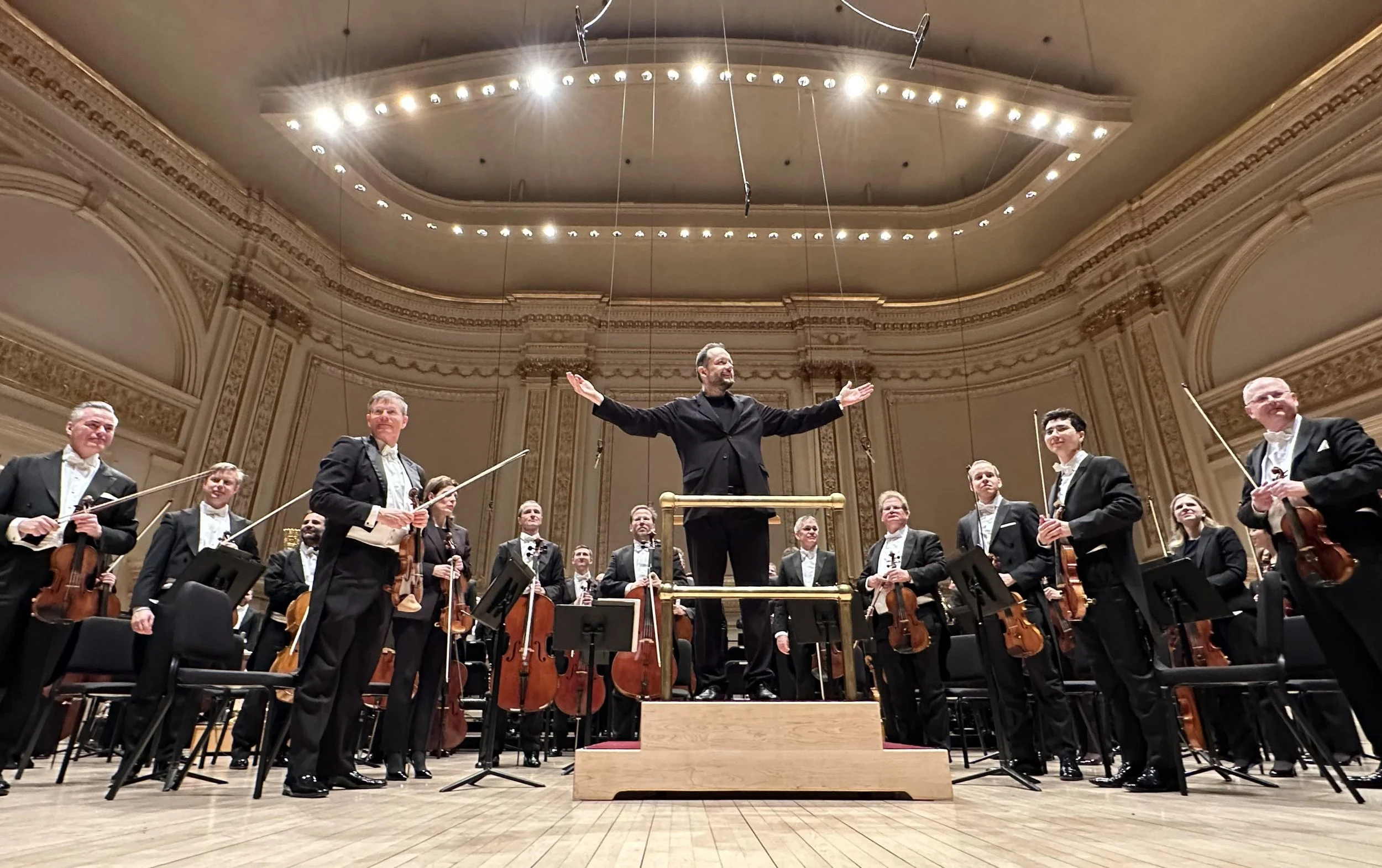
Wien and Nelsons came to Carnegie Hall on February 27, 2026. The opening piece was Bartók's Piano Concerto No. 3, with Lang Lang at the solo piano, who unfolded the soul, breaking it down note by note and carefully unfolding it in Carnegie Hall. He rounded off the rhythmic corners, giving it an improvisational, fluctuating quality and acting freely within the framework. Sometimes, his touch was raspy, and so was the orchestra. Wien strings were sticky and soft, and the woodwinds had such presence that you could make out each individual's face. The brass instruments filled the space with a soft luster. It was as if each member was introduced one by one amid the reverberations of Carnegie Hall.
Nelsons allowed the music to breathe. He carried the music slowly, not building to a climax, but carefully, sometimes placing notes to evade the orchestra's timing. As a result, this resonated not with folksy modernism but with the music of his later years, an extension of late Romanticism. In particular, during the morning rehearsal of the second movement, Adagio religioso, Nelson's instructions further reduced the volume and enhanced the clarity. During the evening performance, I closed my eyes after the first movement and, before I knew it, the music had begun. It was like a mist, a silent presence of souls rising from nature. It was a feeling of tenderness, resignation, and entrusting one's heart to someone. Lang Lang's piano had a clear tone, allowing the time that followed the sound to resonate. What I remember most strongly at that moment was not the sound, but the silence. At the end of the second movement, I felt the opening chords of Mahler's Symphony No. 1. It was the soundlessness of nature and the infinite expanse of space. In Bartók's piece, the faint sounds of nature rising from the distant landscape seemed to quietly reflect on the past in his final years. And it was Lang Lang playing the solo. Bartók's music, while free and unfettered by certain forms, is ephemeral, failing to speak the truth and obscuring the core. A light that quietly fades away. Music that offers the soul. The silence that remains after the sound has faded.
I don't know what piece Lang Lang played for the encore, but it was simply beautiful. The tangle of sounds dissolved into the space, like a tangled thread being unraveled. Their performance gave the listener a sense of slowly beginning to breathe inside. That was the kind of session it was.
Listening to Mahler's First Symphony after Bartók's ephemeral, silent light was like moving from the individual's inner self to the cosmos. As the lingering echoes of Bartók entered the Mahler, energy spread outward, giving a sense of the expanse of space and time. The very high tone of the first violin produced overtones, as if gazing at an infinite expanse. From the back right, a hunting horn, followed by a trumpet, and the theme returned to the strings, the cello adding a rich swell, and the harp and percussion adding color to this Viennese Mahler. From Bartók's fading light, Mahler allows us to experience the great currents and ups and downs of life. Listening to Mahler with the Vienna Philharmonic at Carnegie Hall expands the sense of inwardness that Bartók had in its early stages. Nelsons, like Bartók, allowed the orchestra to breathe deeply. Each individual played with precision, and the richness and breadth of Lang Lang's piano playing in Bartók blended seamlessly with the orchestra's flow. The climax, too, was a place where the notes were placed, as if one were examining Mahler's DNA under a microscope and rejoicing in the new discoveries. The dance in the second movement and the march in the third were palpable and unfolding, conveying the timpani and mallet textures. The cello's pizzicato notes. The metallic, faint sound of the cymbals and drums created a mysterious atmosphere. The double bass shadowed the supple violins. A blend of all manner of wind instruments. Phrases faded from violin to brass fragments and then to the second violin. Mahler's world unfolded before me, clearly, as if in slow motion. In fact, the second half of the third movement had an impossible tempo. The violins sang along with the horns' notes. Nelsons created expressions. I wonder how he managed to synchronize them. This orchestra lived in a world of a different gravity. In this performance, the trumpets had a strong core and were particularly vibrant. I was awed by the brass lined up at the back of the stage. Nelsons then carefully introduced the set, a mix of long-time Vienna veterans and young musicians, so that I could see each musician's face. Taekwondo Boston-Nelsons.
Performers
Vienna Philharmonic
Andris Nelsons, Conductor
Lang Lang, Piano
Program
BARTÓK Piano Concerto No. 3
G. MAHLER Symphony No. 1
ウィーンフィルがネルソンスと2.27.2026にカーネギーにやってきた。一曲目はバルトークのピアノ協奏曲3番で、ランランがソロを弾いた。ランランは音の魂を繰り広げていた。そのひとつひとつを分解し、カーネギーの空間に丁寧に繰り広げていった。リズムの角を丸め即興の揺らぎを与え、枠の中で自由に振る舞う。崩れた大人の演奏に聴こえた。時には掠れて聴こえない音もあったし、オーケストラもそうだった。ウィーン・フィルの弦の粘りと柔らかさ、木管は一人ひとりの顔がわかるほど存在感がある。金管は柔らかい光沢で空間を満たす。まるでウィーンのメンバーが、カーネギーの響きの中で順番に紹介されていくようだった。
ネルソンスは音楽を呼吸させる。じっくり音楽を運び、クライマックスをあおらず、丁寧に、時には相手のタイミングをはぐらかして音を置く。その結果、この演奏は民族性のあるモダニズムではなく、後期ロマン派の延長線上にある晩年の音楽として響いた。特に2楽章、Adagio religiosoが朝のリハーサルでは、ネルソンスの指示により音量はさらに抑えられ、透明度が増していた。夜の本番では、第1楽章が終わったあと目を閉じていると、いつの間にか音楽が始まっていた。自然の中から魂の気配が静かに立ちのぼる霧のようだった。それは優しさと諦め、誰かに心を預けるような感覚だった。ランランのピアノは澄んだ音色で、音のあとの時間を響かせていた。あの瞬間、もっとも強く記憶に残ったのは音ではなく沈黙だった。2楽章終盤、マーラーの1番の冒頭のコードを感じた。自然や宇宙の空間が無限に広がっていく無音のような感覚。バルトークでは遠景から立ち上がる自然の響きのあわさが、彼の晩年に過去を静かに振り返っているように感じた。そしてソロを弾いていたのはランランだった。バルトークは確かな形式で自由に振る舞いながら真実を語らず核心を曖昧にする儚い。静かに消えていく光。魂を差し出す音楽。音が消えたあとに残った沈黙。
アンコールにランランが弾いた曲はわからないが、ただただ美しかった。音と音の縺れが、絡まった糸をほどいていくような、優しいが、美しい音の光が空間に溶けていった。彼らの演奏は、聴き手の内側でこれからゆっくり呼吸を始める。そういうセッションだった。
バルトークの儚い沈黙の光の後、マーラー1番を聴くことは、個人の内面から宇宙へ移動するような体験だ。バルトークの余韻がマーラーに入ると、エネルギーが外に広がり空間と時間の広がりを感じる。第1バイオリンのとても高い音色が倍音を生んで、無限の広がりを眺めているようだ。右の奥からハンティングホルンがトランペットが、そして主題が弦楽器に戻り、チェロが豊に膨らみを与えてハープや打楽器が彩るウィーンのマーラー。バルトークの消えゆく光から、マーラーは大きな流れと人生の起伏を体感させる、Carnegie Hallでウィーンフィルの響きで聴くマーラーは、バルトークで内側に向かっていた感覚を膨張させる。音楽運びはバルトークと同じように、ネルソンスはオーケストラをじっくり呼吸させた。一人ひとり確実に、そして、バルトークでのランランのピアノの味わいや広がりをを、オーケストラの流れでなぞるように、自然に溶け合うように。クライマックスも音が置かれていく、まるで顕微鏡でマーラーのDNAを除いて、新しい発見に大喜びしているような感覚だった。2楽章のダンス、3楽章の途方にくれたマーチ。ティンパの皮やマレットの質まで伝わるゆったり広がる連打。チェロのピッツィカート。シンバルやドラのジワーっと金属音が広がる怪しい雰囲気。しなやかなバイオリンに影のように付き纏うコントラバス。管楽器のあらゆるブレンド。ヴァイオリンから、ブラスのかけら、そしてセカンドバイオリンに消えていくフレーズ。マーラーの世界が目の前でくっきりスローモーションの様に広がる。実際、3楽章の後半はありえないテンポ。ホルンの刻みにバイオリンが歌う。ネルソンスは表情を作っている。一体どうやって合わせているんだろう。このオーケストラ違う重力の世界で生きている。この公演ではトランペットが芯があってひと際活きていた。ステージの後ろの奥に並んだブラスに圧倒された。そして、長年ウィーンで活躍してきた名手と若手がいじり混じったこのセットをネルソンスは一人ひとりの顔が見えるようにじっくり紹介してくれた。テコンドーボストン。ネルソンス。